
Brazing commonly uses filler alloys such as copper, silver, aluminum, and brass alloys.
Silver-based alloys are widely used because they provide strong and reliable joints.
The alloy selected depends on the base metal and application requirements.
In this article:
- Which alloy is used for brazing?
- Common alloys used for brazing
- 1. Copper-based brazing alloys
- 2. Silver-based brazing alloys
- 3. Aluminum-based brazing alloys
- 4. Nickel-based brazing alloys
- 5. Gold-based brazing alloys
- 6. Brass and bronze brazing alloys
- 7. Cobalt-based brazing alloys
- Common composition examples
- Factors affecting selection of brazing alloy
- Properties of a good brazing alloy
- Example
- Conclusion
Which alloy is used for brazing?
Brazing alloys are special filler metals used in the brazing process to join two or more metals. In brazing, the filler metal melts and flows into the joint by capillary action, while the base metals do not melt. The filler alloy used must have a melting temperature above 450°C and below the melting temperature of the parent metals.
Different alloys are used depending on the materials being joined, joint strength requirements, corrosion resistance, temperature conditions, and cost.
Definition
A brazing alloy is a filler metal alloy used in brazing that melts and flows into a joint to create a strong metallurgical bond without melting the base metals.
Common alloys used for brazing
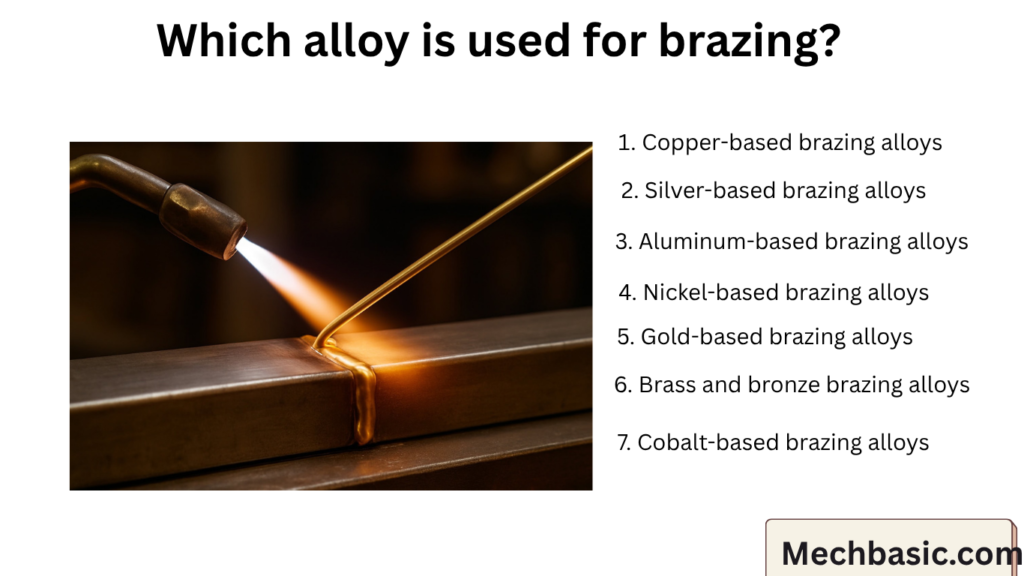
The most widely used brazing alloys include:
- Copper-based alloys
- Silver-based alloys
- Aluminum-based alloys
- Nickel-based alloys
- Gold-based alloys
- Brass and bronze alloys
- Cobalt-based alloys
1. Copper-based brazing alloys
Copper and copper alloys are commonly used because of good conductivity and low cost.
Typical compositions:
- Pure copper
- Copper–phosphorus alloys
- Copper–zinc alloys
Characteristics:
- Good fluidity
- Good joint strength
- Economical
- Suitable for steel and copper
Applications:
- Heat exchangers
- Plumbing
- Steel components
- Copper tubing
Advantages:
- Inexpensive
- Strong joints
- Good thermal conductivity
Limitations:
- High brazing temperatures
2. Silver-based brazing alloys
Silver alloys are among the most commonly used brazing filler materials.
Typical composition:
- Silver
- Copper
- Zinc
- Tin
- Cadmium-free additives
Characteristics:
- Excellent flow characteristics
- Lower brazing temperature
- High joint strength
Applications:
- Refrigeration systems
- Medical instruments
- Electrical components
- Stainless steel assemblies
Advantages:
- Strong joints
- Excellent wetting
- Good corrosion resistance
Disadvantages:
- High cost
Common examples:
- Ag–Cu–Zn alloys
- Silver-copper alloys
3. Aluminum-based brazing alloys
Used mainly for joining aluminum parts.
Typical composition:
- Aluminum–silicon alloys
Characteristics:
- Good compatibility with aluminum
- Good corrosion resistance
Applications:
- Automotive radiators
- Air-conditioning components
- Heat exchangers
Advantages:
- Lightweight
- Suitable for aluminum systems
Limitations:
- Oxide formation can create difficulties
4. Nickel-based brazing alloys
Nickel alloys are used for high-temperature applications.
Typical composition:
- Nickel
- Chromium
- Silicon
- Boron
Characteristics:
- Excellent high-temperature strength
- Oxidation resistance
- Corrosion resistance
Applications:
- Aerospace
- Gas turbines
- High-temperature furnaces
Advantages:
- Excellent thermal stability
- High strength
Disadvantages:
- More expensive
- Requires precise process control
5. Gold-based brazing alloys
Gold alloys are used where reliability and corrosion resistance are critical.
Typical composition:
- Gold–nickel
- Gold–copper
Applications:
- Aerospace electronics
- Vacuum equipment
- Precision instruments
Advantages:
- Excellent corrosion resistance
- Very reliable joints
Disadvantages:
- Extremely expensive
6. Brass and bronze brazing alloys
Brass:
Copper + Zinc
Bronze:
Copper + Tin
Characteristics:
- Good strength
- Good machinability
Applications:
- Steel fabrication
- General engineering work
Advantages:
- Moderate cost
- Good strength
7. Cobalt-based brazing alloys
Used in specialized high-temperature conditions.
Applications:
- Turbine components
- Wear-resistant systems
Characteristics:
- Excellent heat resistance
- Good wear performance
Common composition examples
| Brazing alloy | Typical composition |
|---|---|
| Copper-phosphorus | Cu–P |
| Silver alloy | Ag–Cu–Zn |
| Aluminum alloy | Al–Si |
| Nickel alloy | Ni–Cr–B–Si |
| Brass filler | Cu–Zn |
| Gold alloy | Au–Ni |
Factors affecting selection of brazing alloy
Engineers select filler alloys based on:
Base metal compatibility
The filler must bond properly.
Melting temperature
Should be:
Above 450°C but below base metal melting point.
Joint strength requirements
Higher loads require stronger alloys.
Corrosion resistance
Important in aggressive environments.
Service temperature
High-temperature service may require nickel alloys.
Cost considerations
Silver and gold alloys increase cost.
Properties of a good brazing alloy
A suitable alloy should have:
- Good fluidity
- Good wettability
- Adequate strength
- Corrosion resistance
- Proper melting range
- Compatibility with parent metals
Example
Joining copper pipes in refrigeration systems often uses:
Silver–copper–phosphorus alloy
Reasons:
- Good flow
- Strong joints
- Lower brazing temperature
Conclusion
Many alloys are used for brazing, but the most common are copper-, silver-, aluminum-, and nickel-based alloys. The choice depends on material compatibility, operating temperature, strength requirements, corrosion resistance, and economic factors. Silver alloys are widely used because they provide strong joints and excellent flow characteristics.
Other courses:





