
Skills needed for additive manufacturing include 3D CAD design and modeling knowledge.
Understanding of materials science and machine operation is also important.
Problem-solving and attention to detail help in producing accurate and high-quality parts.
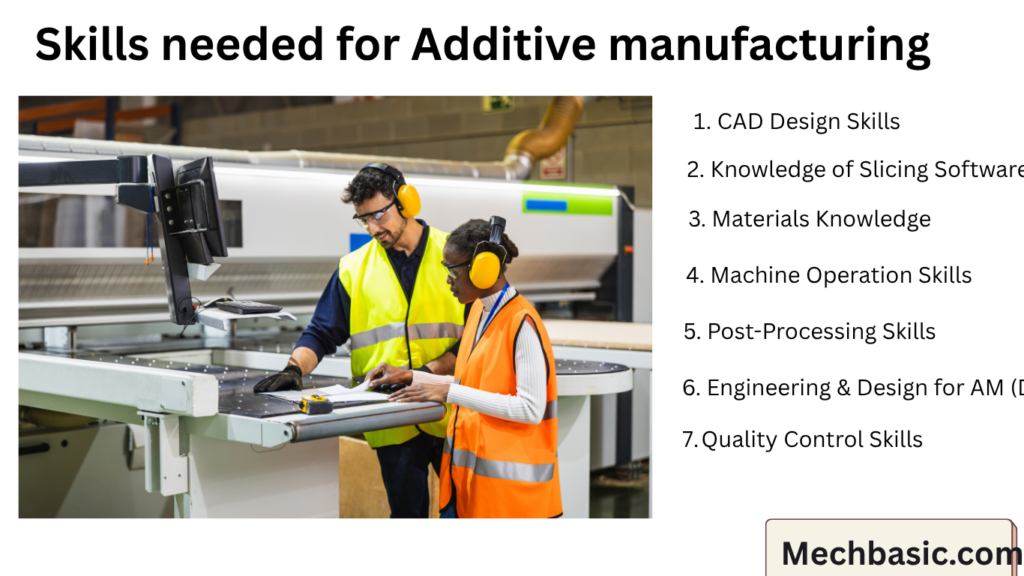
In this article:
- Skills Needed for Additive Manufacturing
- 1. CAD Design Skills (Most Important)
- 2. Knowledge of Slicing Software
- 3. Materials Knowledge
- 4. Machine Operation Skills
- 5. Post-Processing Skills
- 6. Understanding of Manufacturing Processes
- 7. Engineering & Design for AM (DfAM)
- 8. Software & Digital Skills
- 10. Quality Control Skills
- 11. Knowledge of Process Parameters
- 12. Automation & Industry 4.0 Skills (Advanced)
- Summary Table
- Summary:
- Conclusion:
- 1. CAD Design Skills (Most Important)
Skills Needed for Additive Manufacturing
Additive Manufacturing (3D printing) is a multidisciplinary field, so it requires skills from design, materials science, engineering, software, and machine operation.
1. CAD Design Skills (Most Important)
What you need
- Ability to create 3D models using CAD software
Tools
- SolidWorks
- CATIA
- AutoCAD
- Fusion 360
Why important
- Every AM part starts with a digital design
2. Knowledge of Slicing Software
What you need
- Convert 3D model into printable layers
Tools
- Cura
- PrusaSlicer
- Simplify3D
Skills involved
- Setting layer height
- Infill percentage
- Print speed
- Support structures
3. Materials Knowledge
What you need
Understanding of:
- Metals (Ti, steel, Al)
- Polymers (PLA, ABS, Nylon)
- Resins (photopolymers)
Why important
- Different materials behave differently during printing
4. Machine Operation Skills
What you need
- Operating 3D printers (FFF, SLA, SLS, etc.)
Skills include:
- Bed leveling
- Nozzle calibration
- Material loading
- Temperature control
5. Post-Processing Skills
What you need
Finishing printed parts using:
- Sanding
- Polishing
- Heat treatment
- Machining
Why important
- Improves strength and surface finish
6. Understanding of Manufacturing Processes
Knowledge areas
- Additive vs subtractive manufacturing
- Powder metallurgy basics
- Casting and forging principles
Why important
- Helps choose correct manufacturing method
7. Engineering & Design for AM (DfAM)
What it means
Designing parts specifically for 3D printing
Skills include:
- Lightweight structures
- Hollow designs
- Lattice structures
- Support minimization
8. Software & Digital Skills
What you need
- CAD/CAM integration
- Simulation tools
- 3D scanning software
Tools
- ANSYS (simulation)
- Blender (modeling)
- MeshLab (repair models)
10. Quality Control Skills
What you need
- Inspect printed parts
- Measure accuracy
- Detect defects
Tools
- Calipers
- 3D scanners
- CMM machines
11. Knowledge of Process Parameters
Important parameters
- Layer height
- Printing temperature
- Build speed
- Cooling rate
Why important
- Directly affects strength and accuracy
12. Automation & Industry 4.0 Skills (Advanced)
Modern AM trends
- AI-based design
- Smart manufacturing
- IoT-enabled printers
Summary Table
| Skill Area | Why it is needed |
|---|---|
| CAD Design | Create 3D models |
| Slicing Software | Prepare print layers |
| Materials Science | Select correct material |
| Machine Operation | Run printers |
| Post-processing | Improve quality |
| DfAM | Optimize design |
| Problem-solving | Fix printing issues |
| Quality control | Ensure accuracy |
Summary:
👉 Additive manufacturing requires a combination of design, materials, and machine skills, not just operating a printer.
Conclusion:
Skills needed for additive manufacturing include CAD design, knowledge of materials, slicing software operation, machine handling, post-processing, quality control, and understanding of manufacturing processes and design for additive manufacturing.
Other courses:





