
Materials That Cannot Bend
In sheet metal and material forming, not all materials can be bent effectively. Some materials lack sufficient ductility or have high brittleness, making them prone to cracking, breaking, or permanent deformation when bending forces are applied. Understanding these limitations is critical in part design, material selection, and manufacturing.
1. Key Reasons Why a Material Cannot Bend
A material may fail during bending due to:
- Brittleness
- Materials with low ductility cannot withstand tensile and compressive stress during bending.
- They fracture easily at the outer fibers of the bend.
- Low Elongation
- Materials with elongation <5–10% are prone to cracking.
- High Hardness / Low Toughness
- Hard or glassy materials resist plastic deformation.
- Excessive force may break or chip the material.
- Extremely Thin or Thick Sections
- Very thin sheets may tear during bending.
- Very thick sheets may require extremely high forces, exceeding machine capacity.
- High Springback
- Some high-strength alloys may bend but return toward original shape, making bending ineffective.
2. Materials That Are Generally Difficult or Impossible to Bend
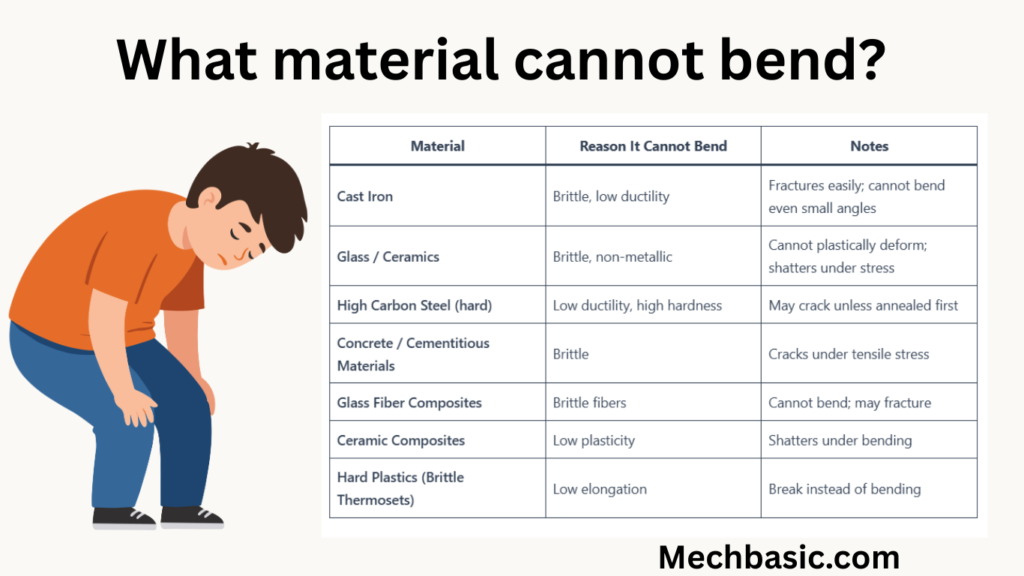
| Material | Reason It Cannot Bend | Notes |
|---|---|---|
| Cast Iron | Brittle, low ductility | Fractures easily; cannot bend even small angles |
| Glass / Ceramics | Brittle, non-metallic | Cannot plastically deform; shatters under stress |
| High Carbon Steel (hard) | Low ductility, high hardness | May crack unless annealed first |
| Concrete / Cementitious Materials | Brittle | Cracks under tensile stress |
| Glass Fiber Composites | Brittle fibers | Cannot bend; may fracture |
| Ceramic Composites | Low plasticity | Shatters under bending |
| Hard Plastics (Brittle Thermosets) | Low elongation | Break instead of bending |
3. Why Metals May Not Bend
Even metals can become unbendable under certain conditions:
- High-Carbon Steel / Tool Steel
- Very hard and strong but low ductility → cracks if bent.
- Solution: Anneal first to soften before bending.
- Work-Hardened Metals
- Metals that have been cold-worked extensively may have low ductility → prone to cracking.
- Thin Brittle Alloys
- Example: Cast aluminum alloys with low elongation.
- Very thin brittle sheets tear during bending.
4. Factors Affecting Bendability
Even a normally ductile material may fail if:
- Bend radius too small
- R/t ratio < minimum recommended → cracks on outer fibers.
- Bending speed too fast
- Rapid bending can shock brittle materials.
- Material defects
- Cracks, inclusions, or porosity reduce bendability.
- Temperature
- Some metals become brittle at low temperatures (e.g., steel below ductile-to-brittle transition temperature).
5. How to Improve Bendability
For materials that are difficult to bend:
- Annealing / Heat Treatment
- Softens the material, increases ductility.
- Common for high-carbon steels and aluminum alloys.
- Increase Bend Radius
- Reduce stress on outer fibers → prevents cracking.
- Use Incremental Bending
- Bend in small steps rather than a single sharp bend.
- Lubrication
- Reduces friction → prevents surface cracks and tearing.
- Use Alternative Forming Methods
- Rolling, hydroforming, or incremental forming may work for brittle materials.
6. Summary
- Materials that cannot bend are generally brittle, low-ductility, or hard.
- Examples: Cast iron, ceramics, glass, cement, hard plastics, high-carbon steel without annealing.
- Even ductile metals may crack if bend radius is too small or sheet thickness is inappropriate.
- Solutions: annealing, larger bend radius, incremental bending, lubrication, or alternative forming.
For bending, a material must have sufficient ductility and elongation to withstand tensile stress on the outer fibers and compressive stress on the inner fibers of the bend.
Other courses:





