
Aerodynamics of a vehicle refers to the study of how air flows around and through a vehicle and how this affects its performance, stability, fuel efficiency, and handling.
It plays a crucial role in modern automotive design, especially in high-speed and energy-efficient vehicles. Here’s a detailed explanation:
1. Definition
Vehicle aerodynamics is the science of controlling airflow over, under, and around a vehicle to minimize air resistance (drag) and improve stability, cooling, and fuel efficiency.
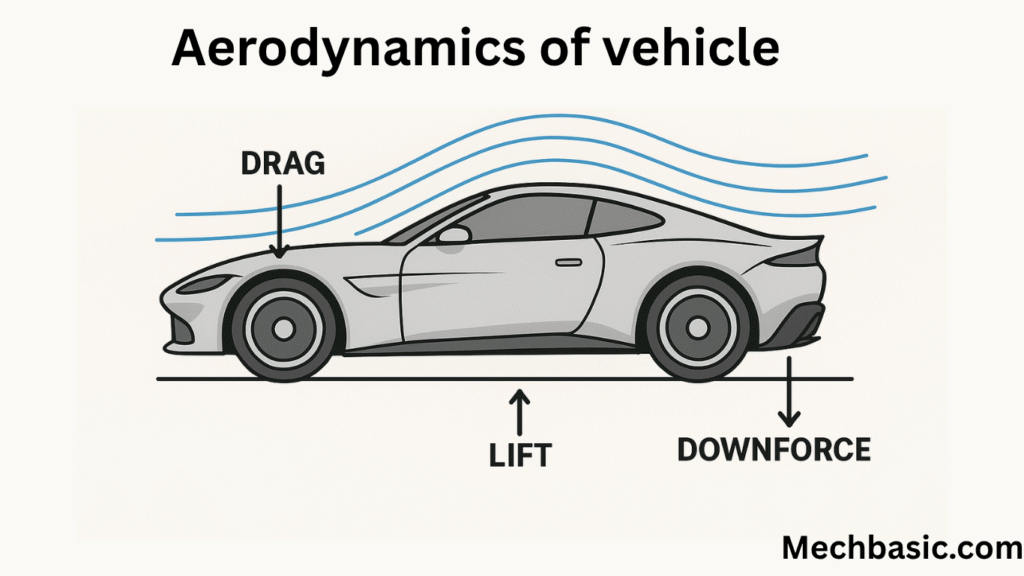
- Aerodynamic forces primarily acting on a vehicle:
- Drag Force (Air Resistance): Opposes motion, reduces speed, increases fuel consumption.
- Lift/Downforce: Vertical force; lift can make the vehicle unstable, while downforce improves traction.
- Side Forces: Lateral air pressure affecting stability during crosswinds.
2. Importance of Vehicle Aerodynamics
- Improved Fuel Efficiency
- Reducing drag means the engine uses less energy to maintain speed.
- Especially critical for electric vehicles (EVs) to maximize range.
- Better Vehicle Stability
- Downforce and airflow management help keep the car planted at high speeds.
- Enhanced Performance
- Sports cars and racing vehicles rely on aerodynamics for higher cornering speeds and top speed.
- Noise Reduction
- Smooth airflow reduces wind noise inside the cabin.
- Cooling and Ventilation
- Aerodynamics is used to direct air to engine, brakes, and radiators for proper cooling.
3. Key Aerodynamic Concepts in Vehicles
| Concept | Description |
|---|---|
| Drag Coefficient (Cd) | Dimensionless number indicating how streamlined a vehicle is. Lower Cd → less air resistance. Typical cars: 0.25–0.35; sports cars: 0.20–0.30 |
| Frontal Area (A) | The surface area facing the airflow; larger area increases drag. |
| Downforce | Force pushing the car downwards, increasing tire grip at high speeds. |
| Lift | Upward force caused by airflow, reducing traction (undesirable). |
| Slipstreaming | Reducing drag by following another vehicle closely (used in racing). |
| Turbulence / Wake | Air vortices behind the car causing drag; minimized using smooth rear design and diffusers. |
4. Aerodynamic Features of Vehicles
- Streamlined Shape
- Rounded edges, smooth curves, sloped windshields.
- Spoilers and Wings
- Redirect airflow to create downforce and reduce lift.
- Air Dams / Front Splitters
- Prevent excessive air from flowing under the car, reducing lift and drag.
- Diffusers
- Accelerate air exiting under the car, reducing drag and increasing stability.
- Side Skirts
- Prevent air from entering underneath, improving airflow management.
- Underbody Panels
- Smooth panels reduce turbulence under the car.
- Active Aerodynamics
- Adjustable spoilers, grille shutters, or air vents that change shape based on speed or load.
- Common in high-performance cars and some EVs for efficiency.
5. Examples of Aerodynamic Design in Vehicles
| Vehicle Type | Aerodynamic Features |
|---|---|
| Sports Cars | Low ride height, front splitter, rear wing, side air intakes |
| SUVs | Roof spoilers, air deflectors, smooth underbody panels |
| Trucks | Roof fairings, side skirts, tail flaps to reduce drag |
| Electric Vehicles | Smooth, rounded body, hidden underbody, active grille shutters |
6. Factors Affecting Vehicle Aerodynamics
- Shape and Design
- Sloped windshield, tapered roofline, rounded corners.
- Surface Roughness
- Smooth surfaces reduce friction drag.
- Vehicle Speed
- Drag force increases roughly with square of speed (F_drag ∝ v²).
- Crosswinds
- Side winds can destabilize poorly designed vehicles.
- Attachments
- Roof racks, mirrors, antennas increase drag.
7. Benefits of Good Aerodynamics
- Fuel efficiency improvement: 5–15% reduction in fuel consumption for passenger cars.
- High-speed stability: Reduced lift and better tire grip.
- Reduced noise: Smoother airflow around mirrors and roof.
- Cooling efficiency: Controlled airflow to engine and brakes.
FAQ Section:
- What is vehicle aerodynamics?
Vehicle aerodynamics is the study of how air flows around a vehicle and how this flow affects its performance, stability, and fuel efficiency. - Why is aerodynamics important in vehicles?
Good aerodynamics reduces air resistance (drag), improves fuel economy, enhances stability, and allows for higher speeds with less energy. - What is drag?
Drag is the air resistance that opposes a vehicle’s motion, caused by the air molecules pushing against the vehicle’s surface. - What is lift in vehicle aerodynamics?
Lift is the upward or downward force acting on a vehicle due to air pressure differences; excessive lift can reduce tire grip and stability. - How can drag be reduced in vehicles?
Drag can be reduced by streamlining the vehicle’s shape, smoothing surfaces, reducing frontal area, and managing airflow under and around the car. - What is the drag coefficient (Cd)?
The drag coefficient is a dimensionless number that measures how aerodynamic a vehicle is — lower values mean less drag. - How does aerodynamics affect fuel efficiency?
Lower aerodynamic drag means the engine uses less power to overcome air resistance, improving fuel economy. - What is downforce?
Downforce is the aerodynamic force that pushes a vehicle downward, increasing traction and stability at high speeds. - How do spoilers and diffusers help aerodynamics?
Spoilers and diffusers control airflow to reduce lift and drag, improving grip and vehicle handling. - Does vehicle speed affect aerodynamic forces?
Yes, aerodynamic drag increases with the square of the vehicle’s speed, meaning air resistance becomes much stronger at higher speeds.
✅ In Short
Vehicle aerodynamics is the study and design of a car’s interaction with air to minimize drag, improve stability, enhance fuel efficiency, and increase safety.
Key features include streamlined body, spoilers, diffusers, and underbody panels, with high-performance and electric vehicles relying heavily on optimized airflow management.
Other courses:





