
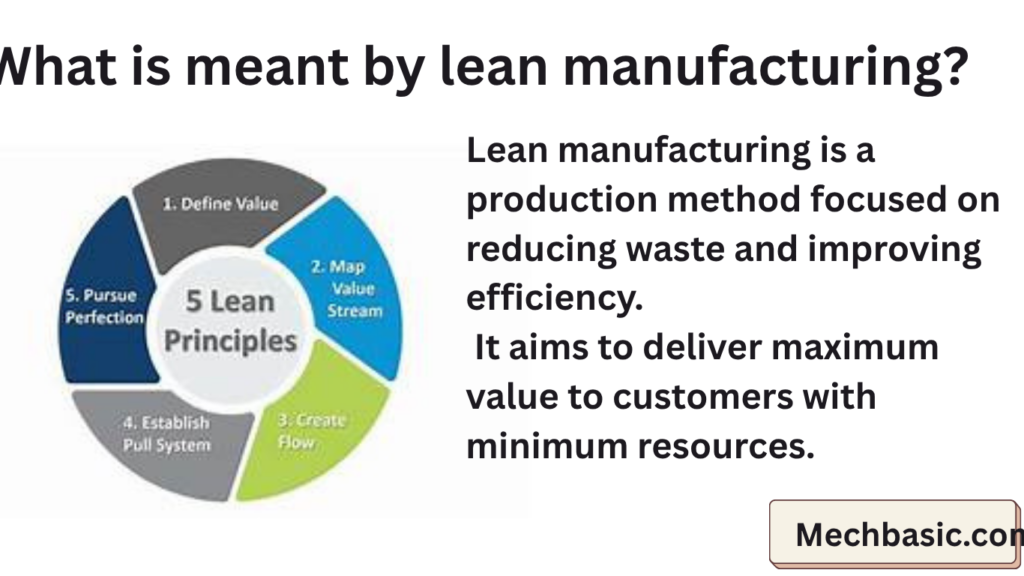
Lean manufacturing is a production method focused on reducing waste and improving efficiency.
It aims to deliver maximum value to customers with minimum resources.
This approach improves productivity, quality, and continuous process improvement.
In this article:
- Definition
- Main objective of Lean manufacturing
- Basic concept of Lean
- Origin of Lean manufacturing
- Core principles of Lean manufacturing
- The 7 wastes in Lean
- Lean tools and techniques
- Lean manufacturing process
- Advantages of Lean manufacturing
- Disadvantages of Lean manufacturing
- Applications of Lean manufacturing
- Example
- Lean vs traditional manufacturing
- Conclusion
Lean manufacturing is a systematic approach to production and process management that focuses on eliminating waste while maximizing customer value. The goal is to produce products using fewer resources, less time, less effort, and lower cost, without reducing quality.
Lean aims to ensure that every activity in a process adds value from the customer’s perspective. Any activity that does not add value is considered waste and should be reduced or eliminated.
Lean manufacturing originated from the Toyota Production System and later became a globally adopted management philosophy.
Definition
Lean manufacturing is a methodology that seeks to improve efficiency by eliminating non-value-added activities and continuously improving processes to deliver maximum value to customers.
Main objective of Lean manufacturing
The primary objectives are:
- Eliminate waste
- Improve productivity
- Reduce cost
- Increase efficiency
- Improve quality
- Reduce lead time
- Increase customer satisfaction
Basic concept of Lean
Lean asks a simple question:
“Does this activity create value for the customer?”
Activities are classified as:
Value-added activities
Actions customers are willing to pay for.
Examples:
- Machining
- Assembly
- Product design
Non-value-added activities
Activities creating no customer value.
Examples:
- Waiting
- Excess movement
- Rework
- Excess inventory
Origin of Lean manufacturing
Lean evolved from the production methods developed by Toyota after World War II.
Important contributors include:
- Taiichi Ohno
- Shigeo Shingo
Their goal was to improve efficiency and remove waste from manufacturing systems.
Core principles of Lean manufacturing
The five principles commonly used are:
- Identify value
- Map value stream
- Create flow
- Establish pull
- Pursue perfection
These principles guide Lean implementation.
The 7 wastes in Lean
Lean identifies seven major wastes using TIMWOOD:
Transportation
Unnecessary movement of materials
Inventory
Excess stock
Motion
Unnecessary worker movement
Waiting
Idle time
Overproduction
Producing more than needed
Overprocessing
Doing more work than necessary
Defects
Errors requiring correction
Many organizations also add an eighth waste:
Unused employee talent
Lean tools and techniques
Several tools help implement Lean.
1. 5S
Workplace organization system:
- Sort
- Set in order
- Shine
- Standardize
- Sustain
2. Kanban
Visual system controlling production flow.
3. Value Stream Mapping
Visualizes process flow and identifies waste.
4. Kaizen
Continuous improvement through small changes.
5. Just-in-Time (JIT)
Produce items only when needed.
6. Poka-Yoke
Error-proofing methods.
7. Root cause analysis
Identifies underlying causes of problems.
Lean manufacturing process
Typical implementation steps:
Step 1
Identify customer requirements
Step 2
Map current process
Step 3
Identify waste
Step 4
Redesign process flow
Step 5
Implement pull system
Step 6
Continuously improve
Advantages of Lean manufacturing
Reduced waste
Removes unnecessary activities.
Lower operating cost
Less inventory and fewer defects.
Improved quality
Focus on process improvement.
Faster production
Reduced waiting and delays.
Better customer satisfaction
Improved quality and delivery.
Increased productivity
Better use of resources.
Disadvantages of Lean manufacturing
Implementation challenges
Requires organizational changes.
Employee resistance
Changes may not be accepted easily.
Training requirements
Employees need education and involvement.
Supply chain dependency
Low inventory requires reliable suppliers.
Applications of Lean manufacturing
Used in many industries:
Manufacturing
Automotive, electronics, machinery
Healthcare
Patient flow improvement
Logistics
Reduce delays and waste
Software development
Agile and Lean concepts
Retail
Inventory optimization
Example
Suppose a factory produces machine parts.
Problems:
- Excess inventory
- Waiting time
- Frequent movement
Lean actions:
- Rearranged layout
- Reduced inventory
- Introduced pull production
Results:
- Faster production
- Lower costs
- Improved productivity
Lean vs traditional manufacturing
| Feature | Lean manufacturing | Traditional manufacturing |
|---|---|---|
| Inventory | Low | High |
| Focus | Waste reduction | Production volume |
| Production style | Pull | Push |
| Improvement | Continuous | Periodic |
| Customer focus | High | Moderate |
Conclusion
Lean manufacturing is a customer-focused methodology that improves efficiency by eliminating waste and continuously improving processes. By reducing non-value-added activities and optimizing workflow, organizations can achieve higher productivity, lower cost, better quality, and improved customer satisfaction.
Other courses:





