
Lane keeping is an advanced driver-assistance function that helps a vehicle stay centered within its lane. Using cameras and sensors to detect lane markings, the system gently adjusts steering—or alerts the driver—when the car begins to drift unintentionally.
It improves safety by reducing the risk of lane-departure accidents and easing driver workload during highway driving.
In this article:
1. Definition of Lane Keeping
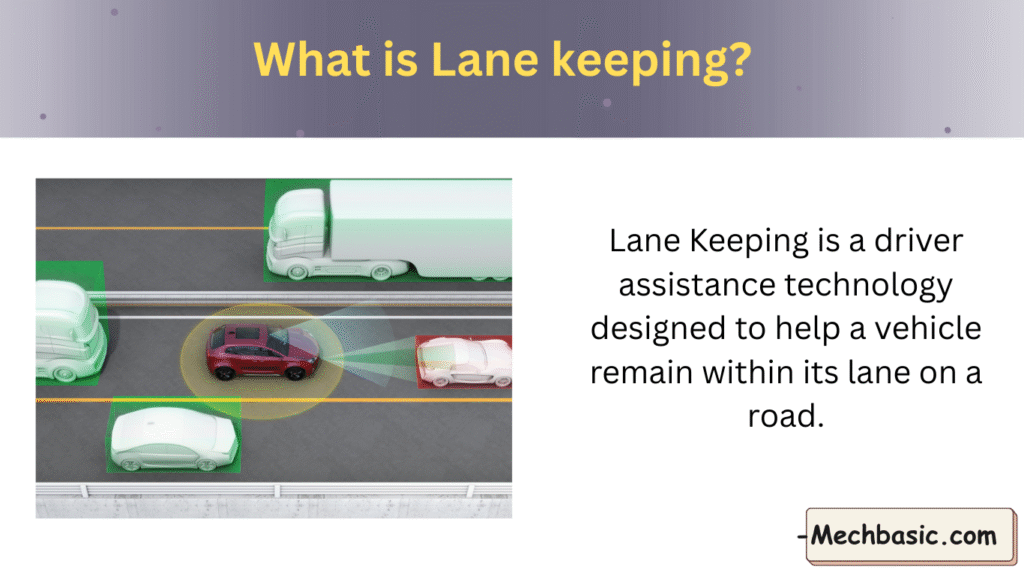
Lane Keeping is a driver assistance technology designed to help a vehicle remain within its lane on a road. Unlike simple warning systems, lane keeping can actively correct the vehicle’s trajectory if it starts to drift unintentionally.
It is a core feature in modern Advanced Driver Assistance Systems (ADAS) and is often paired with adaptive cruise control in semi-autonomous driving.
2. Components of Lane Keeping Systems
A typical Lane Keeping system uses a combination of sensors, cameras, and control systems:
- Lane Detection Sensors and Cameras
- Usually forward-facing cameras detect lane markings.
- Some systems also use radar or LIDAR to supplement lane detection in poor visibility.
- Electronic Control Unit (ECU)
- Processes the lane position data.
- Determines the vehicle’s position relative to the lane center.
- Calculates the necessary steering input to correct trajectory.
- Actuators
- Steering actuators apply torque to the steering wheel.
- Some advanced systems can also use braking or throttle control for lane adjustments.
- Driver Monitoring (Optional)
- Ensures the driver is engaged (hands on wheel, eyes on road).
- If driver attention is lost, some systems issue stronger warnings or reduce speed.
3. How Lane Keeping Works
Step-by-Step Operation
- Lane Detection
- The camera identifies lane markings or the edges of the lane.
- Advanced algorithms handle curved roads, faded lines, or shadows.
- Vehicle Positioning
- System calculates the vehicle’s lateral position relative to the lane center.
- Detects unintentional drifting (typically when no turn signal is active).
- Decision Making
- If the vehicle drifts beyond a threshold, the system determines corrective action.
- The correction can be mild (subtle steering torque) or stronger in critical situations.
- Steering Correction
- Actuators gently steer the vehicle back toward the lane center.
- Some systems can maintain lane centering continuously at highway speeds.
- Feedback and Monitoring
- System monitors road conditions continuously.
- Alerts the driver if lane markings are unclear or if the vehicle drifts beyond recovery limits.
4. Types of Lane Keeping Systems
- Lane Keeping Assist (LKA)
- Activates only when the vehicle drifts unintentionally.
- Provides corrective steering torque and may alert the driver simultaneously.
- Lane Centering / Lane Following Assist
- Continuously keeps the vehicle centered in the lane.
- Works in combination with adaptive cruise control for semi-autonomous highway driving.
- Can handle curves and gentle steering corrections automatically.
- Enhanced Lane Keeping
- Uses radar and additional sensors for poor visibility conditions.
- May integrate with collision avoidance or emergency braking systems.
5. Key Features of Lane Keeping
- Active Steering Control: Adjusts the steering automatically.
- Lane Departure Prevention: Reduces the risk of unintentional lane departure.
- Driver Alerts: Warns the driver if corrective action is insufficient.
- Semi-Autonomous Capability: Can work with adaptive cruise control for lane centering.
- Speed Dependency: Most systems work effectively above a minimum speed (typically 40–50 km/h).
- Road Type: Primarily designed for highways and well-marked roads.
6. Benefits of Lane Keeping
- Safety: Reduces side collisions and off-road accidents.
- Fatigue Reduction: Helps drivers during long highway trips.
- Assistance in Poor Driving Conditions: Assists distracted or drowsy drivers.
- Foundation for Autonomous Driving: Lane keeping is a stepping stone toward fully self-driving cars.
7. Limitations
- Lane Visibility: Works poorly with faded or missing lane markings.
- Weather Conditions: Rain, snow, or glare can reduce effectiveness.
- Driver Overreliance: Drivers may rely too much on the system.
- Road Types: Less effective on city streets with complex lane structures.
Summary
Lane keeping is an active assistance system that not only detects lane departure but also steers the vehicle to maintain lane position, improving safety and reducing driver fatigue. Modern lane keeping systems are a key step toward semi-autonomous and autonomous vehicles.
FAQ Section:
Here are 10 frequently asked questions (FAQ) about lane keeping:
- What is a Lane Keeping System (LKS)?
A driver-assistance feature that helps keep a vehicle centered within marked lanes by monitoring road lines and adjusting steering when needed. - How does lane keeping work?
It typically uses forward-facing cameras to detect lane markings and software to determine if the vehicle is drifting, then applies gentle steering corrections. - Is lane keeping the same as lane departure warning?
No. Lane departure warning only alerts the driver, while lane keeping can actively steer the car to stay within the lane. - Does lane keeping work on all roads?
It works best on well-marked highways or roads with clear lane lines. Poor or faded markings can reduce performance. - Can lane keeping drive the car for me?
No. It is an assistance system, not autonomous driving. The driver must keep hands on the wheel and remain attentive. - Does lane keeping work in bad weather?
Heavy rain, snow, fog, or glare can interfere with camera visibility and reduce system accuracy. - Will lane keeping prevent all drifting accidents?
It significantly reduces the risk but is not perfect or foolproof. Driver awareness is still essential. - Can lane keeping be turned off?
Yes. Most vehicles allow the driver to disable the feature through a button or settings menu. - Does lane keeping affect how the steering feels?
You may feel small, smooth steering inputs when the system intervenes, but it generally feels natural. - Does lane keeping work in curves?
Yes, within limits. It can follow moderate curves, but sharp bends may require manual steering corrections.
Other courses:





