
ISO 9001 is a quality management standard focused on improving product and service quality.
ISO 14001 deals with environmental management and reducing environmental impact.
ISO 45001 focuses on occupational health and safety management systems.
In this article:
What is ISO 9001, ISO 14001, and ISO 45001?
These three standards are part of the ISO management system family. Each one focuses on a different aspect of organizational performance:
- ISO 9001 → Quality Management
- ISO 14001 → Environmental Management
- ISO 45001 → Occupational Health & Safety
Together, they are often called Integrated Management Systems (IMS) when used in one organization.
1. ISO 9001 — Quality Management System (QMS)
Definition
ISO 9001 is an international standard that specifies requirements for a Quality Management System.
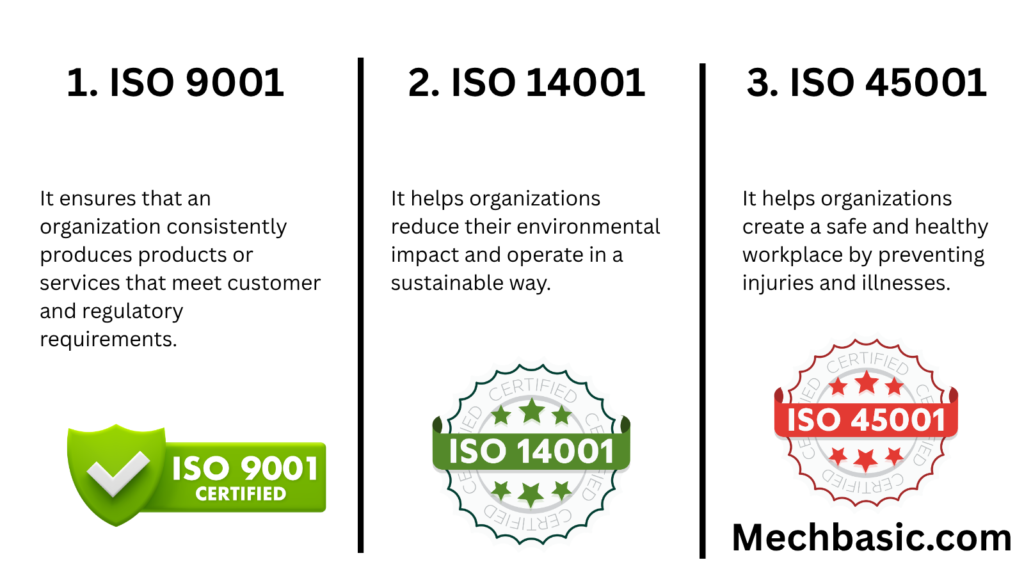
It ensures that an organization consistently produces products or services that meet customer and regulatory requirements.
Main Focus
- Customer satisfaction
- Process control
- Continuous improvement
- Reduction of defects
Key Principles
ISO 9001 is based on 7 quality principles:
- Customer focus
- Leadership
- Engagement of people
- Process approach
- Improvement
- Evidence-based decisions
- Relationship management
What It Ensures
- Consistent product quality
- Fewer defects
- Better process efficiency
Example
A manufacturing company uses ISO 9001 to ensure all machine parts meet exact dimensions every time.
Applications
- Manufacturing industries
- Automotive
- Aerospace
- IT services
- Healthcare
2. ISO 14001 — Environmental Management System (EMS)
Definition
ISO 14001 is an international standard for managing an organization’s environmental responsibilities.
It helps organizations reduce their environmental impact and operate in a sustainable way.
Main Focus
- Pollution control
- Waste reduction
- Resource efficiency
- Environmental compliance
Key Objectives
- Reduce air, water, and soil pollution
- Minimize waste
- Improve energy efficiency
- Comply with environmental laws
Example
A factory reduces chemical waste discharge and recycles water used in production.
Benefits
✔ Lower environmental impact
✔ Cost savings through energy efficiency
✔ Legal compliance
✔ Improved corporate image
Applications
- Manufacturing plants
- Construction
- Chemical industries
- Mining
- Energy sector
3. ISO 45001 — Occupational Health and Safety (OH&S)
Definition
ISO 45001 is an international standard for managing worker health and safety risks.
It helps organizations create a safe and healthy workplace by preventing injuries and illnesses.
Main Focus
- Workplace safety
- Risk prevention
- Injury reduction
- Employee well-being
Key Objectives
- Prevent accidents and injuries
- Reduce workplace hazards
- Improve employee safety awareness
- Comply with safety laws
Example
A construction company enforces safety helmets, fall protection systems, and safety training programs.
Benefits
✔ Fewer workplace accidents
✔ Improved employee morale
✔ Legal compliance
✔ Reduced downtime due to injuries
Applications
- Construction industry
- Manufacturing
- Oil and gas
- Mining
- Warehouses and logistics
Comparison Table
| Standard | Full Name | Focus Area | Main Goal |
|---|---|---|---|
| ISO 9001 | Quality Management System | Product/service quality | Customer satisfaction |
| ISO 14001 | Environmental Management System | Environment | Reduce environmental impact |
| ISO 45001 | Occupational Health & Safety | Workplace safety | Protect employees |
How They Work Together (Integrated Management System)
Many companies combine all three:
Example: Automobile Factory
- ISO 9001 → Ensures car quality
- ISO 14001 → Reduces emissions and waste
- ISO 45001 → Protects worker safety
Benefits of Integration
✔ Lower cost
✔ Less documentation duplication
✔ Better efficiency
✔ Unified management system
Real-Life Analogy
Think of running a restaurant:
- ISO 9001 → Ensures food tastes consistent and high quality
- ISO 14001 → Reduces food waste and uses eco-friendly practices
- ISO 45001 → Ensures kitchen staff safety
Conclusion
- ISO 9001 focuses on quality management and customer satisfaction
- ISO 14001 focuses on environmental protection and sustainability
- ISO 45001 focuses on workplace health and safety
Together, they help organizations operate efficiently, safely, and responsibly while improving quality, protecting the environment, and ensuring employee well-being.
Other courses:





