
The three main types of molding in casting are green sand molding, dry sand molding, and shell molding. Each type differs in the sand preparation, moisture content, and method of forming the mould cavity.
In this article:
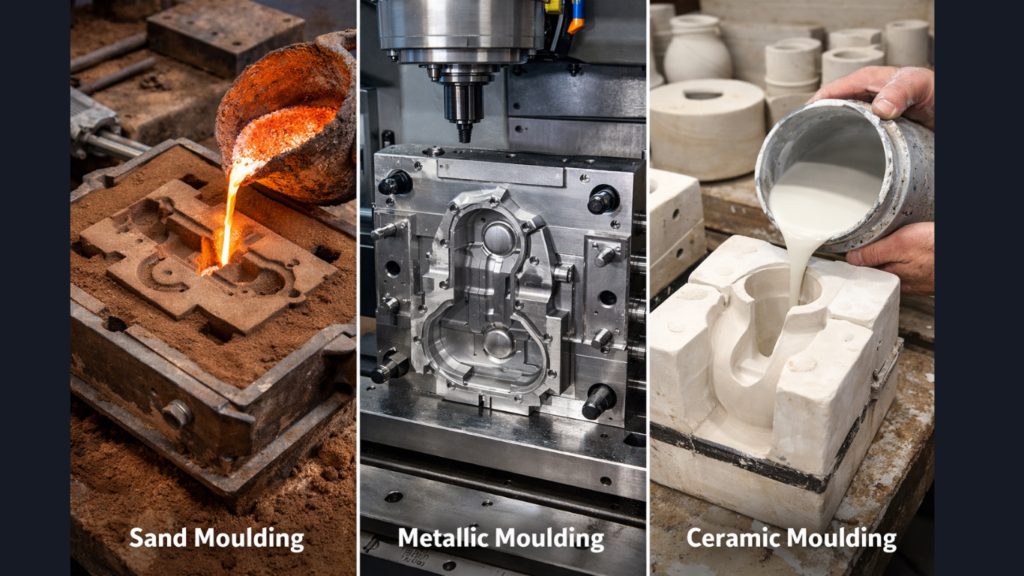
Three Types of Moulding in Manufacturing
In foundry casting, moulding is the process of forming a hollow cavity in which molten metal is poured to produce a casting. There are three main types of moulding processes, classified based on the method of forming the mould and reusability.
1. Sand Moulding
Description
- Most common and widely used method.
- A mould is made of sand mixed with a binder (clay, moisture, resin) to hold shape.
- Pattern is used to form the cavity in the sand.
Types of Sand Moulds
- Green Sand Mould – uses moist sand; used for small/medium castings.
- Dry Sand Mould – baked or chemically hardened; used for larger castings.
- Special Sands – zircon, chromite, for high-temperature alloys.
Process
- Place pattern in moulding box (cope & drag)
- Pack sand around pattern
- Remove pattern carefully
- Insert core (if needed)
- Pour molten metal into cavity
Advantages
- Inexpensive and widely available
- Can make large castings
- Flexible for complex shapes
Limitations
- Lower dimensional accuracy
- Rough surface finish
- Requires venting for gases
Applications
- Engine blocks, pump housings, valves, pipes
2. Permanent (Metallic) Moulding
Description
- Mould is made from metal (steel, cast iron, copper alloy)
- Reusable moulds are used for multiple castings
- Also called permanent mould casting
Process
- Metal mould is prepared
- Molten metal is poured into mould cavity
- Mould is opened after solidification
- Casting is removed; mould reused
Advantages
- Smooth surface finish
- High dimensional accuracy
- Faster solidification → better mechanical properties
- Reusable → economical for mass production
Limitations
- High initial cost
- Limited to smaller castings
- Complex shapes are difficult
Applications
- Aluminium, zinc, and copper alloy castings
- Automotive parts, gear blanks, small machine components
3. Ceramic Moulding (Investment / Shell Moulding)
Description
- A mould made of fine refractory material (ceramic)
- Thin coating or shell is built on wax pattern
- Used for precision and intricate castings
Types
- Investment Casting (Lost Wax Process)
- Wax pattern coated with refractory slurry
- Wax melted → hollow cavity → metal poured
- Shell Moulding
- Fine sand mixed with thermosetting resin
- Heated to form hard shell
Advantages
- Excellent dimensional accuracy
- Smooth surface finish
- Can produce complex shapes
- Minimal machining required
Limitations
- Expensive
- Time-consuming
- Usually limited to small/medium castings
Applications
- Turbine blades, jewelry, aerospace components, precision machinery
Comparison Table
| Property | Sand Moulding | Permanent (Metal) Moulding | Ceramic / Investment Moulding |
|---|---|---|---|
| Mould Material | Sand | Metal | Ceramic / Shell |
| Reusability | Limited | Reusable | Usually single-use (wax pattern) |
| Surface Finish | Rough | Smooth | Very smooth |
| Dimensional Accuracy | Moderate | High | Very high |
| Cost | Low | High | High |
| Complexity | Simple to moderate | Moderate | Complex |
| Typical Castings | Engine blocks, pipes | Small automotive parts | Turbine blades, jewelry |
Summary
- Sand Moulding: Cheap, versatile, large castings, moderate accuracy.
- Permanent (Metal) Moulding: Reusable, high accuracy, smooth finish, small to medium castings.
- Ceramic / Investment Moulding: Precision, smooth finish, complex shapes, small/medium castings.
Conclusion
The three main types of moulding are sand moulding, permanent (metal) moulding, and ceramic (investment/shell) moulding, classified by the material and method used to form the mould cavity.
Other courses:





