
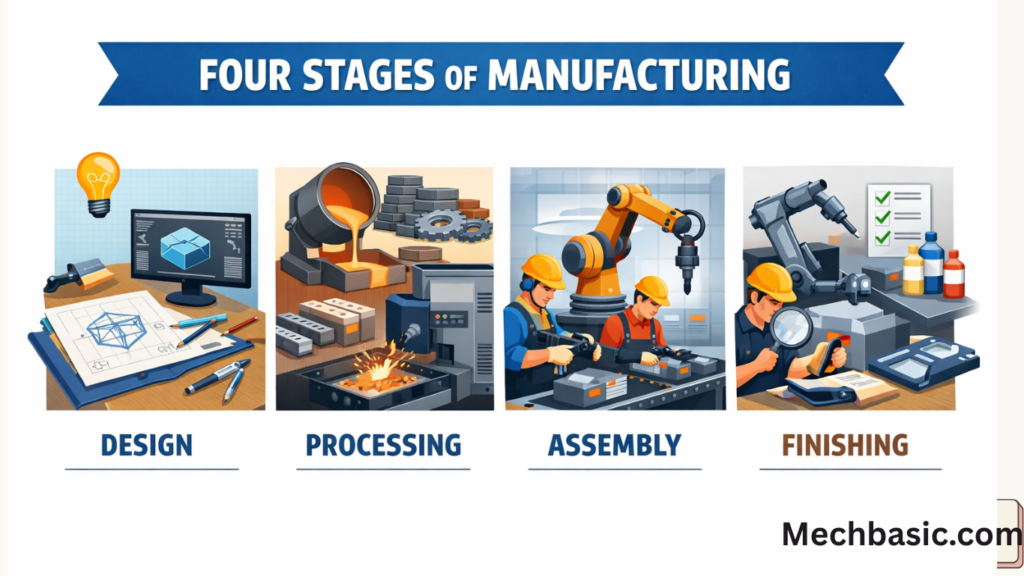
What are the four stages of manufacturing?
The four stages of manufacturing describe the complete process of turning raw materials into finished products.
They are: design, processing, assembly, and finishing.
- Design: Planning the product and its specifications.
- Processing: Transforming raw materials into components.
- Assembly: Combining components into the final product.
- Finishing: Applying coatings, polishing, or quality checks to complete the product.
Here’s a detailed explanation of the four stages of manufacturing, which describe the step-by-step process by which raw materials are transformed into finished products. These stages are fundamental to understanding manufacturing systems, industrial processes, and production planning.
1. Material Preparation (Raw Material Stage)
Definition
The first stage involves selecting, sourcing, and preparing raw materials for the manufacturing process.
Key Activities
- Selection of materials: Choosing metals, polymers, ceramics, composites, or other raw materials based on the product requirements.
- Inspection and testing: Ensuring the materials meet quality standards.
- Processing: Cutting, cleaning, melting, mixing, or grinding materials to make them suitable for shaping.
- Storage and handling: Properly storing materials to prevent contamination or degradation.
Examples
- Steel sheets for automobile body panels
- Plastic pellets for injection molding
- Clay and silica for ceramics
Importance
- Ensures the final product has the required properties
- Reduces defects and waste in later stages
2. Processing / Shaping Stage
Definition
The second stage involves transforming raw materials into the desired shape using various manufacturing methods.
Key Activities
- Forming and shaping techniques: Casting, forging, extrusion, rolling, molding, machining, or additive manufacturing (3D printing).
- Joining processes: Welding, soldering, brazing, or adhesive bonding.
- Tooling: Using dies, molds, jigs, or fixtures to achieve accurate shapes.
Examples
- Sand casting of engine blocks
- Injection molding of plastic bottles
- Forging of steel shafts
- CNC machining of metal components
Importance
- Converts raw materials into usable parts or semi-finished products
- Determines dimensional accuracy and surface quality
3. Finishing / Assembly Stage
Definition
The third stage involves refining, assembling, and adding value to the shaped components to make them functional and aesthetically acceptable.
Key Activities
- Surface finishing: Polishing, grinding, painting, coating, or plating
- Heat treatment: Hardening, annealing, tempering, or stress-relieving metals
- Assembly: Combining multiple parts into subassemblies or finished products
- Inspection and quality control: Checking for defects, dimensions, and functionality
Examples
- Assembling car engines from cast and machined components
- Painting and polishing furniture
- Welding frames for machinery
- Electroplating jewelry
Importance
- Improves product durability, appearance, and performance
- Ensures components fit and function properly
4. Packaging, Distribution, and Delivery Stage
Definition
The final stage involves packaging the finished product, storing it, and delivering it to customers or retailers.
Key Activities
- Packaging: Protecting products during transport (boxes, crates, shrink wrap, cushioning)
- Labeling: Providing product information, instructions, and compliance details
- Inventory management: Storing finished goods for distribution
- Logistics and delivery: Shipping products to warehouses, retailers, or end-users
Examples
- Bottling and labeling beverages
- Boxing electronic gadgets with accessories
- Shipping car parts to dealerships
Importance
- Prevents damage during transportation
- Facilitates efficient distribution and sales
- Enhances customer satisfaction
Summary Table of the Four Stages
| Stage | Key Activities | Examples | Importance |
|---|---|---|---|
| 1. Material Preparation | Selection, inspection, cutting, grinding, storage | Steel sheets, plastic pellets | Ensures quality raw materials for production |
| 2. Processing / Shaping | Casting, forging, molding, machining, joining | Sand casting engine blocks, injection molding bottles | Converts raw materials into usable parts |
| 3. Finishing / Assembly | Surface finishing, heat treatment, assembly, inspection | Painting furniture, assembling car engines | Improves durability, aesthetics, and functionality |
| 4. Packaging & Distribution | Packaging, labeling, storage, shipping | Bottling beverages, boxing electronics | Protects products, facilitates delivery and sales |
Conclusion:
- Every product, from a simple metal bolt to a car, passes through these four essential stages.
- Each stage adds value, precision, and functionality to the product.
- Effective management of all four stages is crucial for cost control, quality assurance, and timely delivery.
Other courses:





