
Here is a detailed explanation of the different types of crankshafts, categorized based on construction, configuration, and engine type:
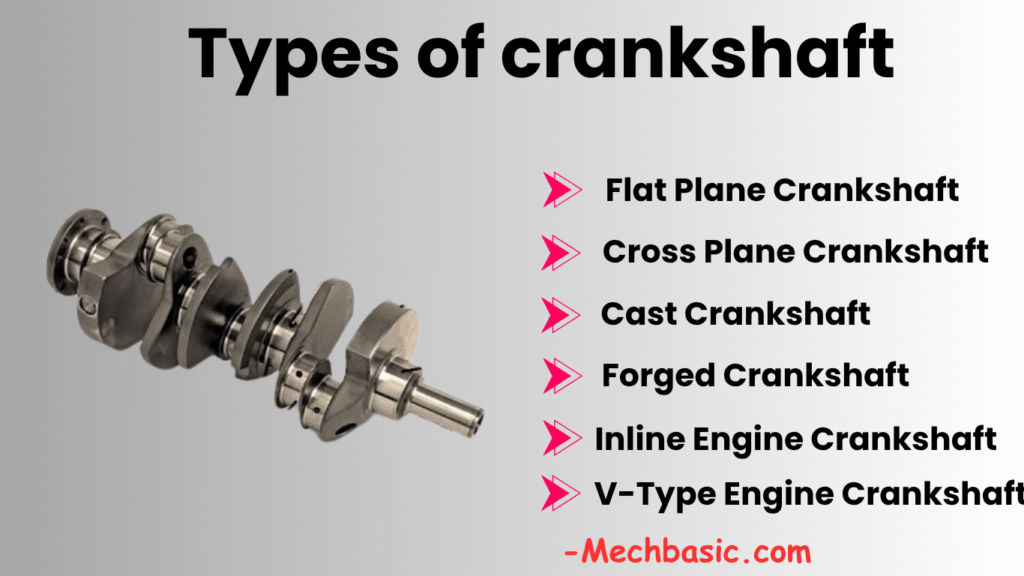
🛠️ Types of Crankshafts
Crankshafts can be classified into several types based on the engine configuration, manufacturing method, and crank design. Each type serves specific purposes in various engine applications.
🔹 1. Based on Engine Configuration
a) Single-Cylinder Crankshaft
- Used in small engines like bikes, scooters, lawnmowers, and generators.
- Simple design with one crankpin and two counterweights.
- Easy to manufacture and balance.
b) Multi-Cylinder Crankshaft
- Found in automobiles and industrial engines (e.g., inline-4, V6, V8).
- Has multiple crankpins and main journals.
- Complex design to maintain proper firing order and engine balance.
🔹 2. Based on Crankshaft Plane Arrangement
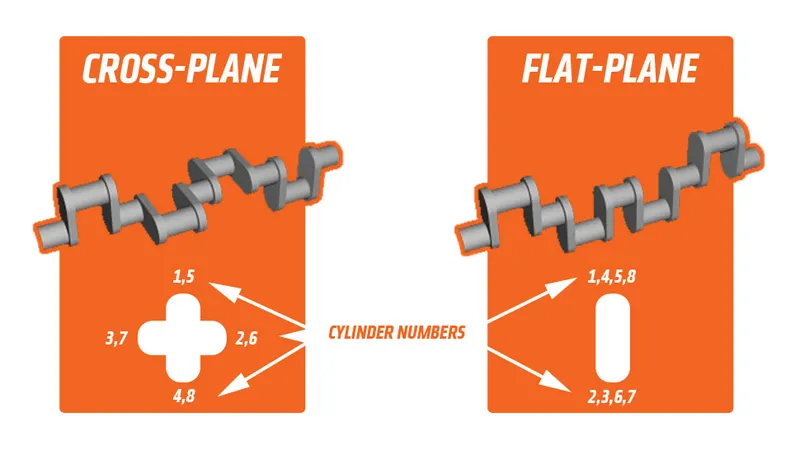
a) Flat Plane Crankshaft
- Crankpins are arranged in a single plane, typically 180° apart.
- Common in inline-4 and some performance V8 engines.
- Pros: Lightweight, better throttle response, simpler firing order.
- Cons: More vibration, less balance.
b) Cross Plane Crankshaft
- Crankpins are arranged at 90° intervals, forming a cross shape.
- Common in V8 engines (especially in American muscle cars).
- Pros: Smoother operation, better balance.
- Cons: Heavier, more complex, slightly slower response.
🔹 3. Based on Manufacturing Method
a) Cast Crankshaft
- Made using cast iron or steel in a mold.
- Cost-effective and suitable for mass production.
- Lower strength compared to forged crankshafts.
- Used in low to medium performance engines.
b) Forged Crankshaft
- Manufactured by forging steel billets under high pressure.
- Stronger and more durable than cast crankshafts.
- Used in high-performance and heavy-duty engines.
- More expensive and heavier to produce.
c) Billet Crankshaft
- Machined from a solid block (billet) of steel.
- Offers custom design and the highest strength.
- Ideal for racing engines and custom builds.
- Expensive and labor-intensive to produce.
🔹 4. Based on Design Style
a) Fully Built-Up Crankshaft
- Individual components (shaft, webs, pins) are assembled together.
- Used in two-stroke engines and motorcycles.
- Allows easy repair but may lack rigidity.
b) Fully Machined Crankshaft
- Made from a single piece of metal and machined to shape.
- Extremely strong and used in high-performance or automotive engines.
🔹 5. Based on Cylinder Arrangement
a) Inline Engine Crankshaft
- Straight crankshaft with evenly spaced crankpins.
- Simple design for inline-3, 4, or 6-cylinder engines.
b) V-Type Engine Crankshaft
- Crankpins are shared or offset depending on the bank angle.
- Designed to maintain proper firing intervals across cylinder banks.
c) Boxer Engine Crankshaft
- Also known as a horizontally opposed crankshaft.
- Used in engines like Subaru and Porsche.
- Crankpins are 180° apart to allow opposing pistons to move simultaneously.
✅ Conclusion
The type of crankshaft used in an engine is determined by the engine’s performance needs, configuration, and cost constraints. From the simple single-cylinder crankshaft to the complex forged or billet types used in racing, each crankshaft type plays a critical role in engine balance, durability, and efficiency.
Also Read : Crankshaft in detail
Other courses:





