
Thermal expansion is the increase in the size of a material when its temperature rises.
In machinery, it can cause misalignment, stress, and dimensional changes if not properly considered.
Engineers use expansion joints, proper clearances, and suitable materials to minimize its effects.
In this article:
- Thermal Expansion: Effects in Machinery Design
- What is Thermal Expansion?
- Why Does Thermal Expansion Occur?
- Types of Thermal Expansion
- Coefficient of Thermal Expansion (CTE)
- Factors Affecting Thermal Expansion
- Effects of Thermal Expansion in Machinery Design
- Examples in Machinery
- Methods to Control Thermal Expansion
- Advantages of Considering Thermal Expansion
- Consequences of Ignoring Thermal Expansion
- Applications
- Comparison of Materials
- Design Considerations
- Summary Table
- Frequently Asked Questions (FAQs)
- Conclusion
Thermal Expansion: Effects in Machinery Design
Introduction
Thermal expansion is the tendency of materials to change their dimensions (length, area, or volume) when their temperature changes. Most materials expand when heated and contract when cooled. In machinery design, thermal expansion is a critical factor because temperature variations can significantly affect the performance, accuracy, reliability, and safety of machine components.
Engineers must account for thermal expansion during the design process to prevent problems such as excessive stresses, misalignment, distortion, leakage, and mechanical failure. Components used in engines, turbines, boilers, pipelines, machine tools, heat exchangers, aerospace systems, and power plants are especially susceptible to thermal expansion due to their exposure to varying temperatures.
This guide explains the principles of thermal expansion, its types, formulas, effects on machinery, prevention methods, engineering applications, and practical examples.
What is Thermal Expansion?
Definition
Thermal expansion is the increase in the dimensions of a material caused by a rise in temperature. Conversely, materials contract when their temperature decreases.
The amount of expansion depends on:
- Type of material
- Initial dimensions
- Temperature change
- Coefficient of thermal expansion
Useful Links: Thermal Expansion Calculator.
Why Does Thermal Expansion Occur?
Atoms in a solid vibrate about their equilibrium positions. As temperature increases:
- Atomic vibrations become more energetic.
- The average distance between atoms increases.
- The material expands.
When temperature decreases, atomic vibrations reduce, and the material contracts.
Types of Thermal Expansion
1. Linear Expansion
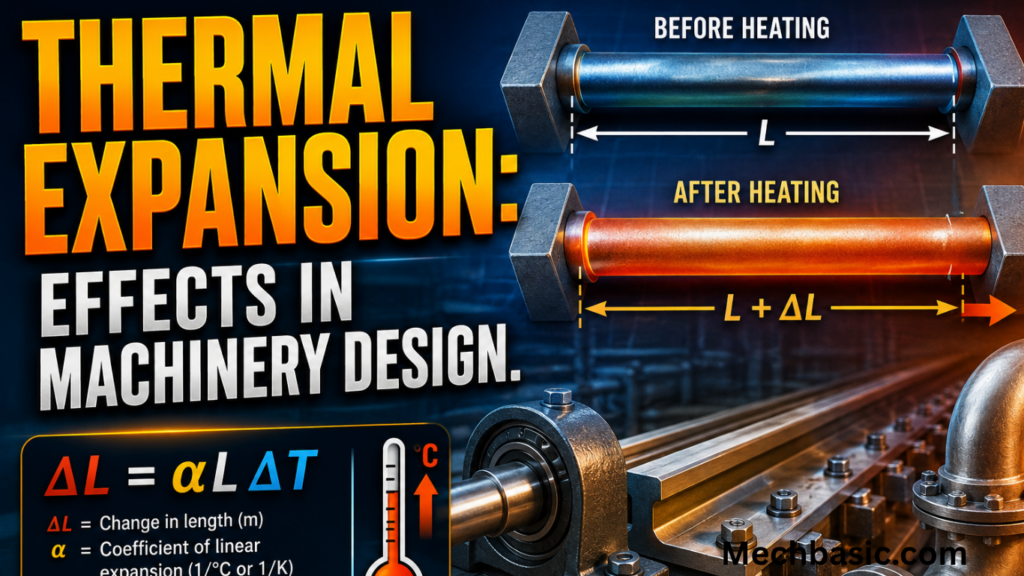
Linear expansion refers to the increase in the length of a material due to a temperature rise.
It is important for components such as:
- Shafts
- Rails
- Pipes
- Beams
- Rods
The relationship is:
Where:
ΔL=αLΔT
- ΔL = Change in length (m)
- α = Coefficient of linear expansion (1/°C or 1/K)
- L = Original length (m)
- ΔT = Temperature change (°C or K)
2. Area Expansion
Area expansion is the increase in the surface area of a material when heated.
Typical applications include:
- Metal plates
- Machine covers
- Heat exchanger plates
3. Volume Expansion
Volume expansion refers to the increase in the volume of a material due to heating.
Applications include:
- Liquids in tanks
- Pressure vessels
- Storage containers
Coefficient of Thermal Expansion (CTE)
Definition
The coefficient of thermal expansion (CTE) is a material property that indicates how much a material expands per unit length for each degree of temperature increase.
Materials with a high CTE expand more than those with a low CTE for the same temperature change.
Factors Affecting Thermal Expansion
Several factors influence thermal expansion:
1. Material Type
Different materials have different coefficients of thermal expansion.
Examples:
- Aluminum expands more than steel.
- Copper expands more than cast iron.
- Ceramics generally expand less than many metals.
2. Temperature Change
Greater temperature changes produce greater expansion.
3. Original Dimensions
Larger components experience greater dimensional changes for the same temperature increase.
4. Material Structure
Crystal structure, composition, and heat treatment influence thermal expansion behavior.
Effects of Thermal Expansion in Machinery Design
1. Dimensional Changes
Machine components may become longer, wider, or thicker as temperature rises.
This can alter clearances and affect assembly accuracy.
2. Misalignment
Thermal expansion can cause:
- Shaft misalignment
- Bearing misalignment
- Gear alignment errors
- Coupling misalignment
Misalignment increases vibration and wear.
3. Thermal Stress
If a component is restrained and cannot expand freely, internal stresses develop.
These thermal stresses may lead to:
- Cracking
- Yielding
- Distortion
- Premature failure
4. Bearing Problems
Thermal expansion may reduce bearing clearances, resulting in:
- Increased friction
- Overheating
- Lubrication failure
- Bearing seizure
5. Shaft Expansion
Rotating shafts expand during operation.
Designers must ensure sufficient clearance between shafts, bearings, and housings.
6. Gear Performance
Thermal expansion changes the center distance between gears.
Possible consequences include:
- Increased noise
- Improper meshing
- Accelerated wear
- Reduced efficiency
7. Seal Leakage
Expansion may alter the contact pressure between seals and mating surfaces, causing leakage or excessive wear.
8. Bolt Loosening or Overloading
Different expansion rates between bolts and connected components may:
- Reduce clamping force
- Increase bolt stress
- Lead to joint failure
9. Reduced Dimensional Accuracy
Precision machines such as CNC machines, measuring instruments, and coordinate measuring machines (CMMs) can lose accuracy because of thermal expansion.
Examples in Machinery
Internal Combustion Engines
Engine parts such as pistons, cylinders, valves, and cylinder heads expand during operation.
Proper clearances are essential to prevent seizure and ensure smooth operation.
Steam Turbines
Rotors and casings experience significant thermal expansion.
Expansion joints and controlled warm-up procedures help prevent excessive thermal stresses.
Pipelines
Long pipelines expand when transporting hot fluids.
Expansion loops, bellows, and expansion joints accommodate this movement.
Boilers
Boiler tubes expand during heating.
Supports and expansion provisions prevent excessive stresses.
Machine Tools
Thermal expansion of machine frames and spindles can reduce machining accuracy.
Cooling systems and temperature compensation improve precision.
Methods to Control Thermal Expansion
1. Expansion Joints
Expansion joints absorb dimensional changes in:
- Pipelines
- Bridges
- Buildings
- Heat exchangers
2. Expansion Loops
Pipe loops provide flexibility, allowing thermal expansion without excessive stress.
3. Material Selection
Choose materials with suitable thermal expansion characteristics.
Examples:
- Invar (very low CTE)
- Stainless steel
- Ceramics
- Composite materials
4. Thermal Insulation
Insulation reduces temperature fluctuations and minimizes expansion.
5. Cooling Systems
Cooling systems maintain stable operating temperatures.
Examples:
- Water cooling
- Air cooling
- Oil cooling
6. Proper Clearance Design
Adequate clearances should be provided between:
- Pistons and cylinders
- Shafts and bearings
- Gears
- Sliding components
7. Flexible Supports
Flexible supports allow controlled movement caused by expansion while reducing stress.
8. Controlled Heating
Gradual heating minimizes thermal shock and uneven expansion.
Advantages of Considering Thermal Expansion
- Prevents structural damage.
- Improves machine reliability.
- Extends component life.
- Reduces maintenance.
- Improves dimensional accuracy.
- Enhances operational safety.
- Increases equipment efficiency.
Consequences of Ignoring Thermal Expansion
Ignoring thermal expansion can result in:
- Cracks
- Distortion
- Excessive vibration
- Bearing failure
- Gear damage
- Seal leakage
- Misalignment
- Reduced service life
- Unexpected shutdowns
Applications
Thermal expansion analysis is important in:
Mechanical Engineering
- Engines
- Turbines
- Compressors
- Pumps
Civil Engineering
- Bridges
- Railway tracks
- Buildings
- Pipelines
Aerospace Engineering
- Aircraft structures
- Rocket engines
- Spacecraft
Power Plants
- Boilers
- Steam turbines
- Heat exchangers
Manufacturing
- CNC machines
- Precision measuring equipment
- Metal processing machinery
Comparison of Materials
| Material | Relative Thermal Expansion |
|---|---|
| Aluminum | High |
| Copper | High |
| Brass | Moderate to High |
| Steel | Moderate |
| Cast Iron | Low to Moderate |
| Invar | Very Low |
| Ceramics | Generally Low |
Design Considerations
Engineers should consider:
- Operating temperature range
- Material compatibility
- Thermal gradients
- Expansion allowances
- Joint flexibility
- Manufacturing tolerances
- Lubrication effects
- Safety factors
Summary Table
| Aspect | Description |
|---|---|
| Thermal Expansion | Increase in dimensions due to heating |
| Linear Expansion | Change in length |
| Area Expansion | Change in surface area |
| Volume Expansion | Change in volume |
| Thermal Stress | Stress caused by restrained expansion |
| CTE | Material property describing expansion rate |
| Prevention | Expansion joints, clearances, cooling, material selection |
Frequently Asked Questions (FAQs)
1. What is thermal expansion?
Thermal expansion is the increase in the dimensions of a material when its temperature rises. Most materials expand when heated and contract when cooled.
2. Why is thermal expansion important in machinery design?
It affects component dimensions, clearances, alignment, stresses, and overall machine performance. Proper consideration helps prevent failures and ensures reliable operation.
3. What is the coefficient of thermal expansion (CTE)?
The coefficient of thermal expansion is a material property that indicates how much a material expands per unit length for each degree of temperature increase.
4. What causes thermal stress?
Thermal stress develops when a material is prevented from expanding or contracting freely due to temperature changes.
5. Which machinery components are most affected by thermal expansion?
Components such as shafts, bearings, gears, pistons, cylinders, pipelines, turbines, boilers, and machine tool structures are commonly affected.
6. How can engineers reduce the effects of thermal expansion?
They can use expansion joints, expansion loops, suitable materials, adequate clearances, cooling systems, flexible supports, and thermal insulation.
7. Why are expansion joints used in pipelines?
Expansion joints absorb dimensional changes caused by temperature variations, reducing thermal stress and preventing damage to the piping system.
8. Which material has a very low coefficient of thermal expansion?
Invar, a nickel–iron alloy, is well known for its extremely low coefficient of thermal expansion and is widely used in precision instruments.
9. How does thermal expansion affect bearings?
It can reduce internal clearances, leading to increased friction, overheating, lubrication problems, and, in severe cases, bearing seizure.
10. How is thermal expansion analyzed in modern engineering?
Engineers commonly use Finite Element Analysis (FEA) and thermal simulation software to predict temperature distributions, thermal stresses, and dimensional changes before manufacturing.
Conclusion
Thermal expansion is a fundamental consideration in machinery design because temperature changes can significantly influence the dimensions, alignment, and structural integrity of engineering components. If not properly addressed, thermal expansion may lead to thermal stresses, misalignment, excessive wear, leakage, reduced accuracy, and premature failure. By understanding material properties, providing appropriate clearances, selecting suitable materials, incorporating expansion joints, and using advanced simulation tools such as Finite Element Analysis (FEA), engineers can design machinery that operates safely, efficiently, and reliably under varying thermal conditions. Proper management of thermal expansion is therefore essential for improving performance, extending service life, and reducing maintenance costs across a wide range of engineering applications.
Other courses:





