
Soldering is a metal joining process that uses a low-melting-point filler metal called solder.
The base metals are not melted; only the solder melts and flows into the joint.
It is commonly used in electronics, electrical wiring, and small metal assemblies.
In this article:
- Soldering
- Principle of Soldering
- How Soldering Works
- Components of Soldering
- Equipment Used in Soldering
- Types of Soldering
- Soldering Process (Step-by-Step)
- Characteristics of a Good Solder Joint
- Defects in Soldering
- Advantages of Soldering
- Limitations of Soldering
- Soldering vs Brazing
- Soldering vs Welding
- Applications of Soldering
- Safety Precautions
- Conclusion
Soldering
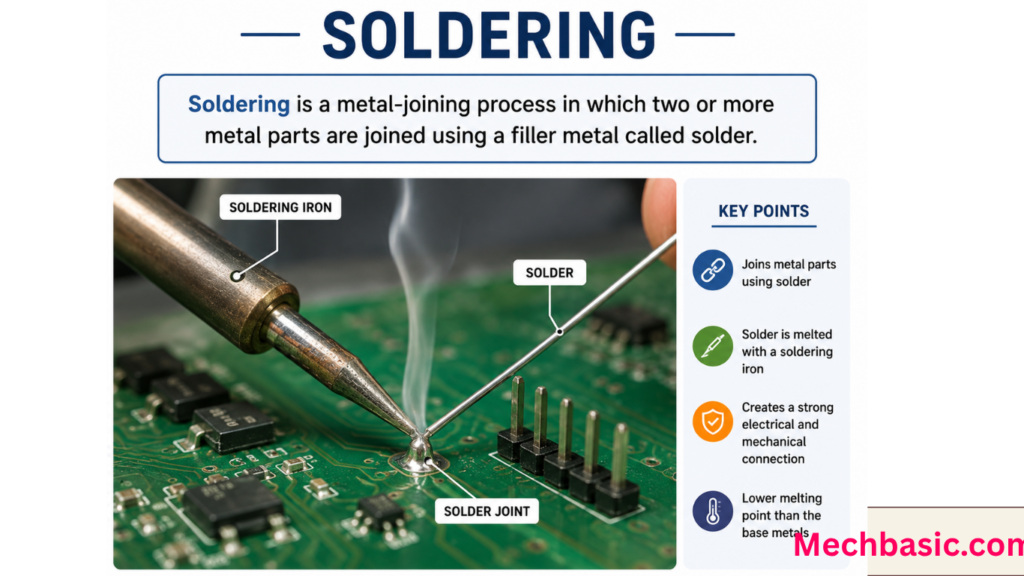
Soldering is a metal-joining process in which two or more metal parts are joined using a filler metal called solder. The solder melts and flows into the joint, while the base metals do not melt. After cooling, the solder solidifies and forms a mechanical and electrical bond between the parts.
Soldering is widely used in:
- Electronics and circuit boards
- Electrical wiring
- Plumbing
- Jewelry making
- Metal fabrication
- Automotive electrical systems
Definition
Soldering is a joining process in which a filler metal with a melting temperature below 450°C is melted and used to join metal components without melting the base metals.
Principle of Soldering
The process works through:
- Cleaning the surfaces
- Heating the joint
- Melting the solder
- Allowing solder to flow into the joint
- Cooling and solidification
The molten solder wets the surfaces and creates a bond.
How Soldering Works
When heat is applied:
- The base metals are heated.
- Solder melts and flows.
- Flux removes oxides.
- Solder fills the joint.
- The joint cools and solidifies.
The base metals remain below their melting temperatures.
Components of Soldering
1. Base Metals
Common materials joined by soldering:
- Copper
- Brass
- Tin-plated metals
- Electrical conductors
- Electronic components
2. Solder
Solder is the filler metal used for joining.
Traditional solder
Contains:
- Tin (Sn)
- Lead (Pb)
Common alloy:
- 60% Tin
- 40% Lead
Lead-free solder
Common modern composition:
- Tin
- Silver
- Copper
Often called SAC solder.
Used due to environmental regulations.
3. Flux
Flux is used to:
- Remove oxides
- Prevent oxidation
- Improve solder flow
- Improve wetting
Common flux types:
Rosin flux
Used in electronics.
Acid flux
Used in plumbing and sheet metal work.
Water-soluble flux
Easy to clean after soldering.
Equipment Used in Soldering
Soldering Iron
Most common tool.
Typical temperature:
250–450°C
Used for:
- Electronic components
- Wires
- Circuit boards
Soldering Station
Includes:
- Temperature control
- Soldering iron
- Stand
Provides better precision.
Soldering Gun
Higher power than soldering irons.
Used for:
- Heavy electrical work
Torch Soldering Equipment
Uses gas flame.
Applications:
- Plumbing
- Sheet metal
Types of Soldering
1. Soft Soldering
Most common type.
Temperature
Below 450°C
Solder
Tin-based alloys
Applications
- Electronics
- Electrical wiring
Advantages
- Low cost
- Simple process
2. Hard Soldering
Uses higher-melting solders.
Temperature
Near the upper limit of soldering
Applications
- Mechanical joints
- Metal assemblies
3. Silver Soldering
Uses silver-containing solder.
Advantages
- Strong joints
- Good corrosion resistance
Applications
- Jewelry
- Precision components
Soldering Process (Step-by-Step)
Step 1: Surface Preparation
Clean surfaces thoroughly.
Remove:
- Oil
- Grease
- Dirt
- Oxides
Methods:
- Sandpaper
- Wire brush
- Solvent cleaning
Step 2: Apply Flux
Apply flux to the joint area.
Purpose:
- Prevent oxidation
- Improve solder flow
Step 3: Heat the Joint
Use soldering iron or torch.
Heat the base metals.
Do not simply melt solder onto a cold joint.
Step 4: Apply Solder
Touch solder to the heated joint.
If temperature is correct:
- Solder melts
- Flows smoothly
Step 5: Remove Heat
After enough solder flows:
- Remove heat source
Step 6: Cooling
Allow joint to cool naturally.
Avoid movement during cooling.
Step 7: Cleaning
Remove excess flux residue.
Especially important for corrosive fluxes.
Characteristics of a Good Solder Joint
A good solder joint should be:
- Smooth
- Shiny
- Fully wetted
- Free from cracks
- Free from voids
Defects in Soldering
Cold Joint
Occurs when solder does not fully melt.
Characteristics:
- Dull appearance
- Weak bond
Insufficient Solder
Too little solder in joint.
Results:
- Weak connection
Excess Solder
Too much solder.
May cause:
- Short circuits
- Poor appearance
Flux Residue
Improper cleaning may lead to corrosion.
Solder Bridges
Unwanted connection between conductors.
Common in electronics.
Advantages of Soldering
Low temperature process
Minimal thermal damage.
Easy to perform
Suitable for small assemblies.
Cost effective
Simple equipment required.
Good electrical conductivity
Ideal for electrical connections.
Minimal distortion
Base metals do not melt.
Limitations of Soldering
Lower joint strength
Compared with:
- Brazing
- Welding
Limited high-temperature performance
Solder may soften at elevated temperatures.
Soldering vs Brazing
| Feature | Soldering | Brazing |
|---|---|---|
| Filler melting temperature | Below 450°C | Above 450°C |
| Joint strength | Lower | Higher |
| Heat required | Lower | Higher |
| Typical use | Electronics | Mechanical components |
| Distortion risk | Very low | Low |
Soldering vs Welding
| Feature | Soldering | Welding |
|---|---|---|
| Base metal melting | No | Yes |
| Heat required | Lower | Very high |
| Joint strength | Lower | Higher |
| Distortion | Minimal | Higher |
Applications of Soldering
Electronics
- Printed circuit boards (PCBs)
- Microelectronics
- Connectors
Electrical Work
- Wire connections
- Cable joints
Plumbing
- Copper pipe joints
Jewelry
- Precious metal assembly
Automotive
- Electrical systems
- Sensors
- Connectors
Safety Precautions
- Wear safety glasses
- Work in a ventilated area
- Avoid inhaling flux fumes
- Use heat-resistant tools
- Keep flammable materials away
- Wash hands after handling solder
Conclusion
Soldering is a low-temperature metal joining process that uses a molten filler metal (solder) to create mechanical and electrical connections without melting the base metals. It is widely used in electronics, electrical systems, plumbing, and precision assemblies because it is simple, economical, and produces reliable joints with minimal distortion.
Other courses:





