
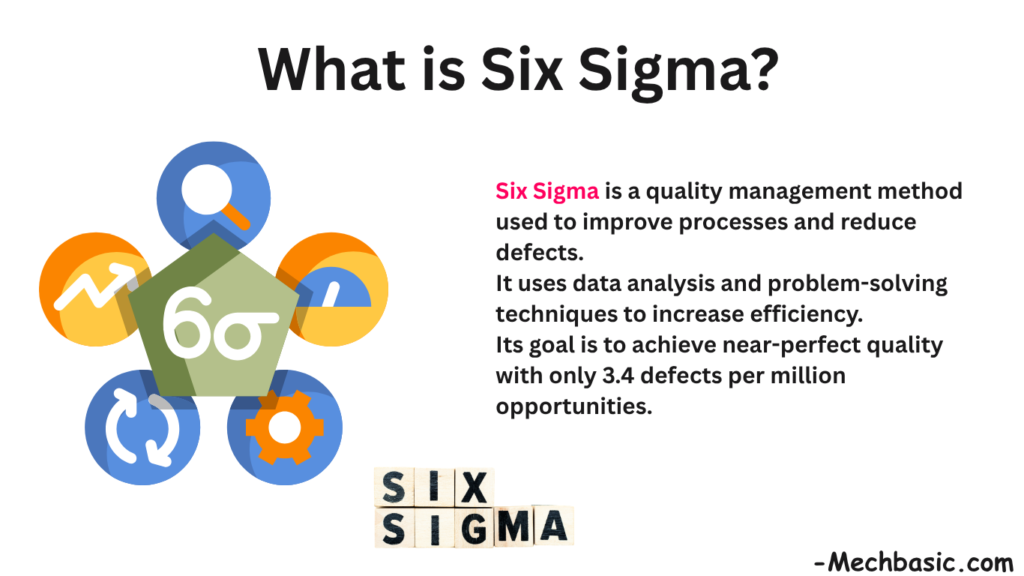
Six Sigma is a quality management method used to improve processes and reduce defects.
It uses data analysis and problem-solving techniques to increase efficiency.
Its goal is to achieve near-perfect quality with only 3.4 defects per million opportunities.
In this article:
- Six Sigma:
- Definition
- Meaning of “Six Sigma”
- Main goals of Six Sigma
- Core principles of Six Sigma
- Six Sigma methodologies
- Six Sigma belt levels
- Common Six Sigma tools
- Advantages of Six Sigma
- Limitations of Six Sigma
- Applications of Six Sigma
- Example of Six Sigma application
- Difference between Six Sigma and traditional quality control
- Conclusion
Six Sigma:
Six Sigma is a data-driven quality management and process improvement methodology used to reduce defects, minimize process variation, improve efficiency, and enhance customer satisfaction. It uses statistical methods and structured problem-solving techniques to achieve near-perfect process performance.
It was originally developed by Motorola in the 1980s and later became widely popular through General Electric under the leadership of Jack Welch.
Definition
Six Sigma is a disciplined methodology that aims to improve process quality by identifying and eliminating causes of defects and reducing variation using statistical and management techniques.
The term Sigma (σ) represents the standard deviation, which measures process variation.
A Six Sigma process theoretically produces only about 3.4 defects per million opportunities (DPMO).
Meaning of “Six Sigma”
Sigma (σ) is a statistical measure of variation.
Higher sigma level = fewer defects.
Typical performance levels:
| Sigma level | Approximate defects per million opportunities |
|---|---|
| 1 Sigma | 690,000 |
| 2 Sigma | 308,000 |
| 3 Sigma | 66,800 |
| 4 Sigma | 6,210 |
| 5 Sigma | 233 |
| 6 Sigma | 3.4 |
The objective is to move processes toward extremely low defect rates.
Main goals of Six Sigma
- Reduce defects
- Minimize process variation
- Improve quality
- Increase customer satisfaction
- Reduce costs
- Improve efficiency
- Increase profitability
- Support continuous improvement
Core principles of Six Sigma
1. Focus on customer requirements
Customer expectations drive improvement efforts.
Questions asked:
- What does the customer value?
- What are critical quality requirements?
2. Use data-driven decisions
Decisions rely on:
- Measurement
- Statistical analysis
- Facts
Not assumptions.
3. Reduce process variation
Variation often creates inconsistent results.
Six Sigma seeks stable, predictable processes.
4. Improve processes continuously
Processes are measured and improved repeatedly.
5. Involve employees
Successful Six Sigma requires:
- Teamwork
- Leadership
- Participation
Six Sigma methodologies
Two major methodologies are used:
A. DMAIC
Used for improving existing processes.
DMAIC stands for:
- Define
- Measure
- Analyze
- Improve
- Control
Detailed explanation:
Define
Identify:
- Problem
- Project scope
- Customer needs
- Goals
Example:
Reduce product defects by 20%.
Measure
Collect data and understand current performance.
Activities:
- Data collection
- Process mapping
- Measurement system analysis
Analyze
Determine root causes.
Tools:
- Fishbone diagram
- Pareto analysis
- Statistical methods
Improve
Implement solutions.
Examples:
- Process redesign
- Training
- Equipment changes
Control
Maintain improvements.
Methods:
- Control charts
- Standard procedures
- Monitoring systems
B. DMADV
Used for designing new products or processes.
DMADV:
- Define
- Measure
- Analyze
- Design
- Verify
Often associated with Design for Six Sigma (DFSS).
Six Sigma belt levels
Training is organized into belt systems.
White Belt
- Basic awareness
Yellow Belt
- Team support role
Green Belt
- Leads smaller projects
Black Belt
- Leads complex projects
- Advanced statistical knowledge
Master Black Belt
- Mentors and strategy leadership
Champion
- Senior management support role
Common Six Sigma tools
Examples include:
- Process mapping
- Pareto charts
- Cause-and-effect diagrams
- Control charts
- Histograms
- Scatter plots
- Regression analysis
- Hypothesis testing
- Failure Mode and Effects Analysis (FMEA)
- Statistical Process Control (SPC)
Advantages of Six Sigma
Quality improvement
Reduces defects.
Cost reduction
Reduces waste and rework.
Higher customer satisfaction
Improves product consistency.
Better process understanding
Identifies inefficiencies.
Improved productivity
Processes become more efficient.
Better decision-making
Uses measurable data.
Limitations of Six Sigma
Can require significant training
Advanced concepts involve statistics.
Implementation cost
Training and projects can be expensive.
Data dependence
Poor data can create poor conclusions.
Resistance to change
Employees may resist new methods.
Applications of Six Sigma
Originally used in manufacturing but now used across many industries:
Manufacturing
- Defect reduction
- Process optimization
Healthcare
- Reduce medical errors
- Improve patient flow
Banking
- Reduce transaction errors
Information technology
- Improve software quality
Supply chain
- Reduce delays
Retail and service industries
- Improve customer experience
Example of Six Sigma application
Suppose a factory produces 10,000 parts per day.
Problem:
300 defective parts daily.
Using DMAIC:
- Define defect problem
- Measure defect data
- Analyze causes
- Improve machine settings
- Control future performance
Result:
Defects decrease significantly.
Difference between Six Sigma and traditional quality control
| Feature | Six Sigma | Traditional quality control |
|---|---|---|
| Focus | Prevent defects | Detect defects |
| Method | Data-driven | Inspection-based |
| Goal | Continuous improvement | Quality checking |
| Tools | Statistical analysis | Inspection methods |
Conclusion
Six Sigma is a structured, statistical, and customer-focused methodology for reducing defects and improving process performance. By using data analysis, disciplined problem solving, and continuous improvement principles, organizations can achieve better quality, lower costs, and greater efficiency.
Other courses:





