
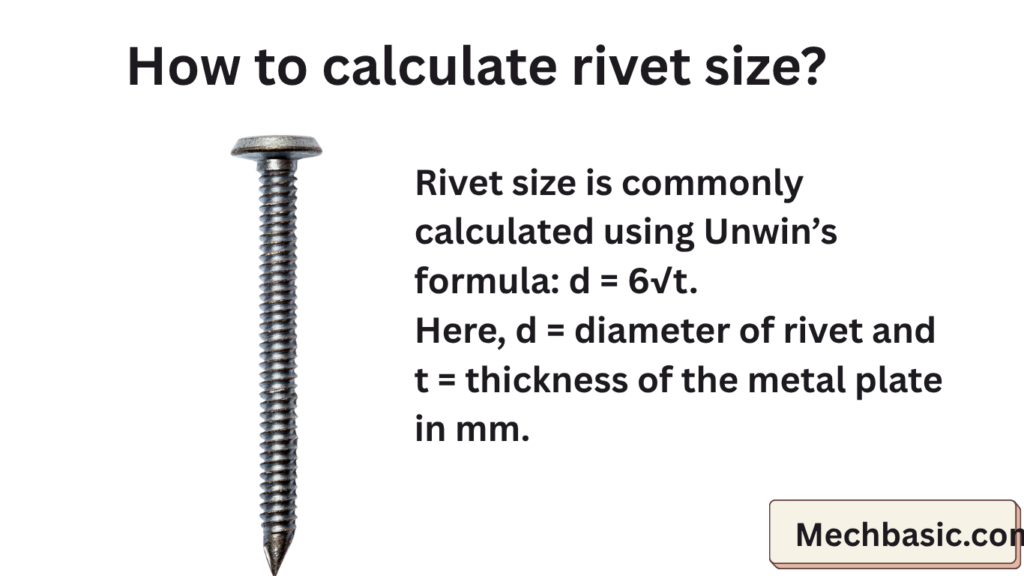
Rivet size is commonly calculated using Unwin’s formula: d = 6√t.
Here, d = diameter of rivet and t = thickness of the metal plate in mm.
This formula helps select a suitable rivet size for strong joints.
In this article:
How to calculate rivet size?
Rivet size calculation is important in machine design and sheet metal work because the rivet must be strong enough to carry the load without failure. The size of a rivet mainly includes:
- Rivet diameter (d)
- Rivet length (L)
The diameter is usually calculated first, and then the required length is determined.
1. Calculation of rivet diameter
The most commonly used empirical relation is Unwin’s formula:
d = 6\sqrt{t}
Where:
- d = diameter of rivet (mm)
- t = thickness of plate (mm)
This formula gives an approximate rivet diameter for structural applications.
Procedure
Step 1: Find plate thickness (t)
Step 2: Substitute into Unwin’s formula
Step 3: Choose the nearest standard rivet size
Example
Plate thickness:
t = 9 mm
Using:
d = 6√9
d = 6 × 3
d = 18 mm
Therefore:
Required rivet diameter = 18 mm
Nearest standard size may then be selected.
2. Calculation of rivet length
The rivet length depends on:
- Total thickness of plates joined
- Extra material required for forming the rivet head
General relation:
For snap-head rivets:
L = T + 1.5d
Where:
- L = rivet length
- T = total thickness of plates
- d = rivet diameter
Example
Suppose:
Total plate thickness:
T = 20 mm
Diameter:
d = 18 mm
Substitute:
L = 20 + (1.5 × 18)
L = 20 + 27
L = 47 mm
Therefore:
Rivet length ≈ 47 mm
Additional design proportions of rivets
Common empirical proportions:
Head diameter
D = 1.6d
Where:
D = head diameter
Head height
h = 0.7d
Pitch of rivets
Distance between centers of adjacent rivets:
P = 3d
Margin distance
Distance from plate edge to rivet center:
m = 1.5d
Factors affecting rivet size selection
- Thickness of plates
- Material strength
- Type of load
- Number of rivets
- Joint type
- Safety requirements
Summary table
| Parameter | Formula |
|---|---|
| Rivet diameter | d = 6√t |
| Rivet length | L = T + 1.5d |
| Head diameter | D = 1.6d |
| Head height | h = 0.7d |
| Pitch | P = 3d |
| Margin | m = 1.5d |
Conclusion
Rivet size is usually determined using Unwin’s formula for diameter and standard design relations for length and proportions. Correct rivet sizing ensures a strong, safe, and reliable riveted joint.
Other courses:





