
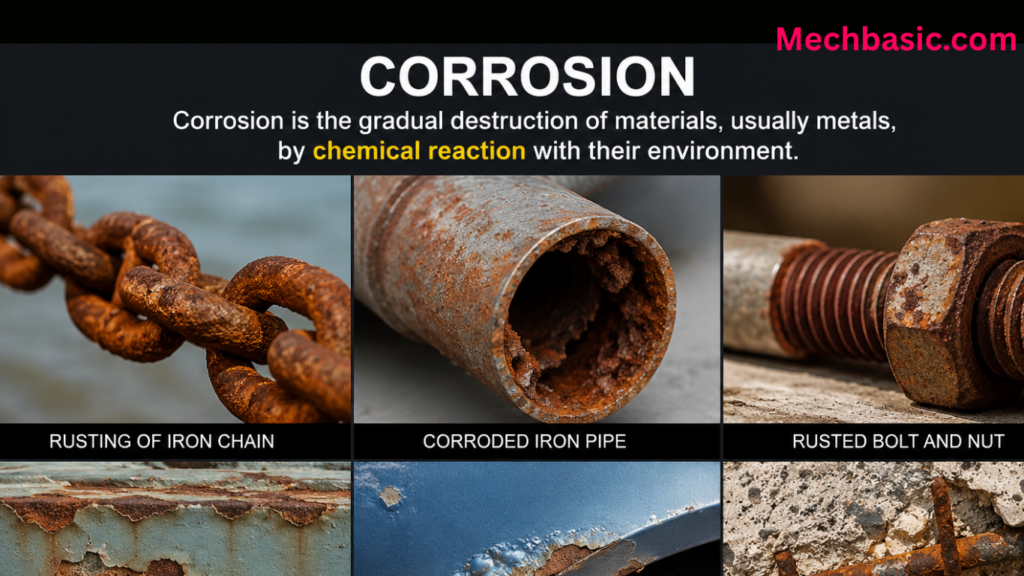
Corrosion is the gradual deterioration of a metal due to chemical reactions with its environment.
It can be caused by moisture, oxygen, chemicals, or salt exposure.
Corrosion weakens metals and reduces their strength, durability, and lifespan.
In this article:
- Corrosion
- Why Does Corrosion Occur?
- How Corrosion Occurs
- Types of Corrosion
- Factors Affecting Corrosion
- Corrosion Resistance of Common Metals
- Corrosion in Different Metals
- Effects of Corrosion
- Industrial Impact of Corrosion
- Corrosion Prevention Methods
- Corrosion Monitoring Techniques
- Corrosion vs Rust
- FAQ Section
- Conclusion
Corrosion
What is Corrosion?
Corrosion is the gradual deterioration or destruction of a material, usually a metal, due to chemical or electrochemical reactions with its environment.
corrosion is the process by which metals try to return to their natural, stable state (such as oxides, sulfides, or hydroxides).
Examples:
- Rusting of steel
- Green patina on copper
- White oxide on aluminum
- Tarnishing of silver
Definition
Corrosion can be defined as:
“The degradation of a material caused by interaction with its surrounding environment.”
It affects:
- Metals
- Alloys
- Concrete
- Polymers
- Ceramics (in certain environments)
Why Does Corrosion Occur?
Most metals are extracted from ores through energy-intensive processes.
Examples:
| Metal | Ore Form |
|---|---|
| Iron | Iron oxide |
| Aluminum | Bauxite |
| Copper | Copper sulfide |
After extraction, metals naturally tend to revert back to their lower-energy compound forms.
This tendency drives corrosion.
How Corrosion Occurs
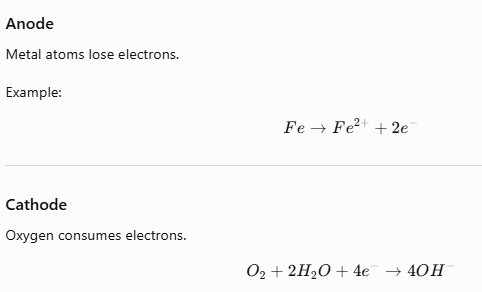
Electrochemical Process
Corrosion is usually an electrochemical reaction involving:
Result
Metal gradually deteriorates and corrosion products form.
Types of Corrosion
1. Uniform Corrosion
Most common type.
Characteristics
- Occurs evenly across the surface.
- Predictable metal loss.
Example
Rusting of an exposed steel plate.
Advantages
Easy to monitor and predict.
2. Pitting Corrosion
Localized attack producing small holes.
Characteristics
- Difficult to detect
- Can cause sudden failure
Common Materials
- Stainless steel
- Aluminum
Causes
- Chlorides
- Saltwater
3. Crevice Corrosion
Occurs in confined spaces.
Examples:
- Bolted joints
- Gaskets
- Flanges
Cause
Oxygen concentration differences.
4. Galvanic Corrosion
Occurs when two dissimilar metals are electrically connected.
Example
Copper connected directly to steel.
The less noble metal corrodes faster.
5. Intergranular Corrosion
Occurs along grain boundaries.
Common Materials
- Stainless steel
Cause
Improper heat treatment.
6. Stress Corrosion Cracking (SCC)
Combination of:
- Tensile stress
- Corrosive environment
Results in cracks.
7. Erosion Corrosion
Corrosion accelerated by moving fluids.
Examples
- Pumps
- Pipelines
- Turbines
8. Fretting Corrosion
Occurs due to repeated small vibrations between contacting surfaces.
Examples
- Bearings
- Fasteners
- Shafts
Factors Affecting Corrosion
1. Humidity
Higher humidity increases corrosion rate.
Above about 60–75% RH, steel corrosion accelerates significantly.
2. Temperature
Higher temperatures usually increase corrosion rates.
3. Oxygen Content
More oxygen generally increases corrosion.
4. Salt
Saltwater is highly corrosive.
Salt improves electrical conductivity.
5. pH
Acidic Solutions
Increase corrosion.
Alkaline Solutions
May reduce corrosion for some metals.
6. Material Type
Different metals have different corrosion resistance.
Corrosion Resistance of Common Metals
| Metal | Corrosion Resistance |
|---|---|
| Carbon Steel | Low |
| Cast Iron | Low |
| Copper | Moderate |
| Brass | Moderate |
| Aluminum | Good |
| Stainless Steel | Very Good |
| Titanium | Excellent |
Corrosion in Different Metals
Steel
Produces reddish-brown rust.
Copper
Produces green patina.
Aluminum
Produces white aluminum oxide.
Silver
Produces black tarnish.
Zinc
Produces white corrosion products.
Effects of Corrosion
Material Loss
Thickness decreases over time.
Reduced Strength
Components become weaker.
Increased Maintenance Costs
Repairs become necessary.
Equipment Failure
May lead to:
- Leakage
- Breakage
- Structural collapse
Safety Hazards
Examples:
- Bridge failures
- Pipeline leaks
- Pressure vessel failures
Industrial Impact of Corrosion
Corrosion costs industries billions of dollars every year through:
- Maintenance
- Replacement
- Production downtime
- Safety incidents
Industries heavily affected include:
- Oil and gas
- Marine
- Aerospace
- Automotive
- Manufacturing
- Construction
Corrosion Prevention Methods
1. Painting
Creates a barrier against moisture.
2. Galvanizing
Steel coated with zinc.
Benefits
- Long-lasting protection
- Sacrificial protection
3. Powder Coating
Provides durable surface protection.
4. Corrosion Inhibitors
Chemicals that reduce corrosion reactions.
5. Cathodic Protection
Uses sacrificial anodes.
Common metals:
- Zinc
- Magnesium
- Aluminum
6. Material Selection
Use corrosion-resistant materials such as:
- 304 Stainless Steel
- 316 Stainless Steel
- Titanium alloys
7. Humidity Control
Use:
- Dehumidifiers
- Air conditioning
- Climate-controlled storage
8. Proper Design
Avoid:
- Water traps
- Crevices
- Poor drainage
Corrosion Monitoring Techniques
Industries monitor corrosion using:
Visual Inspection
Simple and inexpensive.
Ultrasonic Thickness Testing
Measures wall thickness loss.
Corrosion Coupons
Small metal samples exposed to the environment.
Electrochemical Testing
Measures corrosion rates accurately.
Corrosion vs Rust
| Feature | Corrosion | Rust |
|---|---|---|
| Scope | Broad process | Specific type |
| Metals Affected | Many metals | Iron and steel only |
| Appearance | Various colors | Reddish-brown |
| Types | Many | One |
| Examples | Pitting, galvanic, crevice | Rusting |
All rust is corrosion, but not all corrosion is rust.
FAQ Section
What is corrosion?
Deterioration of a material due to chemical or electrochemical reaction with the environment.
What are the main causes?
- Moisture
- Oxygen
- Salts
- Chemicals
- Temperature
What is the most common type?
Uniform corrosion.
What is the most dangerous type?
Pitting corrosion, because it is localized and difficult to detect.
How can corrosion be prevented?
- Coatings
- Galvanizing
- Cathodic protection
- Corrosion-resistant materials
- Humidity control
Conclusion
Corrosion is the gradual destruction of metals and other materials caused by chemical or electrochemical reactions with their environment. It can occur in many forms, including uniform corrosion, pitting, galvanic corrosion, crevice corrosion, and stress corrosion cracking. Corrosion leads to material loss, reduced strength, equipment failure, and significant economic costs. Effective prevention methods include protective coatings, galvanizing, corrosion-resistant materials, cathodic protection, proper design, and environmental control. Understanding corrosion is essential in manufacturing, mechanical engineering, construction, aerospace, marine, and oil-and-gas industries.
Other courses:





