
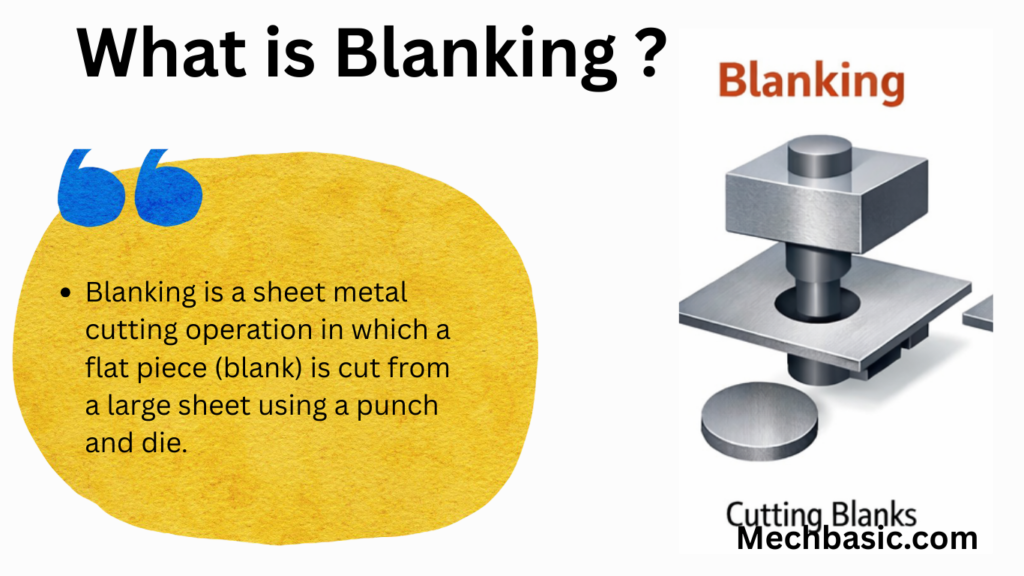
Blanking is a sheet metal cutting operation in which a flat piece (called the blank) is punched out from a metal sheet.
The blanked piece is the required product, and the remaining sheet is scrap.
It is commonly performed using a punch and die in press machines.
In this article:
Blanking in Sheet Metal
What is Blanking?
Blanking is a sheet metal cutting operation in which a flat piece (blank) is cut from a large sheet using a punch and die.
👉 The cut-out piece (blank) is the required product
👉 The remaining sheet is scrap
Working Principle
- The sheet is placed over the die.
- The punch moves downward.
- Shear stress develops.
- The material fractures.
- The blank falls through the die opening.
Main Components
1️⃣ Punch
- Moving tool
- Size equals required blank size
2️⃣ Die
- Fixed tool
- Opening slightly larger than punch (clearance provided)
3️⃣ Sheet Metal
- Material being cut
4️⃣ Press Machine
- Mechanical or hydraulic
Clearance in Blanking
Clearance = Gap between punch and die
Typical clearance:
5–10% of sheet thickness
Effects:
- Too small → High force, tool wear
- Too large → Burr, rough edges
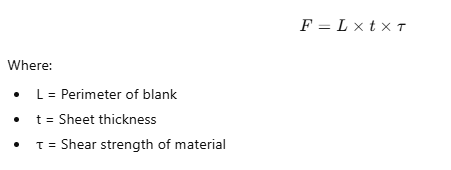
Blanking Force Formula
Example
If:
- Circular blank diameter = 50 mm
- Thickness = 2 mm
- Shear strength = 300 MPa
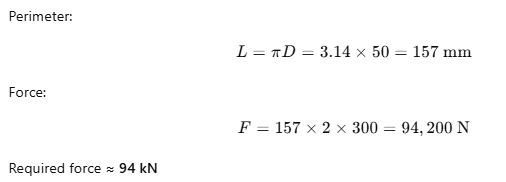
Required force ≈ 94 kN
Types of Blanking
1. Simple Blanking
Single cut operation.
2. Progressive Blanking
Multiple operations in stages.
3. Compound Blanking
More than one cutting operation in one stroke.
Blanking vs Punching
| Feature | Blanking | Punching |
|---|---|---|
| Product | Cut piece (blank) | Sheet with hole |
| Scrap | Remaining sheet | Removed piece |
| Punch Size | Equal to blank size | Smaller than hole size |
Advantages
✔ High production rate
✔ Accurate dimensions
✔ Suitable for mass production
✔ Economical
Disadvantages
✖ Tool wear
✖ Burr formation
✖ Noise
Applications
- Coin manufacturing
- Washers
- Electrical laminations
- Automotive components
- Gaskets
Summary
- Blanking is a shearing operation.
- The blank is the finished product.
- Clearance is given on the die side.
- Force depends on perimeter, thickness, and shear strength.
Other courses:





