
BIS (Bureau of Indian Standards) is the national standards body of India.
It develops and maintains standards to ensure product quality, safety, and reliability.
BIS certification helps protect consumers and promotes consistency in products and services.
In this article:
- BIS Standards (Bureau of Indian Standards)
- Objectives of BIS
- Functions of BIS
- What are BIS Standards?
- Structure of BIS Standards
- Types of BIS Standards
- Important BIS Standards for Engineers
- BIS Standards in Mechanical Engineering
- BIS Standards in Civil Engineering
- BIS Standards in Electrical Engineering
- BIS Certification (ISI Mark)
- BIS Hallmarking
- Benefits of BIS Standards
- BIS and ISO
- Importance of BIS Standards in Engineering Drawing
- Advantages of BIS Standards
- Common Interview Questions
- Conclusion
BIS Standards (Bureau of Indian Standards)
Introduction
BIS (Bureau of Indian Standards) is the National Standards Body of India responsible for developing, maintaining, and promoting standards for products, services, systems, and processes.
BIS ensures that products manufactured and sold in India meet specified requirements for:
- Quality
- Safety
- Reliability
- Performance
- Efficiency
BIS operates under the Bureau of Indian Standards Act, 2016 and functions under the Ministry of Consumer Affairs, Food and Public Distribution, Government of India.
What is BIS?
Definition
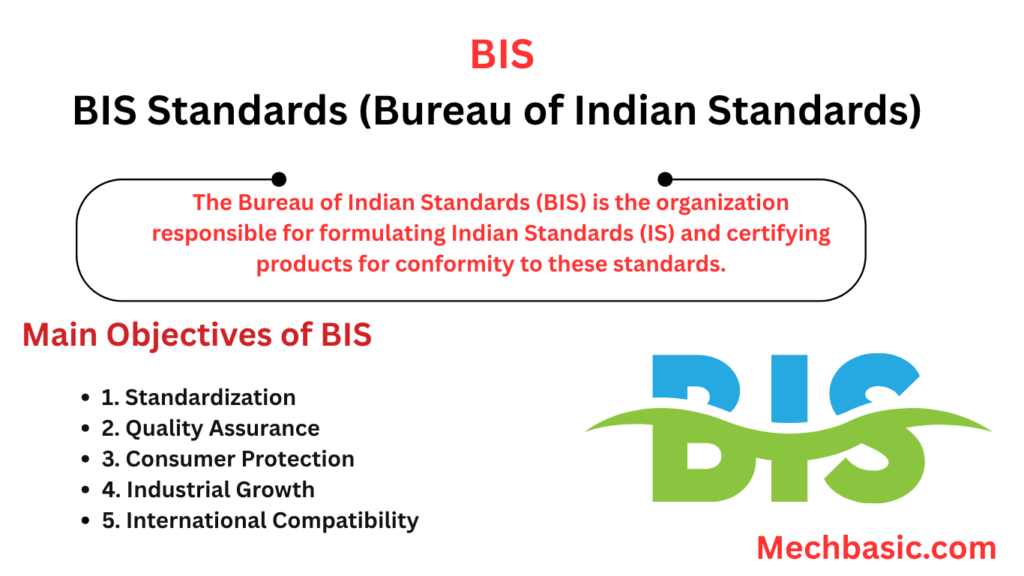
The Bureau of Indian Standards (BIS) is the organization responsible for formulating Indian Standards (IS) and certifying products for conformity to these standards.
Established
- Original organization: Indian Standards Institution (ISI) (1947)
- Renamed as BIS in 1986
Objectives of BIS
1. Standardization
Develop uniform standards for products and services.
2. Quality Assurance
Ensure consistent quality.
3. Consumer Protection
Protect consumers from unsafe products.
4. Industrial Growth
Promote manufacturing excellence.
5. International Compatibility
Align Indian standards with international standards wherever possible.
Functions of BIS
Standard Formulation
Develops Indian Standards (IS).
Example:
IS 2062Structural steel specification.
Product Certification
Provides the famous ISI Mark certification.
Example:
Electrical appliances, cement, steel products.
Hallmarking
Certifies purity of gold and silver jewelry.
Example:
22K BIS Hallmarked Gold.
Laboratory Testing
Tests products for compliance with standards.
Consumer Affairs
Handles complaints regarding certified products.
Training and Education
Provides quality management and standardization training.
What are BIS Standards?
BIS standards are official specifications that define:
- Dimensions
- Materials
- Testing methods
- Performance requirements
- Safety requirements
- Quality criteria
Each standard is assigned an IS Number.
Example:
IS 800General Construction in Steel.
Structure of BIS Standards
A standard typically contains:
Scope
What the standard covers.
Terminology
Definitions of terms.
Material Requirements
Accepted materials.
Dimensions
Size specifications.
Testing Methods
How products are tested.
Inspection Procedures
Quality verification methods.
Acceptance Criteria
Pass/fail requirements.
Types of BIS Standards
1. Product Standards
Define requirements for products.
Examples
- Cement
- Steel
- Electrical equipment
2. Process Standards
Define manufacturing procedures.
Example
Welding processes.
3. Testing Standards
Specify testing methods.
Example
Material testing procedures.
4. Safety Standards
Ensure product safety.
Example
Electrical safety standards.
5. Quality Management Standards
Support quality systems.
Example
ISO-based standards adopted by BIS.
Important BIS Standards for Engineers
IS 2062
Structural Steel
Used for:
- Buildings
- Bridges
- Industrial structures
Specifies:
- Chemical composition
- Mechanical properties
- Testing requirements
IS 800
General Construction in Steel
Provides guidelines for:
- Steel structure design
- Load calculations
- Connections
Widely used by structural engineers.
IS 456
Plain and Reinforced Concrete
One of the most important civil engineering standards.
Covers:
- Concrete design
- Reinforcement requirements
- Durability
IS 875
Design Loads for Buildings
Specifies:
- Dead loads
- Live loads
- Wind loads
Used in structural design.
IS 1893
Earthquake Resistant Design
Provides seismic design criteria.
Used in earthquake-prone regions.
IS 1786
Reinforcement Steel Bars
Specifies:
- Fe415
- Fe500
- Fe550
- Fe600
Reinforcement grades.
IS 1079
Mild Steel Sheets
Used in fabrication and manufacturing.
IS 1367
Fasteners
Specifications for:
- Bolts
- Nuts
- Washers
IS 210
Grey Cast Iron Castings
Defines casting requirements.
IS 808
Steel Sections
Dimensions of:
- Channels
- Beams
- Angles
Used in structural engineering.
BIS Standards in Mechanical Engineering
Mechanical engineers commonly use:
| Standard | Purpose |
|---|---|
| IS 210 | Cast iron castings |
| IS 2062 | Structural steel |
| IS 1367 | Fasteners |
| IS 919 | Rivets |
| IS 808 | Steel sections |
| IS 1570 | Steel grades |
Applications:
- Machine design
- Fabrication
- Manufacturing
- Quality control
BIS Standards in Civil Engineering
Common standards include:
| Standard | Purpose |
|---|---|
| IS 456 | RCC design |
| IS 875 | Design loads |
| IS 1893 | Earthquake design |
| IS 1786 | Reinforcement steel |
| IS 383 | Aggregates |
Applications:
- Buildings
- Bridges
- Roads
- Infrastructure
BIS Standards in Electrical Engineering
Examples:
| Standard | Purpose |
|---|---|
| IS 732 | Electrical wiring |
| IS 3043 | Earthing |
| IS 694 | Electrical cables |
| IS 13779 | Energy meters |
Applications:
- Electrical installations
- Power systems
- Industrial wiring
BIS Certification (ISI Mark)
What is ISI Mark?
The ISI Mark indicates that a product conforms to Indian Standards.
Example products:
- Cement
- LPG cylinders
- Electrical switches
- Water heaters
Benefits
For Consumers
- Quality assurance
- Safety assurance
For Manufacturers
- Market credibility
- Regulatory compliance
BIS Hallmarking
BIS certifies precious metals.
Gold Hallmark
Indicates:
- Purity
- Assaying center
- BIS registration
Common Purities
| Purity | Karat |
|---|---|
| 91.6% | 22K |
| 75.0% | 18K |
| 58.5% | 14K |
Benefits of BIS Standards
1. Product Quality
Ensures consistent quality.
2. Consumer Safety
Reduces accidents and failures.
3. Interchangeability
Components fit correctly.
Example:
Standard bolts and nuts.
4. Industrial Efficiency
Reduces manufacturing variability.
5. International Trade
Facilitates exports.
6. Legal Compliance
Many products require mandatory BIS certification.
BIS and ISO
Many BIS standards are harmonized with standards from:
- ISO
- IEC
Example:
Indian standards may adopt ISO requirements with modifications suitable for Indian conditions.
Importance of BIS Standards in Engineering Drawing
Engineering drawings often reference BIS standards for:
Material Selection
Example:
Material: IS 2062 E250 SteelFasteners
Example:
Bolt: M12 as per IS 1367Welding
Standard welding practices.
Structural Sections
Standard beam dimensions.
Advantages of BIS Standards
- Improved quality
- Increased safety
- Standardized products
- Better reliability
- Easier maintenance
- Consumer protection
- International competitiveness
- Reduced production errors
Common Interview Questions
What does BIS stand for?
Bureau of Indian Standards.
What is the role of BIS?
To formulate standards, certify products, ensure quality, and protect consumers.
What is the ISI Mark?
A certification mark indicating compliance with BIS standards.
Which BIS standard is used for RCC design?
IS 456
Which BIS standard is used for structural steel design?
IS 800
Why are BIS standards important?
They ensure product quality, safety, reliability, standardization, and regulatory compliance.
Conclusion
The Bureau of Indian Standards (BIS) is India’s national standards organization responsible for developing and maintaining Indian Standards (IS). BIS standards provide guidelines for design, manufacturing, testing, safety, quality control, and inspection across industries such as mechanical, civil, electrical, and manufacturing engineering. By ensuring uniformity, safety, and quality, BIS standards play a critical role in engineering, industrial development, consumer protection, and international trade.
Other courses:





