
Additive manufacturing is a process of creating objects by adding material layer by layer from a digital model.
It is commonly known as 3D printing and is used to make complex and customized parts.
It reduces material waste and allows rapid prototyping in industries like aerospace and healthcare.
In this article:
- Additive Manufacturing (AM)
- Definition
- Basic Principle
- Steps in Additive Manufacturing
- Types of Additive Manufacturing Processes
- Materials Used in Additive Manufacturing
- Advantages of Additive Manufacturing
- Disadvantages of Additive Manufacturing
- Applications of Additive Manufacturing
- Additive Manufacturing vs Traditional Manufacturing
- Summary:
- Conclusion:
Additive Manufacturing (AM)
Additive Manufacturing (AM) is a modern manufacturing process in which a product is made by adding material layer by layer from a digital model, instead of removing material (like machining) or shaping it in bulk (like casting/forging).
👉 It is commonly known as 3D Printing.
Definition
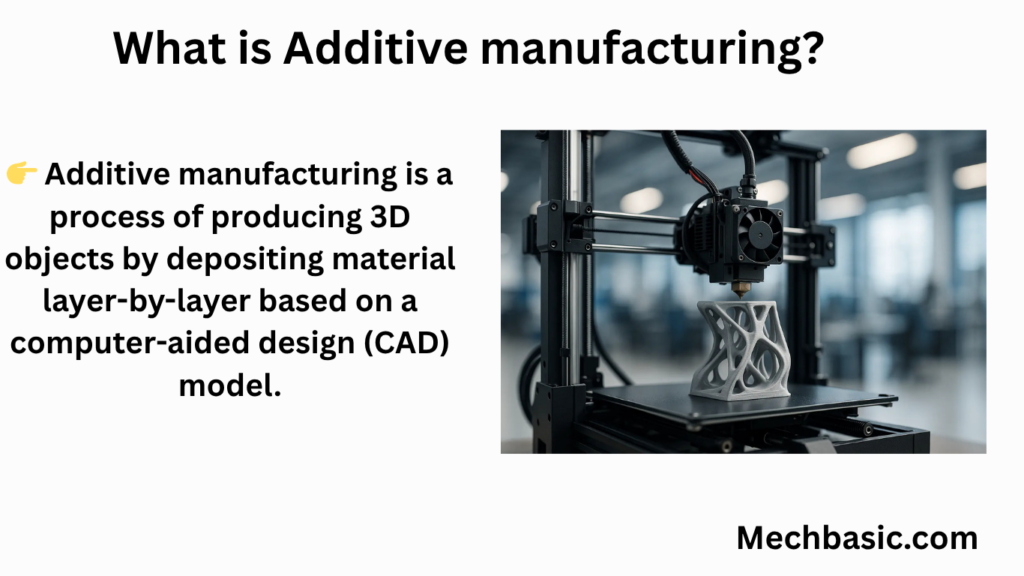
Additive manufacturing is a process of producing 3D objects by depositing material layer-by-layer based on a computer-aided design (CAD) model.
Basic Principle
- A 3D CAD model is created
- The model is sliced into thin layers
- Material is added one layer at a time
- Layers fuse together to form a solid part
Steps in Additive Manufacturing
1. CAD Design
- 3D model is created using software (SolidWorks, CATIA, etc.)
2. Slicing
- Model is divided into thin horizontal layers
- Each layer acts as a print path
3. Layer Deposition
- Material is added layer by layer using:
- Laser
- Nozzle
- Electron beam
4. Fusion / Solidification
- Layers are fused by:
- Heat
- Laser energy
- Chemical bonding
5. Post Processing
- Cleaning, polishing, heat treatment, etc.
Types of Additive Manufacturing Processes
1. Powder Bed Fusion (PBF)
How it works
- Powder layer spread
- Laser melts selected areas
Materials
- Metals (steel, titanium, aluminium)
2. Fused Deposition Modeling (FDM)
How it works
- Thermoplastic filament melted and extruded
Materials
- PLA, ABS plastics
3. Selective Laser Sintering (SLS)
How it works
- Laser sinters powder particles together
4. Material Jetting
- Liquid droplets deposited and cured
5. Binder Jetting
- Binder sprayed onto powder to form shape
6. Directed Energy Deposition (DED)
- Material is fed and melted using laser or electron beam
👉 “Layer-by-layer material addition instead of removal”
Materials Used in Additive Manufacturing
- Metals: Titanium, steel, aluminium
- Polymers: PLA, ABS, Nylon
- Ceramics: Alumina, zirconia
- Composites: Metal-matrix and polymer composites
Advantages of Additive Manufacturing
1. Complex Shapes Possible
- Internal channels and intricate designs
2. Minimal Material Waste
- Only required material is used
3. Customization
- Easy to make personalized products
4. Lightweight Structures
- Used in aerospace for weight reduction
5. Fast Prototyping
- Rapid design-to-product time
Disadvantages of Additive Manufacturing
1. High Machine Cost
- Expensive industrial printers
2. Slow for Mass Production
- Not suitable for large-scale manufacturing
3. Limited Material Options
- Not all metals/plastics can be used
4. Surface Finish Issues
- Requires post-processing
5. Lower Strength in Some Cases
- Layer bonding may be weaker than forged parts
Applications of Additive Manufacturing
Aerospace
- Lightweight engine parts
- Fuel nozzles
Medical
- Bone implants
- Dental crowns
- Prosthetics
Automotive
- Prototypes
- Custom parts
Industrial
- Tooling
- Spare parts
Education & Research
- Models and prototypes
Additive Manufacturing vs Traditional Manufacturing
| Feature | Additive Manufacturing | Traditional |
|---|---|---|
| Material usage | Very efficient | Wasteful |
| Shape complexity | Very high | Limited |
| Speed (mass production) | Slow | Fast |
| Cost (low volume) | Low | High |
Summary:
👉 Additive manufacturing is revolutionizing production by:
- Moving from “subtractive shaping” → “layer-by-layer building”
- Enabling custom, complex, and lightweight designs
Conclusion:
Additive manufacturing is a process of producing components by adding material layer by layer from a CAD model. It includes processes like powder bed fusion, FDM, and binder jetting and is used for complex, lightweight, and customized parts.
Other courses:





