
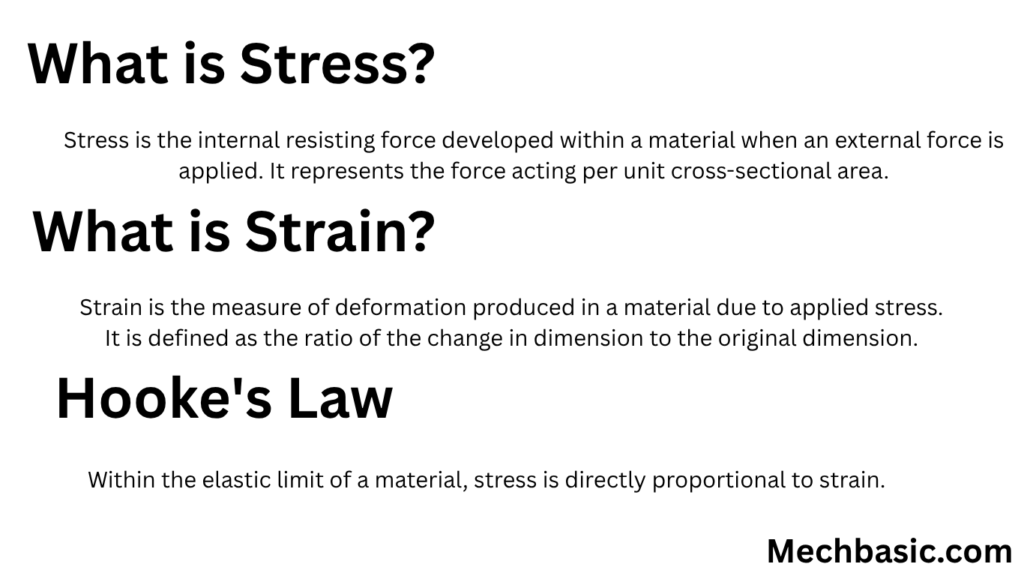
Stress is the force acting per unit area, while strain is the deformation produced due to stress.
Hooke’s Law states that, within the elastic limit, stress is directly proportional to strain.
This principle is widely used in the design and analysis of engineering materials and structures.
In this article:
- Understanding Stress and Strain: Hooke's Law
- What is Stress?
- Types of Stress
- What is Strain?
- Types of Strain
- Relationship Between Stress and Strain
- Hooke's Law
- Elastic Limit
- Young's Modulus (Modulus of Elasticity)
- Stress-Strain Curve
- Factors Affecting Stress and Strain
- Engineering Applications
- Practical Examples
- Advantages of Hooke's Law
- Limitations of Hooke's Law
- Comparison of Stress and Strain
- Summary Table
- Frequently Asked Questions (FAQs)
- Conclusion
Understanding Stress and Strain: Hooke’s Law
Introduction
Stress, strain, and Hooke’s Law are fundamental concepts in mechanical engineering, civil engineering, materials science, and structural engineering. These concepts help engineers understand how materials behave when subjected to external forces or loads. By studying stress and strain, engineers can design structures and machine components that are safe, durable, and efficient.
Hooke’s Law describes the relationship between stress and strain within the elastic limit of a material. It states that the deformation of a material is directly proportional to the applied load, provided the material does not exceed its elastic limit.
This guide explains stress, strain, Hooke’s Law, their types, formulas, stress-strain behavior, engineering applications, and practical examples.
What is Stress?
Definition
Stress is the internal resisting force developed within a material when an external force is applied. It represents the force acting per unit cross-sectional area.
Stress is denoted by the Greek letter σ (sigma).
Formula
Where:
σ = F/ A
- σ = Stress (Pa or N/m²)
- F = Applied force (N)
- A = Cross-sectional area (m²)
SI Unit
- Pascal (Pa)
- 1 MPa = 10⁶ Pa
- 1 GPa = 10⁹ Pa
Types of Stress
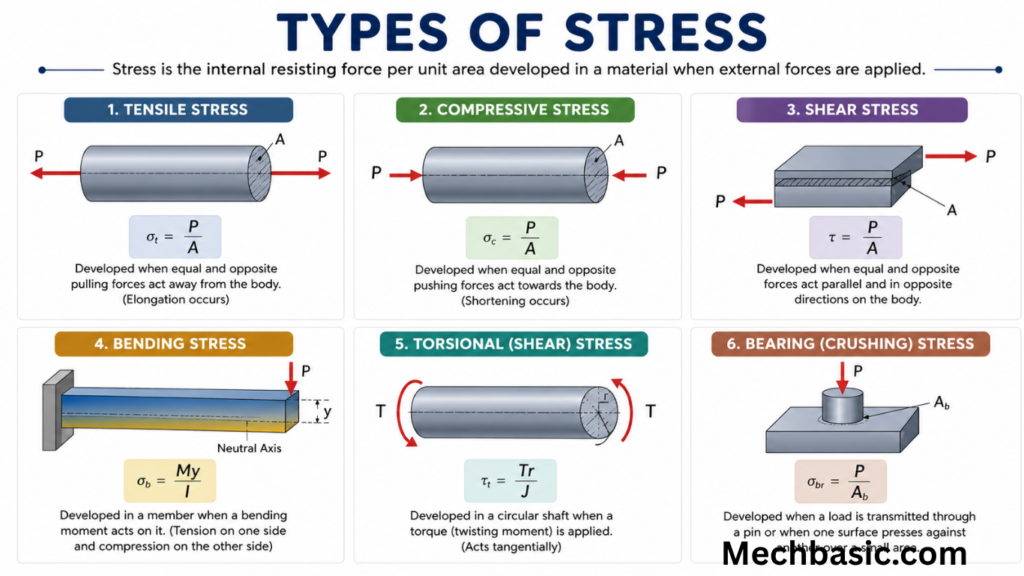
1. Tensile Stress
Occurs when forces pull a material apart, causing it to elongate.
Examples:
- Steel cables in suspension bridges
- Crane lifting cables
2. Compressive Stress
Occurs when forces push a material together, causing it to shorten.
Examples:
- Building columns
- Concrete pillars
3. Shear Stress
Occurs when forces act parallel to a material’s surface, tending to cause adjacent layers to slide past one another.
Examples:
- Rivets
- Bolts
- Scissors cutting paper
4. Bending Stress
Develops when a beam or structural member is subjected to bending loads.
Examples:
- Bridge beams
- Cantilever structures
5. Torsional Stress
Occurs when a shaft or rod experiences twisting due to torque.
Examples:
- Drive shafts
- Screwdrivers
- Transmission shafts
What is Strain?
Definition
Strain is the measure of deformation produced in a material due to applied stress. It is defined as the ratio of the change in dimension to the original dimension.
Strain is represented by ε (epsilon).
Formula
ε =ΔL/L
Where:
- ε = Strain (dimensionless)
- ΔL = Change in length
- L = Original length
Since strain is a ratio of two lengths, it has no unit.
Types of Strain
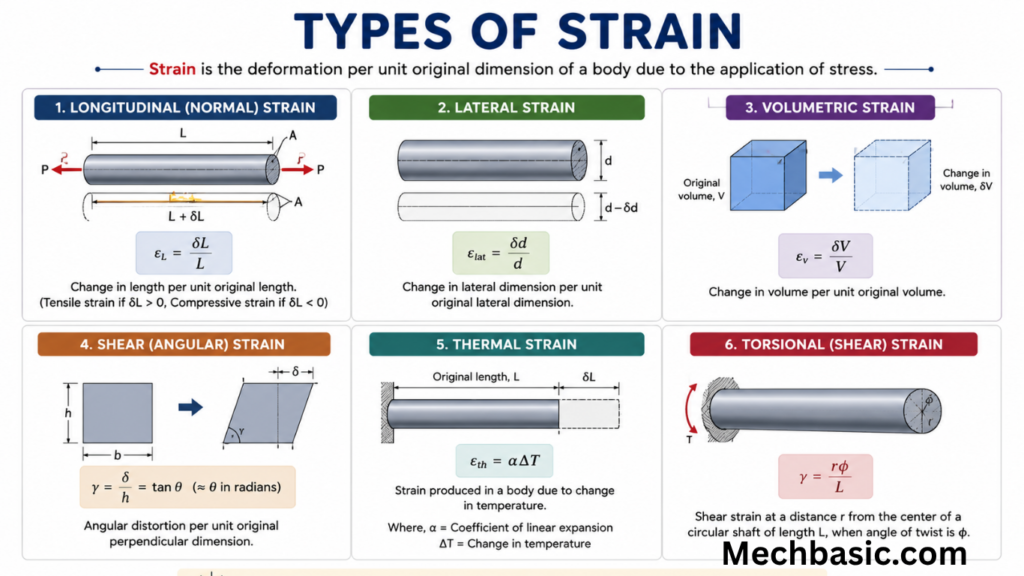
1. Tensile Strain
Occurs when a material elongates due to tensile stress.
2. Compressive Strain
Occurs when a material shortens due to compressive stress.
3. Shear Strain
Represents angular deformation caused by shear stress.
4. Volumetric Strain
Measures the change in volume relative to the original volume.
Relationship Between Stress and Strain
Within the elastic region, stress and strain are directly proportional.
This linear relationship forms the basis of Hooke’s Law.
Hooke’s Law
Definition
Hooke’s Law states:
Within the elastic limit of a material, stress is directly proportional to strain.
This means that if the applied load is doubled (while remaining within the elastic limit), the resulting deformation also doubles.
The relationship is expressed as:
F = −kx
Where:
- F is the restoring force exerted by the spring (in newtons, N),
- k is the spring constant (in N/m),
- x is the displacement from the equilibrium position (in meters),
- The negative sign indicates that the force is restorative, directed opposite to the displacement.
For engineering materials:
σ=Eε
Where:
- σ = Stress
- ε = Strain
- E = Young’s Modulus (Modulus of Elasticity)
Also Read : Hooke’s law in detail
Elastic Limit
The elastic limit is the maximum stress that a material can withstand without suffering permanent deformation.
- Below the elastic limit: the material returns to its original shape after the load is removed.
- Above the elastic limit: permanent (plastic) deformation occurs.
Young’s Modulus (Modulus of Elasticity)
Definition
Young’s Modulus is the ratio of stress to strain within the elastic region.
Formula
Young’s modulus = normal stress / axial strain
Where:
- E is the young’s modulus
- σ is the normal stress (F / A)
- ε is the longitudinal strain (ΔL / Lo)
SI Unit
- Pascal (Pa)
- MPa
- GPa
Significance
- Higher Young’s Modulus → Stiffer material
- Lower Young’s Modulus → More flexible material
Stress-Strain Curve
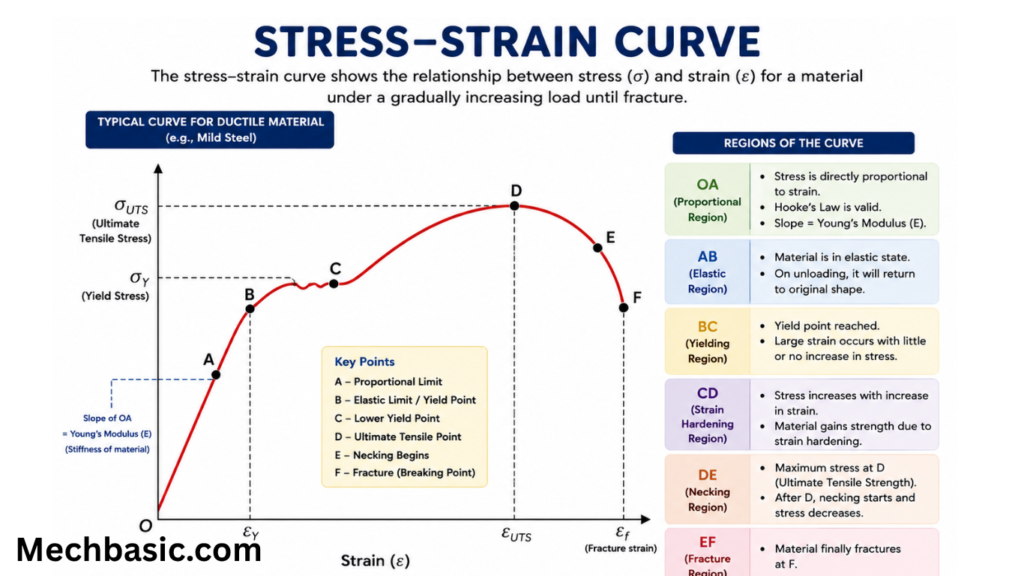
The stress-strain curve illustrates how a material behaves under increasing load.
Regions of the Curve
1. Proportional Limit
Stress is directly proportional to strain, and Hooke’s Law is valid.
2. Elastic Region
The material returns to its original shape when the load is removed.
3. Yield Point
Permanent deformation begins.
4. Plastic Region
Large deformation occurs with relatively small increases in stress.
5. Ultimate Tensile Strength (UTS)
The maximum stress the material can withstand.
6. Fracture Point
The material breaks or fails.
Factors Affecting Stress and Strain
Several factors influence material behavior:
- Material type
- Temperature
- Cross-sectional area
- Magnitude of applied load
- Loading rate
- Manufacturing process
- Material defects
- Environmental conditions
Engineering Applications
Stress, strain, and Hooke’s Law are essential in many engineering fields.
Mechanical Engineering
- Machine design
- Shaft design
- Spring design
- Pressure vessels
Civil Engineering
- Bridges
- Buildings
- Columns
- Beams
- Foundations
Aerospace Engineering
- Aircraft wings
- Fuselage structures
- Landing gear
- Spacecraft components
Automotive Engineering
- Suspension systems
- Chassis design
- Brake components
- Engine parts
Biomedical Engineering
- Artificial joints
- Bone implants
- Prosthetic devices
Practical Examples
Example 1: Steel Rod Under Tension
A steel rod supporting a suspended load experiences tensile stress and elongates slightly. If the stress remains below the elastic limit, the rod returns to its original length after the load is removed.
Example 2: Bridge Beam
A bridge beam bends under traffic loads, developing tensile stress on one side and compressive stress on the other.
Example 3: Compression Column
A concrete column in a building carries compressive stress due to the weight of the structure above it.
Example 4: Helical Spring
A spring in a vehicle suspension compresses under load and returns to its original length after the load is removed, demonstrating Hooke’s Law within its elastic range.
Advantages of Hooke’s Law
- Simple and easy to apply.
- Predicts elastic deformation accurately.
- Forms the basis of structural analysis.
- Essential for spring design.
- Widely used in engineering calculations.
Limitations of Hooke’s Law
- Valid only within the elastic limit.
- Not applicable after yielding.
- Does not accurately describe materials such as rubber or plastics over large deformations.
- Does not account for creep, fatigue, or temperature-dependent behavior.
Comparison of Stress and Strain
| Feature | Stress | Strain |
|---|---|---|
| Definition | Internal force per unit area | Deformation per unit original length |
| Symbol | σ | ε |
| Formula | F/A | ΔL/L |
| SI Unit | Pascal (Pa) | Dimensionless |
| Represents | Internal resistance | Amount of deformation |
Summary Table
| Concept | Description |
|---|---|
| Stress | Internal resisting force per unit area |
| Strain | Relative deformation caused by stress |
| Hooke’s Law | Stress is proportional to strain within the elastic limit |
| Young’s Modulus | Measure of material stiffness |
| Elastic Limit | Maximum stress before permanent deformation |
| Yield Point | Beginning of plastic deformation |
| Ultimate Tensile Strength | Maximum stress before failure |
| Fracture Point | Final failure of the material |
Frequently Asked Questions (FAQs)
1. What is stress?
Stress is the internal resisting force developed within a material per unit cross-sectional area when an external force is applied.
2. What is strain?
Strain is the ratio of the change in dimension to the original dimension of a material caused by applied stress. It is a dimensionless quantity.
3. What does Hooke’s Law state?
Hooke’s Law states that within the elastic limit, stress is directly proportional to strain. This relationship is expressed as:
Stress = Young’s Modulus × Strain
4. What is the elastic limit?
The elastic limit is the maximum stress a material can withstand and still return to its original shape after the load is removed.
5. What is Young’s Modulus?
Young’s Modulus is a measure of a material’s stiffness and is defined as the ratio of stress to strain in the elastic region.
6. What is the difference between stress and strain?
Stress measures the internal force acting per unit area, while strain measures the resulting deformation relative to the original dimension.
7. Why is Hooke’s Law important in engineering?
It allows engineers to predict how materials deform under load, ensuring the safe design of structures, machines, springs, and mechanical components.
8. Does Hooke’s Law apply to all materials?
No. Hooke’s Law is valid only for materials that behave elastically within their elastic limit. Beyond this range, many materials exhibit plastic or nonlinear behavior.
9. What happens after the yield point?
After the yield point, the material undergoes permanent (plastic) deformation and does not completely recover its original shape when the load is removed.
10. Where are stress and strain concepts used?
They are used extensively in mechanical, civil, aerospace, automotive, and biomedical engineering for designing safe and reliable components and structures.
Conclusion
Stress, strain, and Hooke’s Law are fundamental concepts in engineering mechanics and materials science. Stress describes the internal resistance developed within a material under load, while strain measures the resulting deformation. Hooke’s Law establishes a linear relationship between stress and strain within the elastic limit, forming the basis for analyzing and designing engineering structures and mechanical components. Understanding these principles enables engineers to select appropriate materials, predict structural behavior, and ensure the safety, durability, and performance of products ranging from buildings and bridges to aircraft, vehicles, and industrial machinery.
Other courses:





