
Sheet metal fabrication involves cutting, bending, and shaping thin metal sheets into useful components.
Common cutting methods include shearing, laser cutting, and plasma cutting, while bending is done using press brakes.
These processes are widely used in the automotive, aerospace, construction, and manufacturing industries.
In this article:
- Sheet Metal Fabrication: Bending and Cutting Processes
- What is Sheet Metal Fabrication?
- Common Sheet Metal Materials
- Typical Sheet Metal Thickness
- Basic Sheet Metal Fabrication Process
- Sheet Metal Cutting Processes
- 1. Shearing
- 2. Laser Cutting
- 3. Plasma Cutting
- 4. Waterjet Cutting
- 5. Punching
- 6. CNC Turret Punching
- Sheet Metal Bending
- Basic Principles of Bending
- Common Bending Processes
- 1. V-Bending
- 2. U-Bending
- 3. Edge Bending
- 4. Roll Bending
- 5. Rotary Bending
- Important Bending Parameters
- Common Sheet Metal Forming Operations
- Design Guidelines for Sheet Metal Parts
- Common Defects in Sheet Metal Fabrication
- Surface Finishing
- Applications of Sheet Metal Fabrication
- Advantages of Sheet Metal Fabrication
- Limitations
- Summary Table
- Frequently Asked Questions (FAQs)
- Conclusion
Sheet Metal Fabrication: Bending and Cutting Processes
Introduction
Sheet metal fabrication is a manufacturing process used to convert flat metal sheets into functional components through operations such as cutting, bending, forming, punching, and joining. It is one of the most versatile and cost-effective manufacturing methods, producing parts with high strength, precision, and repeatability.
Sheet metal fabrication is widely used in industries such as automotive, aerospace, construction, electronics, HVAC, appliances, medical equipment, renewable energy, and industrial machinery. Products ranging from automobile body panels and aircraft fuselages to electrical enclosures and kitchen appliances are manufactured using sheet metal fabrication techniques.
Among the various fabrication operations, cutting and bending are the two most fundamental processes. Cutting creates the desired flat pattern, while bending transforms it into a three-dimensional component.
This guide explains sheet metal fabrication in detail, focusing on bending and cutting processes, equipment, materials, design considerations, and industrial applications.
What is Sheet Metal Fabrication?
Definition
Sheet metal fabrication is the process of manufacturing parts by cutting, bending, forming, and assembling thin metal sheets into finished products.
Unlike casting or machining, sheet metal fabrication primarily reshapes flat sheets without significantly changing their thickness.
Common Sheet Metal Materials
Various metals are used depending on strength, corrosion resistance, weight, and cost.
Steel
- Carbon steel
- Mild steel
- High-strength steel
Applications
- Structural components
- Machine parts
- Automotive frames
Stainless Steel
- Excellent corrosion resistance
- High strength
- Attractive surface finish
Applications
- Food processing equipment
- Medical devices
- Chemical processing
Aluminum
- Lightweight
- Corrosion resistant
- Easily formed
Applications
- Aerospace
- Automotive
- Electronics
- Consumer products
Copper
- Excellent electrical conductivity
- High thermal conductivity
Applications
- Electrical components
- Heat exchangers
Brass
- Decorative appearance
- Good machinability
Applications
- Plumbing
- Decorative hardware
- Musical instruments
Also Read: 6 Most Common Sheetmetal Materials.
Typical Sheet Metal Thickness
Sheet metal thickness is commonly specified using gauge or millimeters.
Examples:
- Thin sheet: 0.5–1 mm
- Medium sheet: 1–3 mm
- Heavy sheet: 3–6 mm
- Plate: Above 6 mm
Basic Sheet Metal Fabrication Process
The manufacturing sequence generally includes:
- CAD design
- Material selection
- Cutting
- Bending
- Forming
- Joining
- Surface finishing
- Inspection
Sheet Metal Cutting Processes
Cutting separates material into the required shape or size.
1. Shearing
Process
A straight blade cuts the sheet using compressive force.
Advantages
- Fast operation
- Low cost
- Clean straight edges
- High productivity
Limitations
- Only straight cuts
- Limited design flexibility
Applications
- Cutting rectangular blanks
- Preparing stock material
2. Laser Cutting
Process
A high-powered laser beam melts or vaporizes material.
Advantages
- Extremely accurate
- Narrow cutting width
- Minimal distortion
- Suitable for intricate profiles
Limitations
- High equipment cost
- Slower on thick materials
Applications
- Precision sheet metal parts
- Electronic enclosures
- Decorative panels
- Aerospace components
3. Plasma Cutting
Process
Uses a high-temperature plasma jet to cut electrically conductive metals.
Advantages
- Fast cutting speed
- Cuts thick materials
- Lower cost than laser cutting
Limitations
- Rougher edge finish
- Lower dimensional accuracy
Applications
- Structural steel
- Shipbuilding
- Heavy equipment
4. Waterjet Cutting
Process
A high-pressure stream of water, often mixed with abrasive particles, cuts the material.
Advantages
- No heat-affected zone
- Cuts almost any material
- Excellent edge quality
Limitations
- Slower cutting speed
- Higher operating cost
Applications
- Aerospace
- Titanium components
- Composite materials
5. Punching
Process
A punch forces material through a die to create holes or cutouts.
Advantages
- Very fast
- High repeatability
- Suitable for mass production
Limitations
- Requires dedicated tooling
- Limited shape flexibility
Applications
- Ventilation holes
- Mounting holes
- Electrical panels
6. CNC Turret Punching
A computer-controlled punch press automatically selects different tools for multiple operations.
Advantages
- High productivity
- Automatic tool changes
- Complex hole patterns
Applications
- Electrical cabinets
- HVAC components
- Industrial enclosures
Sheet Metal Bending
Definition
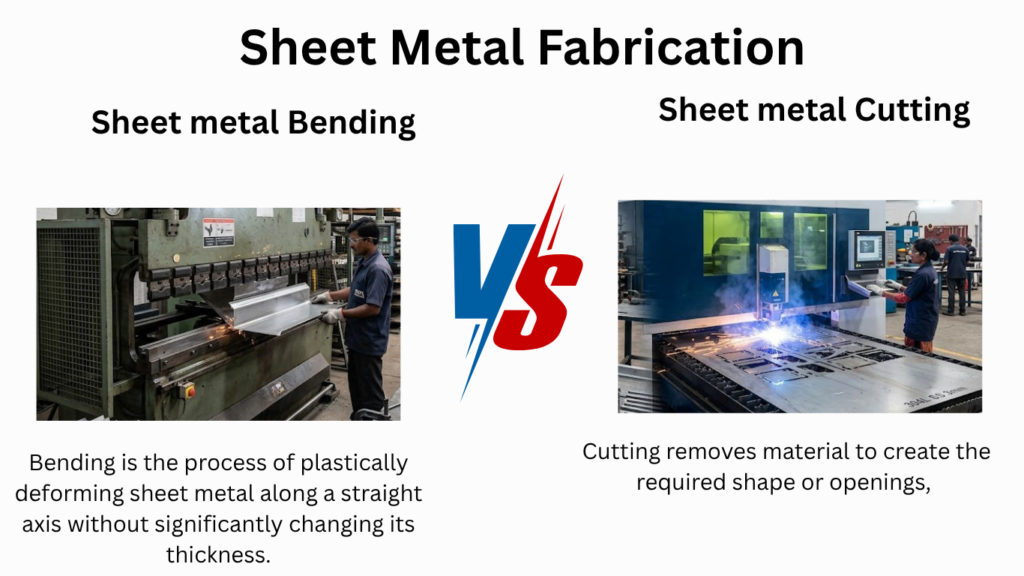
Bending is the process of plastically deforming sheet metal along a straight axis without significantly changing its thickness.
The inside surface undergoes compression, while the outside surface experiences tension.
Basic Principles of Bending
During bending:
- Inner fibers compress.
- Outer fibers stretch.
- A neutral axis experiences no change in length.
Understanding these principles helps engineers calculate bend allowances and finished dimensions accurately.
Common Bending Processes
1. V-Bending
The most common bending process.
The punch forces the sheet into a V-shaped die.
Advantages
- Simple
- Versatile
- Economical
Applications
- General fabrication
- Brackets
- Enclosures
2. U-Bending
Uses a U-shaped die to create channel sections.
Applications
- Structural channels
- Frames
- Supports
3. Edge Bending
Bends only the edge of a sheet.
Applications
- Flanges
- Reinforcement edges
4. Roll Bending
Uses multiple rollers to produce large-radius bends.
Applications
- Cylinders
- Pipes
- Tanks
- Pressure vessels
5. Rotary Bending
Uses rotating dies to reduce surface scratching.
Applications
- Decorative panels
- Visible components
Press Brake Bending
The press brake is the most common machine used for sheet metal bending.
Main Components
- Frame
- Ram
- Punch
- Die
- Back gauge
- CNC controller
Modern CNC press brakes provide highly accurate bends with programmable sequences.
Important Bending Parameters
Bend Radius
The radius of the inside bend.
Smaller radii require greater forming force and may increase the risk of cracking.
Bend Angle
The angle formed after bending.
Common angles include:
- 30°
- 45°
- 90°
- 120°
- 180°
Bend Allowance
The additional material required to account for stretching during bending.
Accurate bend allowance ensures the finished part matches design dimensions.
Bend Deduction
The amount subtracted from the total flange lengths to determine the flat pattern length.
Springback
After unloading, the material partially returns toward its original shape due to elastic recovery.
Factors Affecting Springback
- Material strength
- Thickness
- Bend radius
- Forming pressure
Compensation methods include overbending or using bottoming/coining techniques.
Factors Affecting Bending Quality
- Material type
- Material thickness
- Grain direction
- Punch radius
- Die opening
- Press force
- Lubrication
- Tool wear
Common Sheet Metal Forming Operations
In addition to cutting and bending:
- Deep drawing
- Flanging
- Hemming
- Curling
- Beading
- Embossing
- Stretch forming
- Coining
These operations improve strength, appearance, or functionality.
Design Guidelines for Sheet Metal Parts
To improve manufacturability:
- Use consistent bend radii.
- Avoid placing holes too close to bends.
- Minimize sharp internal corners.
- Maintain uniform material thickness.
- Design for standard tooling sizes.
- Include appropriate reliefs near bends.
- Consider grain direction to reduce cracking.
- Account for bend allowance during design.
Common Defects in Sheet Metal Fabrication
Cracking
Occurs when the bend radius is too small or the material lacks ductility.
Wrinkling
Caused by excessive compressive stresses during forming.
Springback
Results in bend angles larger than intended after unloading.
Burr Formation
Sharp edges left after cutting.
Distortion
Can occur due to improper handling or excessive forming forces.
Surface Finishing
Finished sheet metal products may undergo:
- Powder coating
- Painting
- Electroplating
- Galvanizing
- Anodizing (for aluminum)
- Polishing
- Brushing
These treatments improve corrosion resistance, appearance, and durability.
Applications of Sheet Metal Fabrication
Sheet metal fabrication is widely used in:
Automotive
- Body panels
- Chassis parts
- Exhaust systems
Aerospace
- Aircraft skins
- Structural panels
- Engine covers
Electronics
- Computer chassis
- Server racks
- Electrical enclosures
HVAC
- Air ducts
- Ventilation systems
- Air conditioning housings
Construction
- Roofing
- Cladding
- Structural supports
Medical Equipment
- Hospital furniture
- Medical device enclosures
Renewable Energy
- Solar panel frames
- Wind turbine components
- Battery enclosures
Advantages of Sheet Metal Fabrication
- High production speed.
- Excellent dimensional accuracy.
- Cost-effective for medium and high production volumes.
- Strong yet lightweight components.
- Easy automation using CNC machines.
- Wide material selection.
- High repeatability.
- Good recyclability.
Limitations
- Initial tooling costs can be high.
- Limited by sheet thickness.
- Complex shapes may require multiple operations.
- Springback must be compensated.
- Some designs require secondary machining or welding.
Future Trends
Modern sheet metal fabrication is advancing with:
- AI-assisted process optimization.
- CNC automation.
- Robotic bending cells.
- Fiber laser cutting.
- Smart factories and Industry 4.0.
- Digital twins.
- Real-time quality monitoring.
- Sustainable manufacturing practices.
These innovations improve productivity, reduce waste, and enhance precision.
Comparison of Cutting Processes
| Process | Accuracy | Speed | Heat Generation | Best Applications |
|---|---|---|---|---|
| Shearing | Moderate | Very High | None | Straight cuts |
| Laser Cutting | Excellent | High | Yes | Precision parts |
| Plasma Cutting | Good | Very High | Yes | Thick conductive metals |
| Waterjet Cutting | Excellent | Moderate | None | Heat-sensitive materials |
| Punching | Good | Very High | None | Holes and repetitive shapes |
Summary Table
| Aspect | Bending | Cutting |
|---|---|---|
| Purpose | Change the shape without removing material | Remove material to create the desired profile |
| Common Machines | Press brake, roll bender | Laser cutter, shear, plasma cutter, waterjet, punch press |
| Material Removal | No | Yes |
| Typical Outputs | Flanges, channels, brackets | Blanks, holes, slots, profiles |
Frequently Asked Questions (FAQs)
1. What is sheet metal fabrication?
Sheet metal fabrication is the process of transforming flat metal sheets into finished components through operations such as cutting, bending, forming, joining, and finishing.
2. What is the difference between bending and cutting?
Cutting removes material to create the required shape or openings, while bending plastically deforms the sheet to achieve the desired three-dimensional form without significantly changing its thickness.
3. Which cutting process offers the highest precision?
Laser cutting generally provides the highest precision and excellent edge quality for most sheet metal applications, while waterjet cutting is preferred when heat must be avoided.
4. What is springback in sheet metal bending?
Springback is the elastic recovery of the material after the bending force is removed, causing the bend angle to open slightly. It is compensated by overbending or specialized tooling.
5. What is a press brake?
A press brake is a machine that uses a punch and die to bend sheet metal into precise angles and shapes. CNC press brakes provide programmable, repeatable bending operations.
6. Which materials are commonly used in sheet metal fabrication?
Common materials include mild steel, stainless steel, aluminum, copper, brass, galvanized steel, and various specialty alloys.
7. Why is bend allowance important?
Bend allowance accounts for the stretching of the material during bending and ensures that the flat pattern develops into the correct final dimensions after forming.
8. Which industries rely heavily on sheet metal fabrication?
Automotive, aerospace, construction, HVAC, electronics, renewable energy, medical equipment, and industrial machinery industries all depend extensively on sheet metal fabrication.
9. What are the advantages of CNC sheet metal fabrication?
CNC fabrication offers high precision, repeatability, faster production, reduced human error, efficient material utilization, and the ability to manufacture complex parts consistently.
10. What are the future trends in sheet metal fabrication?
Emerging trends include AI-driven manufacturing, robotic bending systems, fiber laser technology, Industry 4.0 integration, digital twins, real-time quality monitoring, and more sustainable production methods.
Conclusion
Sheet metal fabrication is a cornerstone of modern manufacturing, enabling the production of strong, lightweight, and precise components for a wide range of industries. Cutting processes such as shearing, laser cutting, plasma cutting, waterjet cutting, and punching create accurate flat patterns, while bending processes using press brakes and specialized tooling transform these patterns into functional three-dimensional parts. By understanding material properties, bend allowances, cutting methods, and design guidelines, engineers can optimize manufacturability, reduce costs, and improve product quality. As automation, CNC technology, robotics, and Industry 4.0 continue to evolve, sheet metal fabrication will remain a key technology in efficient and sustainable manufacturing.
Other courses:





