
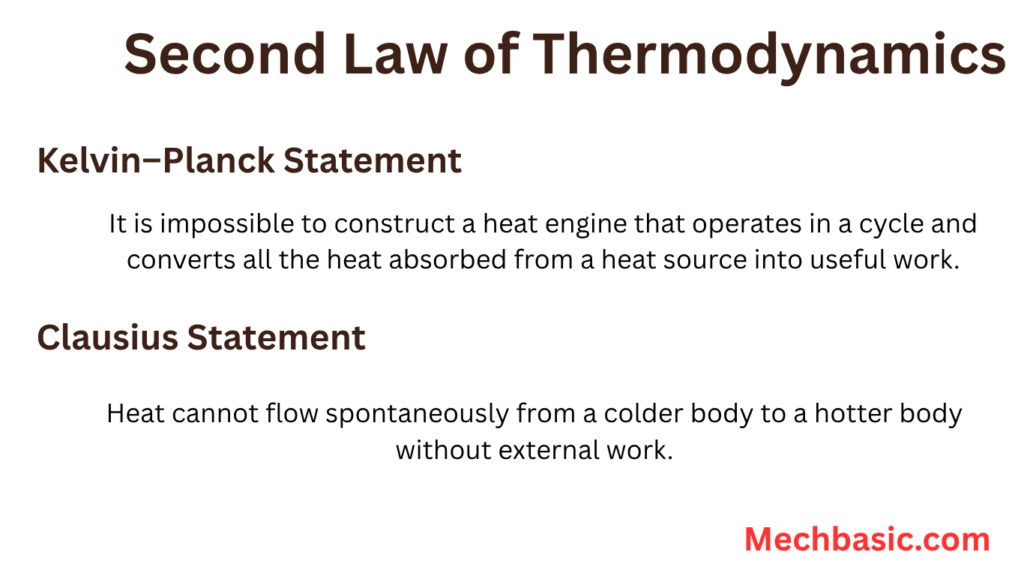
The Second Law of Thermodynamics states that heat flows naturally from a hotter body to a colder body.
It introduces entropy, which measures the degree of disorder and always tends to increase in an isolated system.
This law explains why no heat engine can be 100% efficient.
In this article:
- Second Law of Thermodynamics: Entropy and Efficiency
- Statement of the Second Law of Thermodynamics
- Understanding the Second Law
- What is Entropy?
- Definition of Entropy
- Examples of Entropy
- Entropy Formula
- Characteristics of Entropy
- Entropy and Natural Processes
- Thermal Efficiency
- Heat Engine Efficiency
- Carnot Efficiency
- Why No Engine Can Be 100% Efficient
- Reversible and Irreversible Processes
- Real-World Examples
- Applications of the Second Law
- Advantages of Understanding the Second Law
- Limitations
- Summary Table
- Everyday Examples
- Frequently Asked Questions (FAQs)
- Conclusion
Second Law of Thermodynamics: Entropy and Efficiency
Introduction
The Second Law of Thermodynamics is one of the most important principles in physics and engineering. While the First Law of Thermodynamics states that energy is conserved, the Second Law explains how energy is transferred, the direction of natural processes, and why no machine can be 100% efficient.
The Second Law introduces the concept of entropy, which measures the degree of disorder or randomness in a system. It also establishes the maximum possible efficiency of heat engines, refrigerators, and other thermodynamic systems.
The Second Law is fundamental to the design of:
- Heat engines
- Steam turbines
- Refrigerators
- Air conditioners
- Power plants
- Internal combustion engines
- Jet engines
Statement of the Second Law of Thermodynamics
The Second Law can be expressed in several equivalent ways.
Kelvin–Planck Statement
It is impossible to construct a heat engine that operates in a cycle and converts all the heat absorbed from a heat source into useful work.
This means:
- Every heat engine must reject some heat to a cooler reservoir.
- No heat engine can have 100% thermal efficiency.
Clausius Statement
Heat cannot flow spontaneously from a colder body to a hotter body without external work.
Example
- A hot cup of coffee naturally cools to room temperature.
- A refrigerator requires electrical energy to transfer heat from its cold interior to the warmer surroundings.
Understanding the Second Law
Suppose a heat engine receives 1000 kJ of heat.
- It converts 400 kJ into useful work.
- The remaining 600 kJ is rejected to the surroundings.
The rejected heat cannot be completely eliminated because of the Second Law.
What is Entropy?
Definition
Entropy is a thermodynamic property that measures the degree of disorder, randomness, or energy unavailability in a system.
It is represented by the symbol:
S
SI Unit
J/K(Joule per Kelvin)
Definition of Entropy
Entropy indicates how spread out or unavailable energy becomes during a process.
- Low entropy → More ordered system
- High entropy → More disordered system
Examples of Entropy
Example 1: Ice Melting
Ice has an orderly crystal structure.
When it melts:
- Molecules move more freely.
- Disorder increases.
- Entropy increases.
Example 2: Perfume in a Room
Initially:
- Perfume molecules are concentrated.
Later:
- Molecules spread throughout the room.
Disorder increases, so entropy increases.
Example 3: Burning Wood
Wood has a relatively ordered structure.
After burning:
- Ash
- Smoke
- Carbon dioxide
- Water vapor
are dispersed, increasing disorder and entropy.
Entropy Formula
For a reversible process, the change in entropy is:
where:
- (\Delta S) = Change in entropy
- (Q_{rev}) = Heat transferred reversibly
- (T) = Absolute temperature (Kelvin)
Characteristics of Entropy
- Entropy increases in spontaneous processes.
- Entropy remains constant for an ideal reversible process.
- Entropy never decreases for an isolated system.
- Every real process generates entropy.
Entropy and Natural Processes
Natural processes always move toward greater entropy.
Examples:
- Ice melts.
- Metal rusts.
- Perfume spreads.
- Hot coffee cools.
- Gas expands into empty space.
The reverse processes require external energy.
Thermal Efficiency
Heat Engine Efficiency
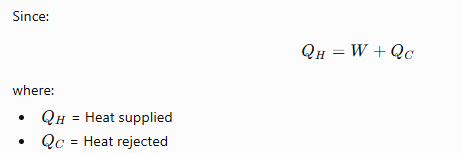
Efficiency can also be written as:
This shows that reducing rejected heat increases efficiency, but (Q_C) can never be zero in a real heat engine.
Carnot Efficiency
The Carnot engine is an ideal heat engine with the maximum possible efficiency.
Its efficiency is:
where:
- (T_H) = Temperature of the hot reservoir (K)
- (T_C) = Temperature of the cold reservoir (K)
Important Points
- Temperatures must be in Kelvin.
- No real engine can exceed Carnot efficiency.
- Increasing (T_H) or decreasing (T_C) improves efficiency.
Why No Engine Can Be 100% Efficient
According to the Second Law:
- Some heat must always be rejected.
- Friction causes energy losses.
- Heat leaks occur.
- Combustion is not perfectly efficient.
- Mechanical components create irreversibilities.
Therefore:
- Complete conversion of heat into work is impossible.
Reversible and Irreversible Processes
Reversible Process
An ideal process that can be reversed without leaving any change in the system or surroundings.
Characteristics:
- No friction
- No heat loss
- Maximum efficiency
- No entropy generation
Irreversible Process
A real process that cannot be completely reversed.
Characteristics:
- Friction present
- Heat losses
- Entropy increases
- Lower efficiency
Examples:
- Car engine
- Steam turbine
- Mixing hot and cold water
Real-World Examples
1. Automobile Engine
- Fuel burns.
- Heat is produced.
- Piston moves.
- Some heat is converted to work.
- Remaining heat escapes through the exhaust and radiator.
2. Steam Power Plant
- Coal heats water.
- Steam rotates a turbine.
- Generator produces electricity.
- Remaining heat is rejected in a condenser.
3. Refrigerator
A refrigerator removes heat from its cold interior and rejects it to the warmer room.
It requires electrical work because heat does not naturally flow from cold to hot.
4. Air Conditioner
An air conditioner:
- Removes heat from indoors.
- Rejects heat outdoors.
- Uses electrical energy to make this possible.
5. Human Body
The body converts food energy into:
- Mechanical work
- Heat
- Stored energy
Some energy is always lost as body heat.
Applications of the Second Law
Mechanical Engineering
- Engine design
- Turbine analysis
- Compressor efficiency
- Heat exchangers
Electrical Engineering
- Thermal power plants
- Nuclear plants
- Generator cooling
Chemical Engineering
- Chemical reactors
- Distillation
- Industrial heating
Civil Engineering
- HVAC systems
- Energy-efficient buildings
Aerospace Engineering
- Jet engines
- Rocket propulsion
- Gas turbines
Environmental Engineering
- Waste heat recovery
- Energy conservation
- Sustainable systems
Advantages of Understanding the Second Law
- Improves machine efficiency.
- Reduces energy waste.
- Enhances power plant performance.
- Supports sustainable energy use.
- Guides the design of refrigeration and HVAC systems.
Limitations
- It does not quantify the exact amount of work produced (this is addressed by the First Law).
- It cannot eliminate all energy losses in practical systems.
- Real processes always involve irreversibilities.
Summary Table
| Concept | Description |
|---|---|
| Second Law | Heat flows naturally from hot to cold; no heat engine is 100% efficient |
| Entropy ((S)) | Measure of disorder or energy unavailability |
| Entropy Unit | J/K |
| Thermal Efficiency | Ratio of useful work to heat supplied |
| Carnot Efficiency | Maximum theoretical efficiency of a heat engine |
| Reversible Process | Ideal, no entropy generation |
| Irreversible Process | Real, entropy increases |
Everyday Examples
- Hot coffee cooling.
- Ice melting.
- Refrigerator operation.
- Air conditioner cooling.
- Car engine producing power.
- Steam power plant generating electricity.
- Burning wood.
- Mixing hot and cold water.
Frequently Asked Questions (FAQs)
1. What is the Second Law of Thermodynamics?
It states that heat naturally flows from a hotter body to a colder body, and no heat engine can convert all absorbed heat into useful work.
2. What is entropy?
Entropy is a measure of the disorder or randomness of a system and the amount of energy that is unavailable for useful work.
3. What is the SI unit of entropy?
The SI unit of entropy is joule per kelvin (J/K).
4. Why can’t a heat engine be 100% efficient?
Because the Second Law requires that some heat must always be rejected to a colder reservoir. Complete conversion of heat into work is impossible.
5. What is Carnot efficiency?
Carnot efficiency is the maximum theoretical efficiency that any heat engine operating between two temperatures can achieve.
6. What is the difference between reversible and irreversible processes?
- Reversible process: Ideal, no friction, no entropy generation, maximum efficiency.
- Irreversible process: Real, includes friction and heat losses, generates entropy, lower efficiency.
7. Why does entropy increase?
Entropy increases because natural processes tend to move toward greater disorder and greater energy dispersal.
8. What are examples of entropy increasing?
- Ice melting.
- Perfume spreading through a room.
- Burning fuel.
- Mixing gases.
- Hot coffee cooling.
9. How is the Second Law applied in engineering?
It is used to analyze and improve the performance of engines, turbines, refrigerators, air conditioners, power plants, and industrial processes by identifying efficiency limits and minimizing energy losses.
10. What is the difference between the First and Second Laws of Thermodynamics?
| First Law | Second Law |
|---|---|
| States that energy is conserved. | States the direction of natural processes and limits the efficiency of energy conversion. |
| Relates heat, work, and internal energy. | Introduces entropy and explains why some energy becomes unavailable for useful work. |
Conclusion
The Second Law of Thermodynamics explains the natural direction of heat transfer and establishes the limits of energy conversion. By introducing the concept of entropy, it shows that every real process increases disorder and that some energy always becomes unavailable for useful work. Consequently, no heat engine can achieve 100% efficiency. This law is fundamental to the design and analysis of engines, power plants, refrigeration systems, air conditioners, and countless engineering applications, making it one of the most important principles in science and engineering.
Other courses:





