
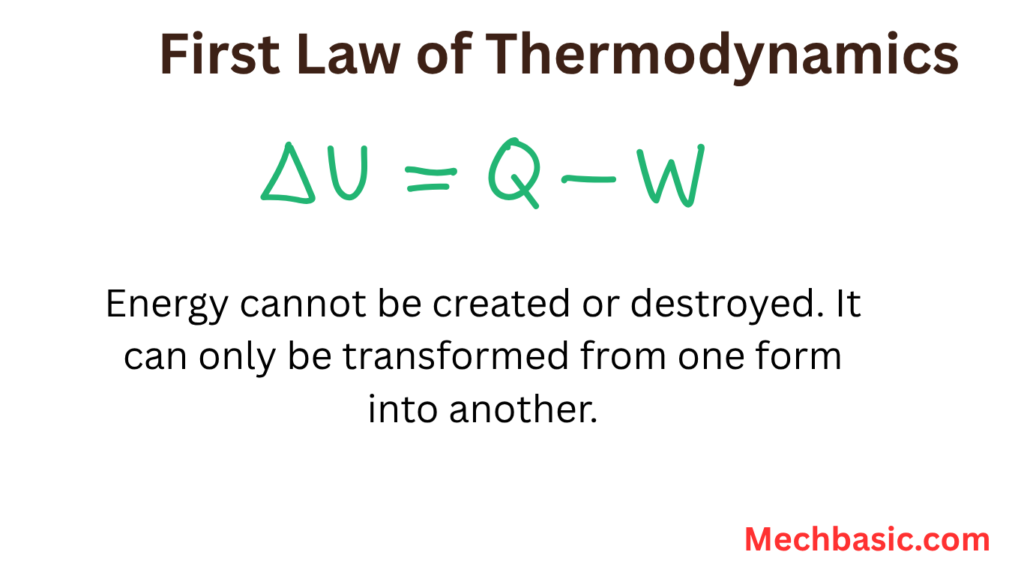
The First Law of Thermodynamics states that energy cannot be created or destroyed, only transformed from one form to another.
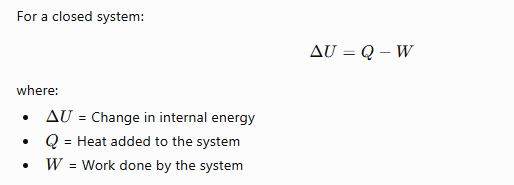
Its formula is ΔU = Q − W, where ΔU is the change in internal energy, Q is heat added, and W is work done by the system.
Examples include car engines, refrigerators, and steam turbines, where heat is converted into work or other forms of energy.
In this article:
- The First Law of Thermodynamics: Formulas and Real-World Examples
- Statement of the First Law of Thermodynamics
- Understanding the First Law
- Key Terms of First Law of Thermodynamics
- Mathematical Form of the First Law
- Sign Convention
- Special Cases of the First Law
- Real-World Examples
- Applications of the First Law
- Advantages of the First Law
- Limitations of the First Law
- Summary Table
- Everyday Examples
- Frequently Asked Questions (FAQs)
- Conclusion
The First Law of Thermodynamics: Formulas and Real-World Examples
Introduction
The First Law of Thermodynamics is one of the most fundamental principles in physics and engineering. It states that energy can neither be created nor destroyed; it can only be transferred or converted from one form to another. This law is essentially the law of conservation of energy applied to thermodynamic systems.
The First Law explains how heat, work, and internal energy are related in processes involving gases, liquids, and solids. It is widely used in the design and analysis of engines, turbines, compressors, refrigerators, air conditioners, boilers, and power plants.
Statement of the First Law of Thermodynamics
The First Law of Thermodynamics states:
Energy cannot be created or destroyed. It can only be transformed from one form into another.
This means that when heat is added to a system, it can either:
- Increase the system’s internal energy,
- Be converted into work done by the system, or
- Be shared between both.
Understanding the First Law
Consider a gas enclosed in a cylinder with a movable piston.
- When heat is supplied to the gas:
- The gas temperature increases.
- The gas expands.
- The expanding gas pushes the piston upward.
- Mechanical work is performed.
The supplied heat is therefore divided into:
- Increasing the gas’s internal energy, and
- Performing work.
Key Terms of First Law of Thermodynamics
1. Heat (Q)
Heat is the energy transferred between bodies due to a temperature difference.
Unit: Joule (J) or Kilojoule (kJ)
2. Work (W)
Work is the energy transferred when a force causes displacement.
Examples:
- A gas pushing a piston.
- Steam rotating a turbine.
Unit: Joule (J)
3. Internal Energy (U)
Internal energy is the microscopic energy stored within a substance because of the motion and interactions of its molecules.
It depends on:
- Temperature
- Pressure
- Phase of the substance
Mathematical Form of the First Law
For a closed system, the First Law is expressed as:
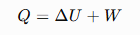
where:
- (Delta U) = Change in internal energy
- (Q) = Heat added to the system
- (W) = Work done by the system
This equation means:
Heat supplied = Increase in internal energy + Work done by the system
It can also be rearranged as:
Sign Convention
| Quantity | Positive When | Negative When |
|---|---|---|
| Heat (Q) | Heat enters the system | Heat leaves the system |
| Work (W) | Work is done by the system | Work is done on the system |
| Internal Energy ((\Delta U)) | Internal energy increases | Internal energy decreases |
Special Cases of the First Law
1. Constant Volume Process (Isochoric)
Since the volume does not change:
W = 0
Therefore:

All the supplied heat increases the internal energy.
Example: Heating gas in a rigid sealed container.
2. Adiabatic Process
No heat is transferred:
Q = 0
Hence:

The work done comes entirely from the internal energy of the system.
Example: Rapid compression in a diesel engine.
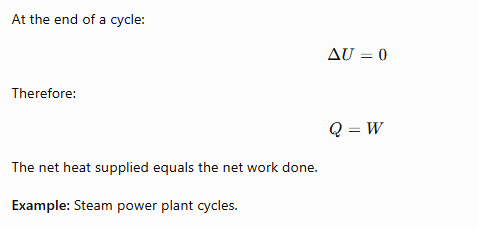
3. Cyclic Process
4. Isothermal Process (Ideal Gas)
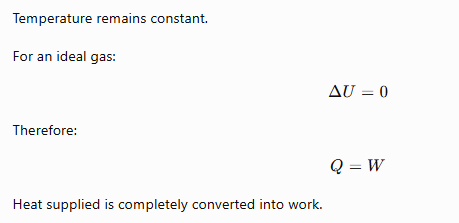
Real-World Examples
1. Automobile Engine
Working
- Fuel burns inside the cylinder.
- Heat is released.
- High-pressure gases expand.
- The piston moves.
- Mechanical work rotates the crankshaft.
Energy Conversion
Chemical Energy → Heat Energy → Mechanical Energy
2. Steam Power Plant
Working
- Coal burns in a boiler.
- Water converts to steam.
- Steam expands through a turbine.
- Turbine drives a generator.
Energy Conversion
Chemical Energy → Heat → Steam Energy → Mechanical Energy → Electrical Energy
3. Pressure Cooker
When heated:
- Heat enters the water.
- Internal energy increases.
- Water temperature rises.
- Steam pressure builds up.
The First Law explains how the supplied heat increases internal energy and changes the state of water.
4. Refrigerator
A refrigerator uses electrical energy to transfer heat from inside the refrigerator to the surrounding room.
Although the process is the reverse of a heat engine, it still obeys the First Law because energy is conserved.
5. Air Conditioner
An air conditioner removes heat from indoor air and rejects it outdoors using electrical work.
The total energy balance satisfies the First Law.
6. Bicycle Pump
When air is compressed rapidly:
- Work is done on the air.
- Internal energy increases.
- The pump becomes warm.
This demonstrates the conversion of mechanical work into internal energy.
7. Human Body
The body converts chemical energy from food into:
- Mechanical work (movement)
- Heat (maintaining body temperature)
- Stored energy
This energy transformation follows the First Law.
Applications of the First Law
Mechanical Engineering
- Internal combustion engines
- Steam turbines
- Compressors
- Boilers
- Heat exchangers
Electrical Engineering
- Thermal power plants
- Nuclear power plants
- Generator cooling systems
Chemical Engineering
- Chemical reactors
- Distillation columns
- Industrial heating processes
Civil Engineering
- Building heating and cooling systems
- HVAC design
- Energy-efficient buildings
Aerospace Engineering
- Jet engines
- Rocket propulsion
- Gas turbines
Renewable Energy
- Solar thermal systems
- Geothermal plants
- Biomass power plants
Advantages of the First Law
- Explains energy conservation.
- Forms the foundation of thermodynamics.
- Helps engineers analyze energy systems.
- Improves machine efficiency.
- Supports sustainable energy management.
- Essential for designing thermal systems.
Limitations of the First Law
- Does not indicate the direction of heat flow.
- Does not explain why some processes occur naturally.
- Cannot determine maximum efficiency.
- Does not account for entropy or irreversibility.
These limitations are addressed by the Second Law of Thermodynamics.
Summary Table
| Quantity | Symbol | Unit | Description |
|---|---|---|---|
| Heat | (Q) | Joule (J) | Energy transferred because of temperature difference |
| Work | (W) | Joule (J) | Energy transferred by force causing displacement |
| Internal Energy | (U) | Joule (J) | Energy stored within a system |
| Change in Internal Energy | (\Delta U) | Joule (J) | Difference between final and initial internal energy |
Everyday Examples
- Boiling water in a kettle.
- Cooking with a pressure cooker.
- Car engine operation.
- Steam turbine in a power plant.
- Refrigerator cooling food.
- Air conditioner cooling a room.
- Bicycle pump warming during use.
- Human metabolism.
Frequently Asked Questions (FAQs)
1. What is the First Law of Thermodynamics?
It states that energy cannot be created or destroyed; it can only be transferred or transformed from one form to another.
2. What is the formula for the First Law of Thermodynamics?
3. What is internal energy?
Internal energy is the total microscopic energy stored within a substance due to the motion and interactions of its molecules.
4. What is the difference between heat and work?
- Heat is energy transferred due to a temperature difference.
- Work is energy transferred when a force causes displacement.
5. Does the First Law apply to refrigerators?
Yes. Refrigerators obey the First Law by using electrical work to transfer heat from a colder region to a warmer one while conserving energy.
6. Why is the First Law important in engineering?
It helps engineers analyze and design engines, turbines, compressors, boilers, refrigeration systems, power plants, and many other energy-conversion devices.
7. Can energy ever be lost?
No. Energy cannot be lost; it only changes form. However, some energy may become less useful (for example, dissipated as waste heat), which is explained by the Second Law of Thermodynamics.
8. What is an example of the First Law in daily life?
When boiling water, the heat supplied from the stove increases the water’s internal energy, raising its temperature and eventually causing it to change into steam.
9. What are the limitations of the First Law?
It does not explain:
- The direction of heat flow.
- Why heat flows naturally from hot to cold.
- Why no heat engine can be 100% efficient.
These topics are explained by the Second Law of Thermodynamics.
10. Which engineering fields use the First Law?
- Mechanical Engineering
- Chemical Engineering
- Electrical Engineering
- Civil Engineering
- Aerospace Engineering
- Energy Engineering
Conclusion
The First Law of Thermodynamics is the principle of energy conservation, stating that energy cannot be created or destroyed but only converted from one form to another. It establishes the relationship between heat, work, and internal energy, forming the basis for analyzing all thermodynamic systems. From automobile engines and steam turbines to refrigerators and power plants, the First Law is essential for understanding how energy is transferred and transformed in real-world applications. It is a cornerstone of engineering and physics, providing the foundation for efficient energy management and technological innovation.
Other courses:





