Rust is a specific type of corrosion that occurs on iron and steel.
Corrosion is the general deterioration of any metal due to chemical or environmental reactions.
All rust is corrosion, but not all corrosion is rust.
In this article:
Rust vs Corrosion: Differences You Need to Know
Many people use the terms rust and corrosion interchangeably, but they are not the same thing.
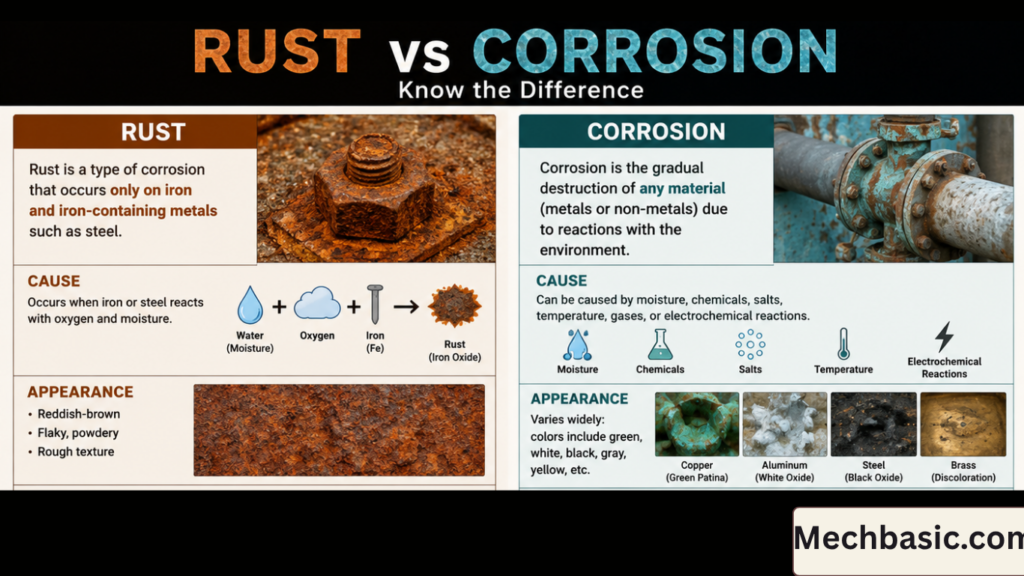
Corrosion is the broad process by which materials deteriorate due to chemical or electrochemical reactions with their environment. Rust is a specific type of corrosion that occurs only on iron and iron-containing metals such as steel.
Definition
Corrosion
Corrosion is the gradual destruction of a material (usually a metal) caused by reactions with its environment.
Examples:
- Steel corroding in seawater
- Copper developing a green patina
- Aluminum oxidizing
Rust
Rust is a reddish-brown iron oxide that forms when iron or steel reacts with oxygen and moisture.
Examples:
- Rust on a steel gate
- Rust on a car body
- Rust on tools
Main Difference
All rust is corrosion, but not all corrosion is rust.
Rust is simply one specific form of corrosion affecting iron-based metals.
10 Key Differences Between Rust and Corrosion
| Feature | Rust | Corrosion |
|---|---|---|
| Definition | Specific corrosion of iron/steel | Deterioration of any material by environmental reactions |
| Metals Affected | Iron and steel only | Many metals and materials |
| Appearance | Reddish-brown oxide | Various colors and forms |
| Material Loss | Yes | Yes |
| Requires Iron | Yes | No |
| Requires Moisture | Usually yes | Not always |
| Color | Red, orange, brown | Green, white, black, gray, red, etc. |
| Types | One specific type | Many different types |
| Examples | Rusted steel | Rust, pitting, galvanic corrosion, oxidation |
| Scope | Narrow | Broad |
What Causes Rust?
Rust occurs when three elements are present:
- Iron or steel
- Oxygen
- Water (moisture)
The basic reaction is:
Iron + Oxygen + Water → Rust
Common Sources
- Humid air
- Rainwater
- Condensation
- Saltwater exposure
What Causes Corrosion?
Corrosion can result from many mechanisms:
Moisture
Causes electrochemical corrosion.
Chemicals
Acids and alkalis can attack metals.
Salt
Accelerates corrosion dramatically.
Temperature
High temperatures can cause oxidation.
Electrical Effects
Galvanic corrosion occurs when dissimilar metals contact each other.
Appearance Differences
Rust
Typical appearance:
Characteristics:
- Reddish brown
- Flaky
- Powdery
- Rough texture
Corrosion
Corrosion can appear in many forms.
Copper Corrosion
Green layer called patina.
Aluminum Corrosion
White powdery oxide.
Stainless Steel Corrosion
Small pits or discoloration.
Zinc Corrosion
White rust.
Types of Corrosion
Corrosion includes many categories:
Uniform Corrosion
Occurs evenly across the surface.
Pitting Corrosion
Small deep holes form.
Crevice Corrosion
Occurs in tight spaces.
Galvanic Corrosion
Occurs between dissimilar metals.
Stress Corrosion Cracking
Corrosion combined with stress.
Intergranular Corrosion
Occurs along grain boundaries.
Rusting
One specific type affecting iron and steel.
Examples
Rust Examples
- Steel bridge exposed to rain
- Rusty garden tools
- Rusted automobile body
Corrosion Examples
- Copper roof turning green
- Aluminum aircraft skin oxidizing
- Brass fittings deteriorating
- Stainless steel pitting in seawater
Impact on Mechanical Properties
Rust
Can cause:
- Reduced strength
- Reduced thickness
- Surface damage
- Structural failure
Corrosion
Can cause:
- Material loss
- Cracking
- Leakage
- Mechanical failure
- Reduced fatigue life
Which Is More Dangerous?
Rust
Can severely weaken steel structures if ignored.
Examples:
- Bridges
- Pipelines
- Vehicles
Corrosion
Generally considered the broader and often more serious issue because it affects many materials and can occur in hidden areas.
Examples:
- Aircraft structures
- Chemical plants
- Offshore platforms
Prevention Methods
Preventing Rust
Paint
Blocks moisture and oxygen.
Oil and Grease
Protect exposed steel.
Galvanizing
Zinc coating protects steel.
Humidity Control
Reduces moisture exposure.
Stainless Steel
Provides improved rust resistance.
Preventing Corrosion
Material Selection
Choose corrosion-resistant materials.
Protective Coatings
Paint, powder coating, epoxy.
Cathodic Protection
Uses sacrificial anodes.
Corrosion Inhibitors
Reduce chemical attack.
Environmental Control
Control humidity, chemicals, and temperature.
Industrial Examples
Rust
A carbon steel machine frame in a humid factory develops reddish-brown rust.
Corrosion
A copper pipe in a chemical plant develops green corrosion products due to chemical exposure.
Conclusion
Corrosion is the general process by which metals and other materials deteriorate due to environmental reactions. Rust is a specific form of corrosion that occurs only on iron and steel, producing reddish-brown iron oxide. While rust requires iron, oxygen, and moisture, corrosion can affect many materials through various mechanisms such as chemical attack, galvanic action, oxidation, and pitting. Understanding the difference is important in engineering, manufacturing, maintenance, and material selection because effective prevention methods depend on the type of corrosion involved.
Other courses: