
A plain scale is a scale used to measure two units or a unit and its subdivision.
It is commonly used in engineering drawings to represent dimensions accurately.
Plain scales help convert actual measurements into scaled drawing measurements.
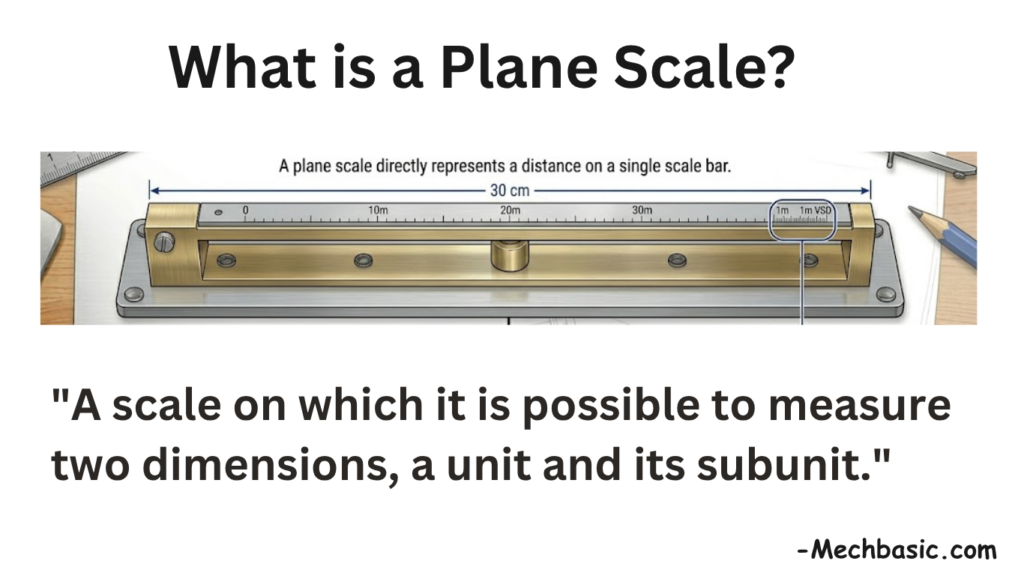
In this article:
- Plane Scale in Engineering Drawing
- What is a Plane Scale?
- Definition
- Purpose of a Plane Scale
- Principle of Plane Scale
- Components of a Plane Scale
- Construction of a Plane Scale
- Types of Measurements Using Plane Scale
- Example of Plane Scale Construction
- Applications of Plane Scale
- Advantages of Plane Scale
- Limitations of Plane Scale
- Plane Scale vs Plain Scale
- Plane Scale vs Diagonal Scale
- Common Examination Questions
- Importance in Engineering Drawing
- Conclusion
Plane Scale in Engineering Drawing
Introduction
A Plane Scale is a type of engineering scale used to measure and represent two units or a unit and its subdivisions accurately on engineering drawings, maps, plans, and layouts.
It is one of the most important scales studied in Engineering Graphics and Engineering Drawing because it allows measurements to be read in two dimensions, such as:
- Meters and decimeters
- Kilometers and meters
- Feet and inches
- Centimeters and millimeters
A plane scale provides greater accuracy than a plain scale because it can show both a unit and its subdivisions.
What is a Plane Scale?
A plane scale is a scale that represents:
A primary unit and its immediate subdivision.
For example:
- 1 meter divided into decimeters
- 1 kilometer divided into meters
- 1 foot divided into inches
It allows measurements to be read more precisely than a simple plain scale.
Definition
A plane scale is defined as:
“A scale on which it is possible to measure two dimensions, a unit and its subunit.”
Purpose of a Plane Scale
The main purposes are:
- Represent large distances on small drawings
- Measure lengths accurately
- Read units and subdivisions
- Convert actual dimensions into scaled dimensions
- Improve drawing precision
Principle of Plane Scale
A plane scale is constructed based on the Representative Fraction (R.F.).
Formula
The Representative Fraction indicates the ratio between the drawing size and the actual size.
Components of a Plane Scale
1. Scale Length
The total length of the scale drawn on paper.
Formula
2. Main Divisions
Represent the primary unit.
Examples:
- Kilometers
- Meters
- Feet
3. Subdivisions
Represent smaller units.
Examples:
- Meters
- Decimeters
- Inches
4. Zero Point
The reference point from which measurements are taken.
Usually placed between the main divisions and subdivisions.
Construction of a Plane Scale
Step 1: Determine the Representative Fraction (R.F.)
Example:
R.F. = 1/500Step 2: Determine Maximum Length to Be Measured
Example:
Maximum length = 50 mStep 3: Calculate Scale Length
Using:
Length of Scale = R.F × Actual Length
Convert actual length into the same unit first.
Example:
50 m = 50000 mmThen:
Length of Scale = 1/500 × 50000= 100 mmStep 4: Draw the Scale
Draw a rectangle of calculated length.
Step 5: Divide into Main Units
For example:
50 m ÷ 5Each division represents:
10 mStep 6: Subdivide the First Main Division
Divide it into:
10 equal partsEach part then represents:
1 mTypes of Measurements Using Plane Scale
Unit and Subunit
Examples:
Kilometers and Meters
Used in maps.
Meters and Decimeters
Used in civil engineering.
Feet and Inches
Used in architectural drawings.
Centimeters and Millimeters
Used in machine drawings.
Example of Plane Scale Construction
Given
R.F. = 1/100
Maximum distance = 5 m
Required:
Measure meters and decimeters.
Step 1
Convert:
5 m = 5000 mmStep 2
Calculate scale length:
Length = 1/100 × 5000= 50 mmStep 3
Draw a 50 mm line.
Step 4
Divide into 5 equal parts.
Each division:
1 mStep 5
Subdivide first division into 10 parts.
Each subdivision:
0.1 mor
1 decimeterThe scale is now complete.
Applications of Plane Scale
Civil Engineering
Used for:
- Road layouts
- Building plans
- Site maps
Mechanical Engineering
Used for:
- Machine layouts
- Equipment drawings
Surveying
Used for:
- Land maps
- Topographical plans
Architecture
Used for:
- Floor plans
- Elevations
Transportation Engineering
Used for:
- Highway plans
- Railway layouts
Advantages of Plane Scale
Higher Accuracy
Can read units and subdivisions.
Easy Construction
Simple geometric procedure.
Better Precision
More precise than a plain scale.
Widely Applicable
Useful in many engineering fields.
Convenient Reading
Measurements can be read directly.
Limitations of Plane Scale
Limited Precision
Cannot measure very small fractions accurately.
Manual Reading Errors
Human error may occur.
Less Accurate Than Diagonal Scale
Diagonal scales provide greater precision.
Plane Scale vs Plain Scale
| Feature | Plain Scale | Plane Scale |
|---|---|---|
| Units Measured | One unit and fraction | Unit and subdivision |
| Accuracy | Moderate | Higher |
| Construction | Simpler | Slightly more complex |
| Usage | Basic measurements | Precise measurements |
| Reading Capability | Limited | Better |
Plane Scale vs Diagonal Scale
| Feature | Plane Scale | Diagonal Scale |
|---|---|---|
| Precision | Good | Very High |
| Subdivision | Unit and subunit | Smaller fractions possible |
| Complexity | Simple | More complex |
| Application | General engineering | High-precision work |
Common Examination Questions
What is a Plane Scale?
A plane scale is a scale that represents a unit and its subdivision, allowing more accurate measurement than a plain scale.
What is the main use of a Plane Scale?
To measure and represent two units or a unit and its subunit accurately on engineering drawings.
What is the difference between Plain Scale and Plane Scale?
A plain scale measures one unit and its fraction, whereas a plane scale measures a unit and its subdivision more accurately.
Importance in Engineering Drawing
Plane scales are important because they:
- Enable accurate representation of dimensions
- Reduce measurement errors
- Improve drawing quality
- Assist in reading scaled distances
- Form the basis for advanced scales such as diagonal scales
Conclusion
A Plane Scale is an engineering drawing scale used to represent a unit and its subdivision, such as meters and decimeters or feet and inches. It is constructed using the Representative Fraction (R.F.) and provides greater accuracy than a plain scale. Plane scales are widely used in civil engineering, mechanical engineering, architecture, surveying, and mapping for accurately measuring and representing dimensions on drawings and plans. Understanding plane scales is essential for mastering engineering graphics and technical drawing.
Other courses:





