
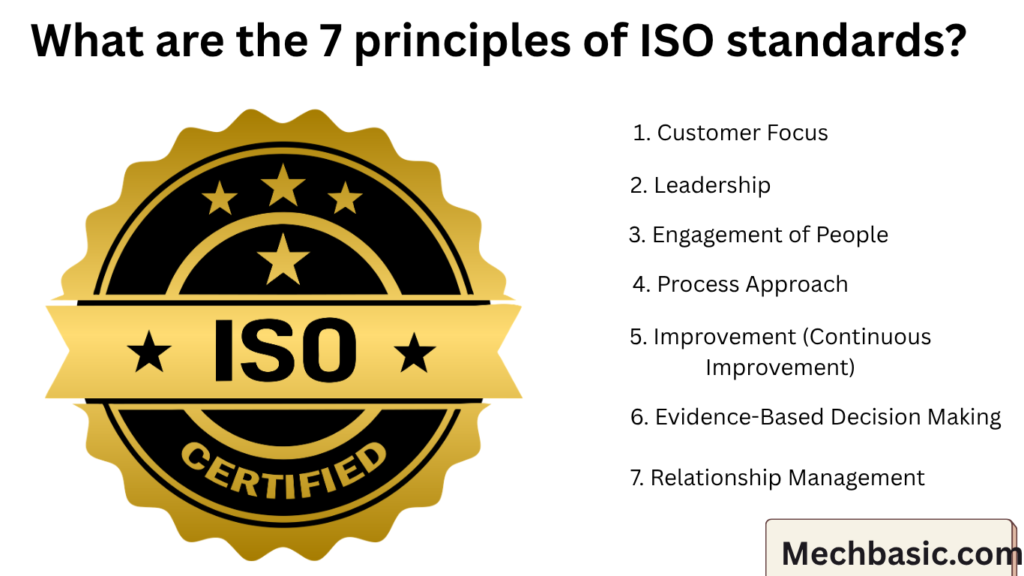
The 7 principles of ISO quality management are customer focus, leadership, engagement of people, process approach, improvement, evidence-based decision making, and relationship management.
They guide organizations in building effective and consistent management systems.
These principles improve quality, efficiency, and customer satisfaction.
In this article:
7 Principles of ISO Standards (ISO 9000 Quality Management Principles)
When people say “7 principles of ISO standards,” they usually refer to the 7 Quality Management Principles (QMPs) defined in the ISO 9000 family, especially used in ISO 9001.
These principles are the foundation of all modern ISO quality management systems.
1. Customer Focus
Definition
The main goal of any ISO-based system is to meet customer requirements and improve customer satisfaction.
Quality is defined by the customer, not the company.
Key idea
- Understand customer needs
- Meet expectations consistently
- Improve satisfaction continuously
Example
A manufacturing company improves product durability based on customer complaints about failures.
Benefits
✔ Higher customer satisfaction
✔ Strong customer loyalty
✔ Better market reputation
2. Leadership
Definition
Top management must provide clear direction and create a quality-driven culture.
Key idea
Without leadership, quality systems fail.
What leaders do
- Set quality objectives
- Provide resources
- Encourage improvement culture
- Lead by example
Example
A company introduces a “zero defect” policy supported by management training programs.
Benefits
✔ Clear direction
✔ Strong motivation
✔ Better coordination
3. Engagement of People
Definition
All employees at all levels must be involved in achieving quality.
Key idea
“Quality is everyone’s responsibility.”
What happens
- Employees participate in improvement activities
- Workers identify defects early
- Teams solve problems together
Example
Machine operators report vibration issues early, preventing machine breakdown.
Benefits
✔ Better teamwork
✔ Faster problem-solving
✔ Higher efficiency
4. Process Approach
Definition
Activities are managed as interconnected processes that convert inputs into outputs.
Key idea
Good processes produce good results.
What is done
- Define all processes
- Monitor inputs and outputs
- Reduce variation
- Standardize operations
Example
In manufacturing, controlling machining speed ensures consistent part dimensions.
Benefits
✔ Consistent quality
✔ Reduced defects
✔ Efficient operations
5. Improvement (Continuous Improvement)
Definition
Organizations must continuously improve performance, processes, and systems.
Key idea
“There is always room for improvement.”
What is done
- Root cause analysis
- Corrective actions
- Kaizen (small improvements)
- Process optimization
Example
Reducing machine setup time from 30 minutes to 20 minutes improves productivity.
Benefits
✔ Higher efficiency
✔ Lower cost
✔ Better quality
6. Evidence-Based Decision Making
Definition
Decisions must be based on data, facts, and analysis, not assumptions or opinions.
Key idea
“If you can’t measure it, you can’t improve it.”
Tools used
- SPC charts
- Histograms
- Pareto analysis
- Check sheets
Example
Using defect data to identify the most frequent manufacturing error and fixing it first.
Benefits
✔ Accurate decisions
✔ Reduced risk
✔ Better problem-solving
7. Relationship Management
Meaning
Organizations must manage relationships with suppliers, customers, and stakeholders effectively.
Key idea
Quality depends on strong relationships across the supply chain.
What is done
- Build supplier partnerships
- Improve communication
- Ensure consistent raw material quality
Example
A manufacturer works closely with suppliers to ensure consistent steel quality for production.
Benefits
✔ Stable supply chain
✔ Better material quality
✔ Long-term partnerships
Summary Table
| Principle | Focus | Outcome |
|---|---|---|
| Customer Focus | Customer needs | Satisfaction |
| Leadership | Direction & support | Stability |
| Engagement of People | Employee involvement | Participation |
| Process Approach | Process control | Consistency |
| Improvement | Continuous improvement | Growth |
| Evidence-Based Decision Making | Data analysis | Accuracy |
| Relationship Management | Supplier & stakeholder relations | Stability |
How the 7 Principles Work Together
- Leadership sets direction
- Employees implement and improve processes
- Processes are controlled and standardized
- Data is used for decision-making
- Suppliers and stakeholders are managed
- Continuous improvement ensures progress
- Customer satisfaction remains the final goal
Real-Life Example: Manufacturing Industry
A factory producing machine parts applies ISO principles:
- Customer feedback collected (Customer focus)
- Management sets quality targets (Leadership)
- Workers involved in improvements (Engagement)
- Processes standardized (Process approach)
- Defects reduced continuously (Improvement)
- SPC charts used for decisions (Evidence-based)
- Supplier quality monitored (Relationship management)
Conclusion
The 7 principles of ISO standards (ISO 9000 quality principles) are Customer Focus, Leadership, Engagement of People, Process Approach, Improvement, Evidence-Based Decision Making, and Relationship Management. These principles form the foundation of modern quality management systems and help organizations achieve consistent quality, efficient processes, and high customer satisfaction.
Other courses:





