
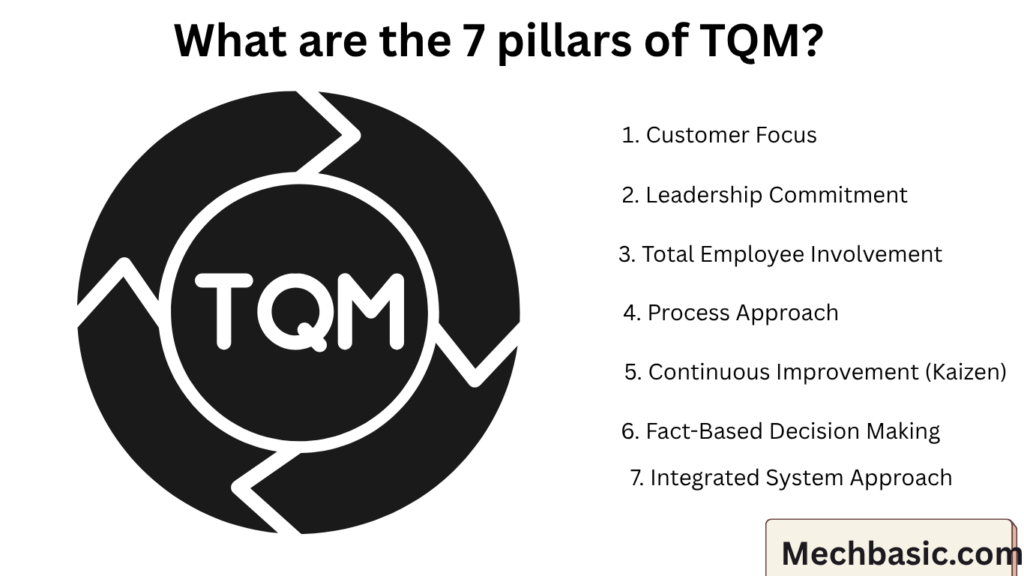
The 7 pillars of TQM are customer focus, leadership, employee involvement, process approach, system approach, continuous improvement, and factual decision making.
They form the foundation for effective quality management in an organization.
These pillars help improve efficiency, consistency, and customer satisfaction.
In this article:
7 Pillars of TQM (Total Quality Management)
The 7 pillars of TQM are the key foundational elements that support a strong quality management system in any organization. These pillars help ensure consistent quality, customer satisfaction, and continuous improvement.
They are often used together to build a quality-driven culture.
1. Customer Focus
Definition
The customer is the central focus of all quality activities.
Key idea
Quality is defined by the customer, not the company.
What organizations do
- Understand customer needs and expectations
- Collect feedback regularly
- Improve products and services based on feedback
Example
A car company improves mileage and safety based on customer reviews.
Benefit
✔ Higher customer satisfaction and loyalty
2. Leadership Commitment
Definition
Top management must actively support and drive quality initiatives.
Key idea
Without leadership support, TQM fails.
What leaders do
- Set quality goals
- Provide resources
- Encourage quality culture
- Lead by example
Example
Company directors introduce zero-defect policies and quality training programs.
Benefit
✔ Strong organizational direction and motivation
3. Total Employee Involvement
Definition
Every employee contributes to quality improvement.
Key idea
Quality is everyone’s responsibility.
What employees do
- Suggest improvements
- Identify defects
- Participate in problem-solving teams
Example
Workers report machine issues early, preventing breakdowns.
Benefit
✔ Better teamwork and faster problem solving
4. Process Approach
Definition
Focus on improving processes rather than just results.
Key idea
Good processes produce good products.
What is done
- Standardize work methods
- Monitor each step of production
- Reduce variation in processes
Example
Monitoring machining speed and tool wear to maintain product quality.
Benefit
✔ Stable and consistent quality output
5. Continuous Improvement (Kaizen)
Definition
Quality is improved continuously through small, ongoing changes.
Key idea
There is always room for improvement.
What is done
- Regular reviews
- Small daily improvements
- Problem-solving teams
Example
Reducing setup time in a machine from 30 minutes to 20 minutes.
Benefit
✔ Long-term efficiency and quality growth
6. Fact-Based Decision Making
Definition
Decisions are made using data and analysis, not opinions.
Key idea
“If you can’t measure it, you can’t improve it.”
Tools used
- SPC charts
- Histograms
- Pareto analysis
- Check sheets
Example
Using defect data to identify the most common production problem.
Benefit
✔ Accurate and reliable decision-making
7. Integrated System Approach
Definition
All departments in the organization must work together as one system.
Key idea
Quality is achieved through coordination across all departments.
Departments involved
- Production
- Quality control
- Maintenance
- Design
- Purchase
Example
Design team improves product based on feedback from production and customers.
Benefit
✔ Better coordination and efficiency across the organization
Summary Table
| Pillar | Focus | Outcome |
|---|---|---|
| Customer Focus | Customer needs | Satisfaction |
| Leadership Commitment | Top management support | Direction |
| Employee Involvement | Workforce participation | Engagement |
| Process Approach | Process control | Consistency |
| Continuous Improvement | Ongoing improvement | Growth |
| Fact-Based Decisions | Data analysis | Accuracy |
| Integrated System | Department coordination | Efficiency |
How the 7 Pillars Work Together
- Leadership sets direction
- Employees participate in improvement
- Processes are controlled and optimized
- Decisions are based on data
- Continuous improvement ensures growth
- All departments work together
- Customer satisfaction remains the goal
Real-Life Example: Manufacturing Company
A company producing machine parts applies TQM:
- Customer complaints analyzed (Customer focus)
- CEO launches quality program (Leadership)
- Workers suggest improvements (Employee involvement)
- Production process monitored (Process approach)
- Defects reduced daily (Continuous improvement)
- SPC charts used for decisions (Fact-based)
- Design + production + QC work together (Integrated system)
Result:
✔ Lower defects
✔ Higher efficiency
✔ Better customer satisfaction
Conclusion
The 7 pillars of TQM are Customer Focus, Leadership Commitment, Total Employee Involvement, Process Approach, Continuous Improvement, Fact-Based Decision Making, and Integrated System Approach. Together, they form the foundation of a strong quality culture that ensures continuous improvement, efficient processes, and high customer satisfaction in any organization.
Other courses:





