
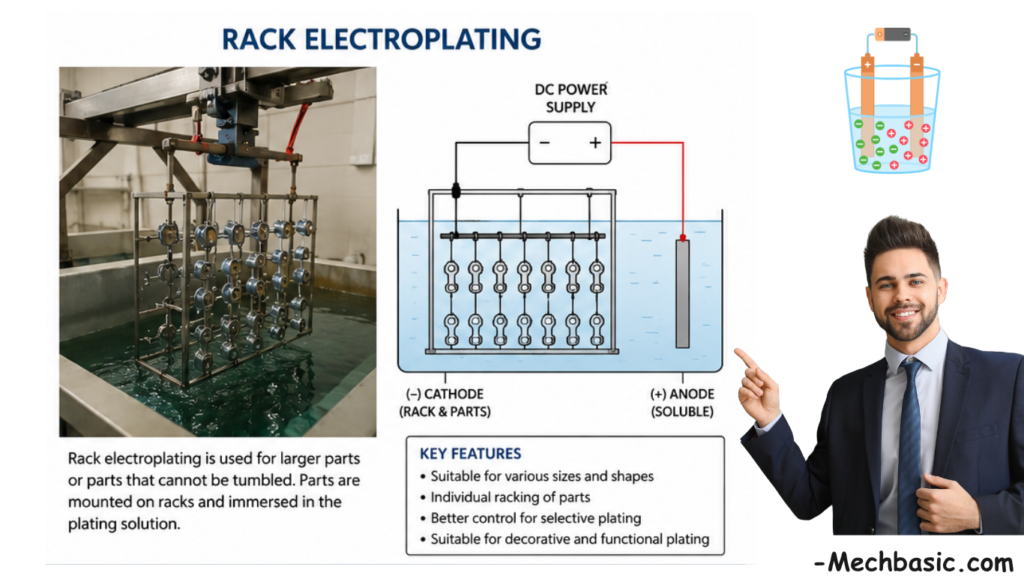
Rack electroplating is a method where components are fixed on racks during plating.
It is used for large, delicate, or specially shaped objects that need uniform coating.
This method provides better control and high-quality surface finishing.
In this article:
- Rack electroplating
- Definition
- Principle of rack electroplating
- Main components of a rack electroplating system
- Working process of rack electroplating
- Common metals used in rack electroplating
- Applications of rack electroplating
- Advantages of rack electroplating
- Disadvantages of rack electroplating
- Comparison: Rack vs Barrel electroplating
- Conclusion
Rack electroplating
Rack electroplating is a type of electroplating process in which workpieces are individually mounted on specially designed racks or fixtures and then immersed in an electrolyte solution for metal coating. It is mainly used for large, delicate, complex-shaped, or high-value components that require a uniform and high-quality finish.
Unlike barrel electroplating, where parts move and tumble together, rack electroplating keeps components fixed in position during the plating process.
Definition
Rack electroplating is an electroplating method in which components are attached to conductive racks and coated with a metal layer by passing electric current through an electrolyte solution.
Principle of rack electroplating
Rack electroplating works on the principle of electrolysis.
When direct current passes through the electrolyte:
- The anode releases metal ions
- The workpiece acts as the cathode
- Metal ions gain electrons and deposit onto the component surface
The racks hold the parts in proper positions for even current distribution.
Main components of a rack electroplating system
1. Rack or fixture
The rack is a conductive frame used to hold parts.
Common materials:
- Copper
- Brass
- Titanium-coated fixtures
- Stainless steel with conductive sections
Functions:
- Supports workpieces
- Provides electrical contact
- Maintains spacing between components
2. Anode
The anode is made from the coating metal.
Examples:
- Nickel
- Copper
- Zinc
- Chromium
- Silver
Connected to the positive terminal.
Function:
- Supplies metal ions to the electrolyte
3. Cathode (workpiece)
The object to be plated acts as the cathode.
Examples:
- Automobile parts
- Jewelry
- Machine components
- Medical equipment
Connected to the negative terminal through the rack.
4. Electrolyte solution
Contains dissolved metal salts.
Examples:
- Nickel sulfate solution
- Copper sulfate solution
- Chromium solution
Functions:
- Conducts electricity
- Provides coating ions
5. DC power supply
Provides direct current required for electrolysis.
Working process of rack electroplating
Step 1: Surface cleaning
Components are cleaned carefully to remove:
- Dust
- Oil
- Grease
- Oxides
- Rust
Methods include:
- Chemical cleaning
- Degreasing
- Acid pickling
Proper cleaning is essential for good adhesion.
Step 2: Mounting on racks
Components are attached securely to the rack.
Important requirements:
- Good electrical contact
- Proper spacing
- Correct orientation
Improper mounting may produce uneven coating.
Step 3: Immersion in electrolyte
The rack holding components is immersed in the plating bath.
Step 4: Application of current
Direct current is supplied.
At the anode:
M → M⁺ + e⁻
At the cathode:
M⁺ + e⁻ → M
Metal deposits on the workpiece surface.
Step 5: Rinsing and drying
After plating:
- Components are removed
- Rinsed with water
- Excess chemicals removed
- Dried
Sometimes polishing or additional finishing is performed.
Common metals used in rack electroplating
Examples:
- Nickel
- Chromium
- Copper
- Zinc
- Gold
- Silver
- Tin
Selection depends on required properties.
Applications of rack electroplating
Rack electroplating is commonly used for:
Automobile components
- Bumpers
- Door handles
- Decorative trims
Jewelry
- Rings
- Chains
- Watches
Electronics
- Connectors
- Precision parts
Medical equipment
- Surgical tools
- Dental instruments
Industrial components
- Machine parts
- Precision equipment
Advantages of rack electroplating
1. Better surface finish
Produces smoother and more decorative coatings.
2. Uniform coating thickness
Controlled positioning improves deposition.
3. Suitable for delicate parts
Little physical contact between components.
4. Reduced damage risk
Components remain fixed.
5. Suitable for complex shapes
Can plate difficult geometries.
Disadvantages of rack electroplating
1. Higher cost
Requires racks and more labor.
2. Lower productivity
Fewer components processed at one time.
3. More setup time
Parts must be mounted individually.
4. Rack marks may occur
Contact points can leave small uncoated areas.
Comparison: Rack vs Barrel electroplating
| Feature | Rack electroplating | Barrel electroplating |
|---|---|---|
| Part size | Large and delicate | Small and durable |
| Surface finish | High quality | Moderate |
| Production quantity | Lower | Very high |
| Cost | Higher | Lower |
| Damage risk | Low | Higher |
| Part movement | Fixed | Rotating/tumbling |
Conclusion
Rack electroplating is a specialized electroplating method used when high-quality coating, delicate handling, and uniform finishing are required. Although it is more expensive than barrel electroplating, it provides superior coating quality and is widely used for automotive, jewelry, medical, and precision components.
Other courses:





