
Japanese steel is known for its hardness, sharpness, and ability to hold an edge longer.
German steel is generally tougher, more flexible, and resistant to chipping.
The better choice depends on the application and the properties required.
In this article:
- Japanese Steel vs German Steel: Which Is Better?
- Historical Philosophy
- Chemical Composition
- Hardness Comparison
- Sharpness
- Edge Retention
- Toughness
- Corrosion Resistance
- Ease of Sharpening
- Manufacturing Style
- Industrial Tool Applications
- Comparison Table
- Which Is Better for Different Users?
- Real-World Example
- Common Misconception
- Conclusion
Japanese Steel vs German Steel: Which Is Better?
In general:
- Japanese steel is often optimized for high hardness, sharpness, and edge retention.
- German steel is often optimized for toughness, durability, corrosion resistance, and ease of maintenance.
This comparison is especially common for kitchen knives, but the principles also apply to tools and industrial products.
Historical Philosophy
Japanese Steel
Japanese metallurgy was influenced by centuries of sword-making.
Traditional goals:
- Extremely sharp edges
- Precise cutting
- Hard steel
This philosophy continues in modern Japanese knives and tools.
German Steel
German engineering emphasized:
- Durability
- Reliability
- Practicality
- Ease of maintenance
German steels are often designed to perform well under heavy everyday use.
Chemical Composition
The properties depend on the specific alloy, but typical differences are:
Japanese Steels
Often contain:
- Higher carbon content
- Sometimes cobalt, vanadium, or tungsten
Examples:
- VG-10
- Aogami (Blue Steel)
- Shirogami (White Steel)
German Steels
Often contain:
- Chromium
- Molybdenum
- Vanadium
Examples:
- X50CrMoV15
- 1.4116 Stainless Steel
These alloys emphasize corrosion resistance and toughness.
Hardness Comparison
Hardness is often measured using the Rockwell C (HRC) scale.
Japanese Steel
Typical hardness:
- 60–65 HRC
Advantages:
- Very sharp edge
- Excellent edge retention
Disadvantages:
- More brittle
- More prone to chipping
German Steel
Typical hardness:
- 54–58 HRC
Advantages:
- Tougher
- Less likely to chip
Disadvantages:
- Requires sharpening more often
Sharpness
Japanese Steel
Generally achieves:
- Finer edge geometry
- Razor-like sharpness
Ideal for:
- Precision cutting
- Slicing fish
- Fine vegetable work
German Steel
Usually has:
- Slightly thicker edge
- Less aggressive sharpness
Ideal for:
- General-purpose kitchen work
- Heavy cutting
Edge Retention
Japanese Steel
Higher hardness means:
- Edge stays sharp longer
Advantage:
- Less frequent sharpening
German Steel
Edge retention is good but generally shorter.
Advantage:
- Easier to resharpen
Toughness
Japanese Steel
Harder steels are usually less tough.
Potential issues:
- Chipping
- Edge damage if misused
German Steel
Typically tougher.
Can tolerate:
- Twisting forces
- Heavy chopping
- Rougher use
Corrosion Resistance
Japanese Carbon Steels
Some traditional Japanese steels can rust if not maintained.
Examples:
- White Steel
- Blue Steel
Require:
- Drying after use
- Regular care
German Stainless Steels
Usually have excellent corrosion resistance because of higher chromium content.
Benefits:
- Easier maintenance
- Better resistance to staining
Ease of Sharpening
Japanese Steel
Some high-hardness steels require more skill and time to sharpen.
German Steel
Often easier for beginners to sharpen.
Manufacturing Style
Japanese Knives
Characteristics:
- Thin blades
- Lightweight
- Precision-focused
German Knives
Characteristics:
- Thicker blades
- Heavier construction
- Multi-purpose design
Industrial Tool Applications
The same principles apply beyond knives.
Japanese Tool Steel
Advantages:
- High wear resistance
- Excellent cutting performance
Applications:
- Precision cutting tools
- Fine machining tools
German Tool Steel
Advantages:
- Toughness
- Impact resistance
Applications:
- Industrial tooling
- Heavy-duty machinery
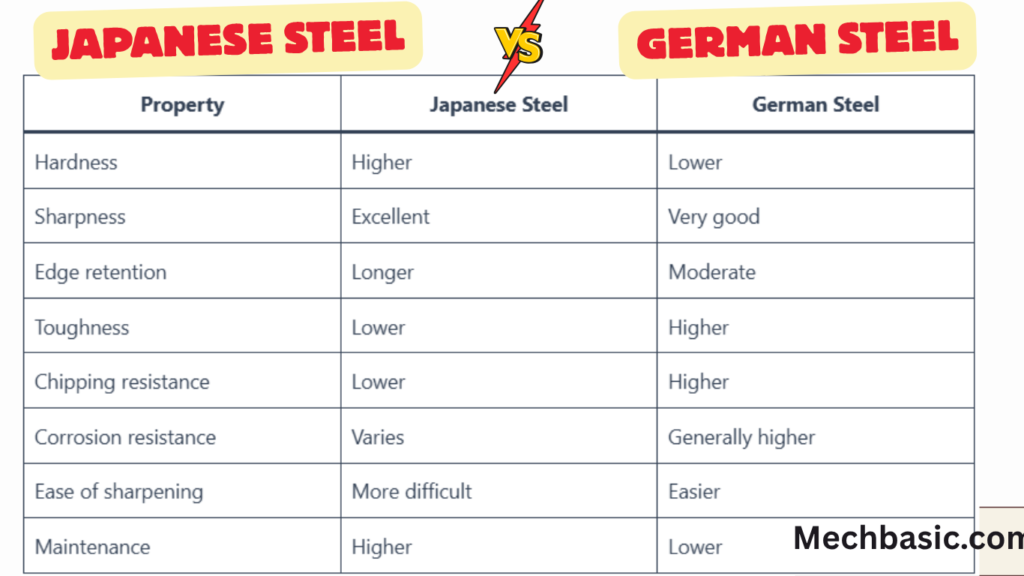
Comparison Table
| Property | Japanese Steel | German Steel |
|---|---|---|
| Hardness | Higher | Lower |
| Sharpness | Excellent | Very good |
| Edge retention | Longer | Moderate |
| Toughness | Lower | Higher |
| Chipping resistance | Lower | Higher |
| Corrosion resistance | Varies | Generally higher |
| Ease of sharpening | More difficult | Easier |
| Maintenance | Higher | Lower |
Which Is Better for Different Users?
Choose Japanese Steel If You Want:
- ✓ Maximum sharpness
- ✓ Long edge retention
- ✓ Precision cutting
- ✓ Professional culinary performance
Choose German Steel If You Want:
- ✓ Durability
- ✓ Toughness
- ✓ Easy maintenance
- ✓ Everyday versatility
Real-World Example
A sushi chef may prefer a knife made from Aogami (Blue Steel) because it can take an extremely sharp edge.
A home cook may prefer a knife made from X50CrMoV15 because it is tougher, more corrosion resistant, and easier to maintain.
Common Misconception
Many people assume:
“Japanese steel is always better.”
In reality:
- Japanese steel often excels in sharpness and edge retention.
- German steel often excels in toughness and practicality.
The better choice depends on the intended application.
Conclusion
Neither Japanese steel nor German steel is universally superior. Japanese steels are generally harder, sharper, and retain an edge longer, making them ideal for precision cutting. German steels are typically tougher, more corrosion resistant, and easier to maintain, making them well suited for heavy-duty and everyday use.
The best choice depends on whether your priority is maximum cutting performance or durability and ease of use.
Other courses:





