
Quenching is a heat treatment process in which a metal is heated to a specific temperature.
It is then rapidly cooled in water, oil, air, or other cooling media.
This process increases hardness and strength of the metal.
In this article:
Quenching :
Quenching is a heat treatment process in which a metal is heated to a specific temperature and then rapidly cooled in a cooling medium such as water, oil, brine, air, or polymer solution. The rapid cooling changes the internal structure of the metal and increases hardness, strength, and wear resistance.
Quenching is commonly used for steel and alloy components that require a hard surface and high mechanical strength.
Definition
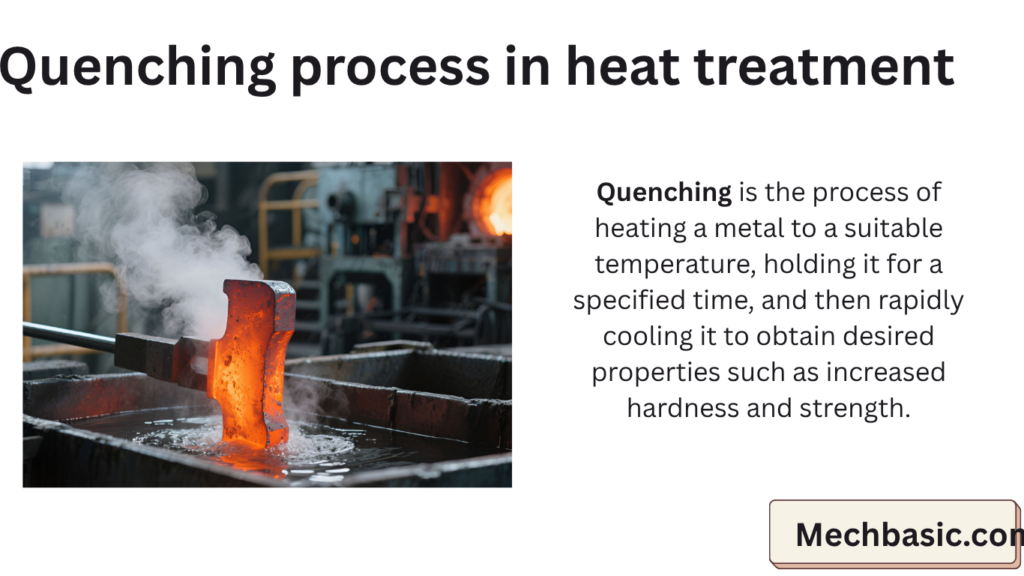
Quenching is the process of heating a metal to a suitable temperature, holding it for a specified time, and then rapidly cooling it to obtain desired properties such as increased hardness and strength.
Objectives of quenching
The main purposes are:
- Increase hardness
- Improve strength
- Increase wear resistance
- Improve surface properties
- Produce a hard microstructure
- Enhance service life of components
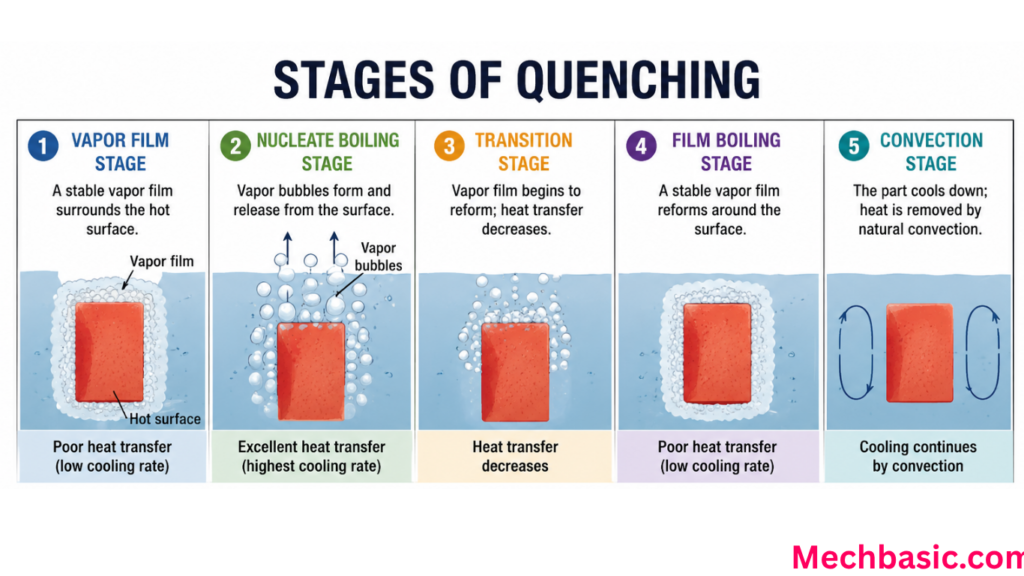
Stages of Quenching process
The quenching process generally involves three major stages:
- Heating
- Soaking (holding)
- Rapid cooling (quenching)
1. Heating stage
The metal is heated above its critical temperature.
For steel, this heating transforms the structure into austenite.
Important points
- Heating must be uniform
- Temperature depends on material composition
- Overheating should be avoided
Typical temperature ranges:
- Carbon steel: approximately 750–950°C
- Alloy steels vary depending on composition
Purpose
- Prepare the material for structural transformation
- Achieve austenitic structure before cooling
2. Soaking stage
After reaching the required temperature, the material is held there for a period.
This holding period is called soaking.
Purpose of soaking
- Uniform temperature distribution
- Complete transformation to austenite
- Ensure proper internal structure
Factors affecting soaking time
- Component thickness
- Shape
- Material composition
- Furnace type
If soaking time is too short:
- Transformation may be incomplete
If too long:
- Grain growth may occur
3. Rapid cooling stage (quenching)
The heated material is removed from the furnace and rapidly cooled.
Rapid cooling causes sudden structural transformation.
In steel, austenite may transform into martensite, a very hard structure.
This stage determines the final hardness.
Common quenching media
Different cooling media produce different cooling rates.
A. Water quenching
Properties:
- Very rapid cooling
- High hardness
Advantages:
- Fast heat removal
- Economical
Disadvantages:
- High cracking risk
- Distortion possible
Applications:
- Simple carbon steels
B. Oil quenching
Properties:
- Slower cooling than water
Advantages:
- Reduced cracking
- Less distortion
Applications:
- Alloy steels
- Precision parts
C. Brine quenching
Brine is salt water.
Properties:
- Faster cooling than ordinary water
Advantages:
- Uniform cooling
Disadvantages:
- Increased corrosion risk
D. Air quenching
Cooling occurs in air.
Advantages:
- Minimal distortion
- Lower stress
Applications:
- Special alloy steels
E. Polymer quenching
Uses water-based polymer solutions.
Advantages:
- Adjustable cooling rate
- Better process control
Structural changes during quenching
For steel:
Ferrite/Pearlite → Austenite → Martensite
Martensite characteristics:
- Very hard
- Strong
- Brittle
Because of brittleness, quenching is often followed by tempering.
Advantages of quenching
- High hardness
- Improved wear resistance
- Increased strength
- Longer component life
- Better performance for tools and machine parts
Disadvantages of quenching
- Internal stress development
- Distortion of parts
- Cracking risk
- Increased brittleness
- Requires careful control
Applications of quenching
Quenching is widely used in:
- Cutting tools
- Gears
- Shafts
- Springs
- Dies and molds
- Automotive components
- Bearings
Examples:
- Drill bits
- Gear teeth
- Machine tools
Summary flow chart
Heating → Soaking → Rapid cooling → Hard structure formation
Conclusion
Quenching is an important heat treatment process that uses rapid cooling after heating to obtain high hardness and strength. It is widely used in manufacturing and engineering industries for producing strong and wear-resistant components. Since quenching can make materials brittle, it is often followed by tempering to achieve a balance of hardness and toughness.
Other courses:





