
Sintering in powder metallurgy is the process of heating compacted metal powder below its melting point.
This heat causes the particles to bond together and increase strength.
It improves density, hardness, and overall mechanical properties of the part.
In this article:
What is Powder Metallurgy Sintering?
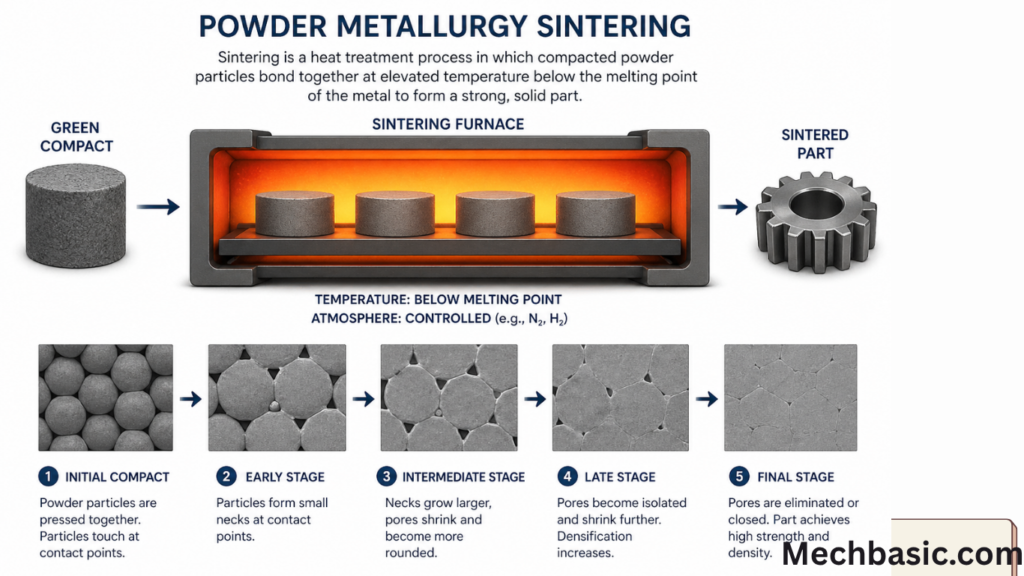
Sintering is a key step in powder metallurgy (PM) where a compacted powder part (called a green compact) is heated below its melting point so that the particles bond together into a strong solid piece.
Definition
👉 Sintering is the process of heating a pressed powder compact to a temperature below its melting point to cause bonding between particles and increase strength and density.
Where Sintering Fits in Powder Metallurgy
- Powder production
- Mixing/blending
- Compaction → green compact
- 🔥 SINTERING (main strengthening step)
- Finishing (machining, sizing, etc.)
Sintering Process (Step-by-Step)
1. Heating Stage
- The compact is placed in a furnace
- Heated to about 0.6–0.9 of melting point of metal
- Done in controlled atmosphere (to avoid oxidation)
2. Neck Formation Between Particles
- Atoms start diffusing between touching powder particles
- Small “necks” form at contact points
👉 This is the beginning of bonding
3. Growth of Bonds
- Necks grow larger
- Particles become strongly joined
- Porosity starts reducing
4. Densification
- Voids (pores) shrink
- Structure becomes stronger and more compact
5. Cooling
- Controlled cooling to prevent cracks or distortion
- Final solid component is obtained
Mechanism Behind Sintering
Sintering works mainly through:
Atomic Diffusion
- At high temperature, atoms move across particle boundaries
- This causes solid-state bonding
Types of Sintering
1. Solid-State Sintering
- No melting occurs
- Most common type
👉 Used for iron, copper, etc.
2. Liquid Phase Sintering
- A small amount of material melts
- Helps particles bond faster
👉 Used in cemented carbides (WC-Co)
3. Activated Sintering
- Uses additives to speed up diffusion
4. Hot Pressing / Hot Isostatic Pressing (HIP)
- Heat + pressure applied simultaneously
- Produces very dense parts
Factors Affecting Sintering
1. Temperature
- Higher temperature → better bonding
- But below melting point
2. Time
- More time → better densification
3. Atmosphere
- Hydrogen, nitrogen, or vacuum used
- Prevents oxidation
4. Particle Size
- Smaller particles → faster sintering
5. Pressure (in some methods)
- Improves density and strength
Effects of Sintering
Improves:
- Strength
- Hardness
- Density
- Wear resistance
Reduces:
- Porosity
- Weak bonding between particles
Why Sintering is Important?
Without sintering:
- The compact is weak and crumbly
With sintering:
- It becomes a strong engineering component
Applications of Sintering
- Gears
- Bearings
- Cutting tools
- Automotive parts
- Electrical contacts
Summary:
👉 Sintering is the heart of powder metallurgy because it transforms a weak powder compact into a strong solid material using atomic bonding (without melting).
Conclusion:
Sintering in powder metallurgy is the process of heating a compacted powder below its melting point to bond particles through diffusion, increase density, and improve strength.
Other courses:





