
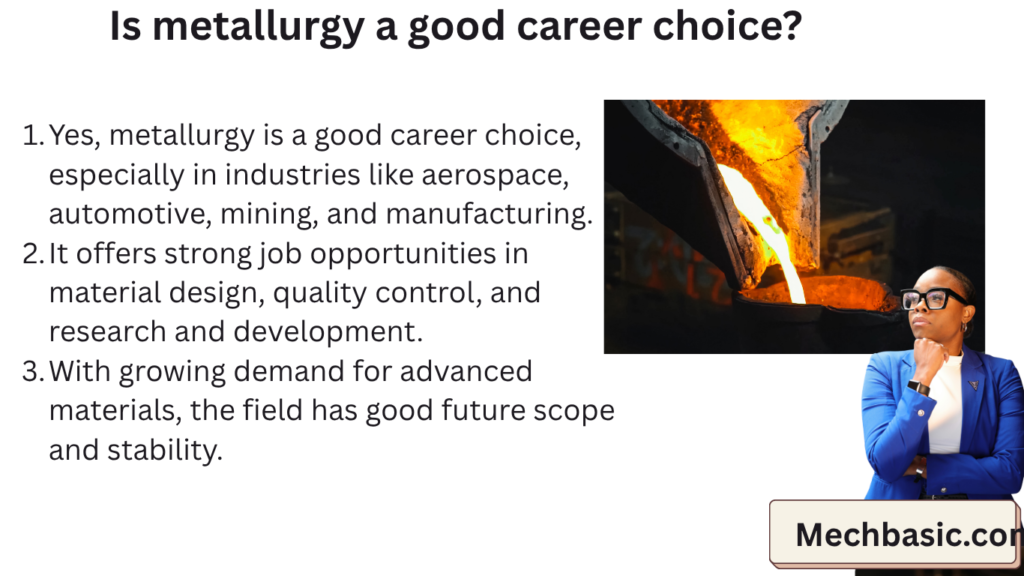
Yes, metallurgy is a good career choice, especially in industries like aerospace, automotive, mining, and manufacturing.
It offers strong job opportunities in material design, quality control, and research and development.
With growing demand for advanced materials, the field has good future scope and stability.
In this article:
Yes—metallurgy is a very good career choice, especially if you are interested in materials science, engineering design, manufacturing, aerospace, automotive, and advanced technologies. However, like any field, it has strengths and limitations, so the “goodness” depends on your interests and goals.
Let’s break it down clearly.
Is Metallurgy a Good Career?
1. Strong Demand in Core Industries
Metallurgy is essential in almost every engineering sector:
Key industries
- Aerospace ✈️
- Automotive 🚗
- Steel & manufacturing 🏭
- Defence & weapons systems
- Energy (nuclear, thermal, renewable) ⚡
- Construction & infrastructure 🌉
👉 Metals are everywhere—so metallurgists are always needed.
2. Good Career Roles
A metallurgy graduate or materials engineer can work as:
Core roles
- Metallurgical Engineer
- Materials Engineer
- Quality Control Engineer
- Failure Analysis Engineer
- Research & Development (R&D) Scientist
- Welding / Heat Treatment Engineer
3. High Importance in Modern Technology
Metallurgy is becoming more advanced due to:
Emerging fields
- Additive manufacturing (3D metal printing)
- Nanomaterials
- High-entropy alloys
- Smart materials
- Aerospace-grade alloys
- Biomedical implants
👉 This means metallurgy is not outdated—it is evolving fast.
4. Salary Potential
Entry-level
- Moderate compared to IT fields
- Depends heavily on company and role
Growth
- In core companies (steel, aerospace, PSU):
- Salary increases steadily with experience
High-paying sectors
- Aerospace
- Defence
- Oil & gas
- R&D labs
- Multinational manufacturing companies
5. Education Path
Common routes:
- B.E./B.Tech in Metallurgical Engineering
- M.Tech in Materials Science / Metallurgy
- PhD for research roles
6. Job Stability
Advantages
- Stable demand in core industries
- Essential for infrastructure and manufacturing
Limitation
- Fewer companies compared to IT
- Jobs are more location-dependent (industrial zones)
7. Global Opportunities
Metallurgists are needed worldwide:
- USA 🇺🇸 (aerospace, defense)
- Germany 🇩🇪 (automotive, manufacturing)
- Japan 🇯🇵 (advanced materials)
- Middle East 🇦🇪 (oil & gas)
8. Advantages vs Disadvantages as a Career
Advantages
- Core engineering field
- Stable industries
- High technical value
- Strong role in innovation
Disadvantages
- Fewer job openings than IT
- Requires deep technical knowledge
- Fieldwork or plant environments may be required
- Slower salary growth initially compared to software jobs
9. Who Should Choose Metallurgy?
👉 Good fit if you:
- Like physics, chemistry, and materials
- Enjoy manufacturing and machines
- Want core engineering jobs
- Are interested in aerospace or R&D
Not ideal if you:
- Want only high-paying quick-entry IT jobs
- Prefer pure software careers
- Don’t like industrial environments
Summary:
👉 Metallurgy is a high-value core engineering field with:
- Strong industrial importance
- Good long-term stability
- Growing relevance in advanced technologies
But:
- It requires patience and technical depth for career growth
Conclusion:
Metallurgy is a good career choice because it has strong demand in core industries like aerospace, automotive, and manufacturing. It offers stable jobs, research opportunities, and growing importance in advanced materials, though job opportunities are fewer compared to IT fields.
Other courses:





