
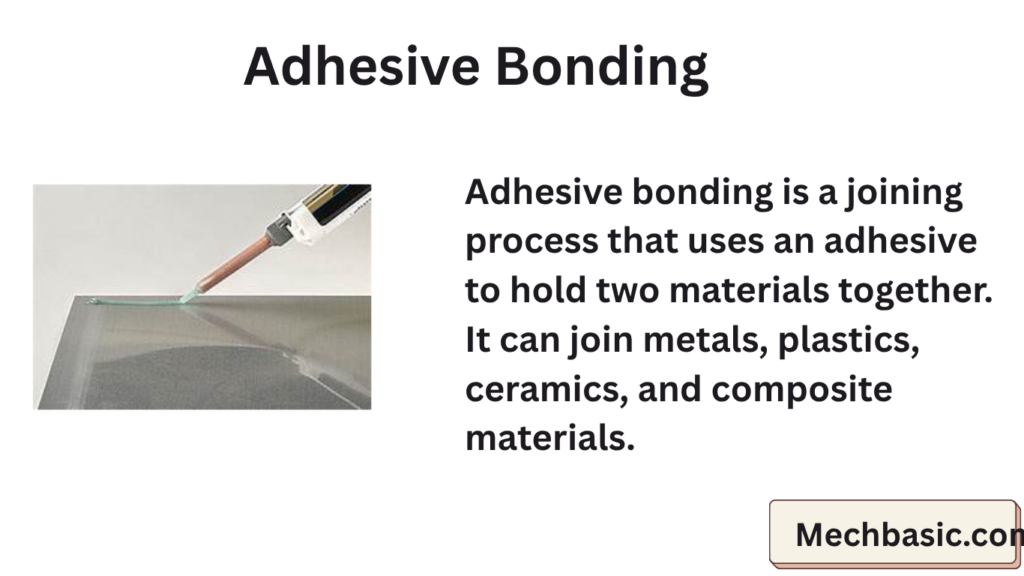
Adhesive bonding is a joining process that uses an adhesive to hold two materials together.
It can join metals, plastics, ceramics, and composite materials.
This method provides good bonding strength and distributes stress evenly.
In this article:
- Adhesive Bonding :
- Definition
- Principle of adhesive bonding
- Mechanisms of adhesion
- Components of adhesive bonding
- Types of adhesives
- Classification by curing mechanism
- Adhesive bonding process
- Types of adhesive joints
- Properties of a good adhesive
- Advantages of adhesive bonding
- Disadvantages of adhesive bonding
- Applications of adhesive bonding
- Comparison with welding and riveting
- Conclusion
Adhesive Bonding :
Adhesive bonding is a joining process in which two or more surfaces are joined together using an adhesive material. The adhesive is applied between the surfaces and forms a bond after curing, creating a strong connection without melting the base materials or using mechanical fasteners.
It is widely used in automotive, aerospace, electronics, construction, medical devices, packaging, and manufacturing industries because it can join similar and dissimilar materials.
Definition
Adhesive bonding is a process of joining materials by applying an adhesive between surfaces to create a permanent or semi-permanent bond through physical and/or chemical attraction.
Principle of adhesive bonding
Adhesive bonding works through:
- Adhesion → attraction between adhesive and surface
- Cohesion → internal strength within the adhesive
For a successful bond:
- Adhesive must wet the surface properly
- It must spread uniformly
- It must cure and develop strength
Mechanisms of adhesion
Several theories explain bonding:
1. Mechanical interlocking
Adhesive flows into microscopic surface irregularities and locks into them.
2. Chemical bonding
Chemical reactions create strong molecular bonds.
3. Electrostatic attraction
Electrical attraction develops between surfaces.
4. Diffusion theory
Molecules from adhesive and material interpenetrate.
Components of adhesive bonding
The system generally includes:
Adhesive material
Substances used for bonding.
Examples:
- Epoxy
- Acrylic
- Polyurethane
- Silicone
- Cyanoacrylate
- Phenolic adhesives
Adherends
Materials being joined.
Examples:
- Metals
- Plastics
- Ceramics
- Glass
- Wood
- Composites
Surface preparation
Cleaning and treatment improve bonding.
Types of adhesives
1. Natural adhesives
Derived from natural sources.
Examples:
- Starch
- Animal glue
- Natural rubber
Applications:
- Paper
- Packaging
- Wood
2. Synthetic adhesives
Man-made adhesives.
Examples:
- Epoxy
- Acrylic
- Polyurethane
Applications:
- Engineering and industrial use
Classification by curing mechanism
Thermosetting adhesives
Harden permanently.
Examples:
- Epoxy
- Phenolic resin
Properties:
- High strength
- Heat resistance
Thermoplastic adhesives
Soften on heating.
Examples:
- Hot-melt adhesives
Elastomeric adhesives
Remain flexible.
Examples:
- Silicone
- Rubber-based adhesives
Adhesive bonding process
The process generally consists of several steps.
Step 1: Surface preparation
Surfaces are cleaned to remove:
- Oil
- Dust
- Rust
- Grease
- Oxides
Methods:
- Solvent cleaning
- Sanding
- Chemical treatment
- Abrasive blasting
This is one of the most important steps.
Step 2: Surface treatment
Additional treatment may improve adhesion.
Methods:
- Priming
- Plasma treatment
- Etching
Step 3: Adhesive application
Adhesive is applied by:
- Brushing
- Spraying
- Rolling
- Dispensing
- Film application
Uniform thickness is important.
Step 4: Assembly
Parts are aligned and pressed together.
Pressure may be applied using:
- Clamps
- Fixtures
- Presses
Step 5: Curing
Adhesive develops strength through curing.
Methods:
- Room-temperature curing
- Heat curing
- UV curing
- Moisture curing
Step 6: Inspection
Check for:
- Voids
- Misalignment
- Bond quality
Types of adhesive joints
Common joint designs include:
Lap joint
Overlapping surfaces are bonded.
Butt joint
Ends are joined directly.
Scarf joint
Angled surfaces increase area.
T-joint
Forms a T-shaped connection.
Edge joint
Edges of materials are joined.
Properties of a good adhesive
A suitable adhesive should have:
- High strength
- Good wettability
- Chemical resistance
- Heat resistance
- Durability
- Good curing characteristics
- Compatibility with materials
Advantages of adhesive bonding
Can join dissimilar materials
Examples:
- Metal to plastic
- Metal to composites
Uniform stress distribution
Reduces stress concentration.
No drilling required
Preserves structural integrity.
Lightweight joining
Useful in aerospace and automotive industries.
Seals and joins simultaneously
Provides leak resistance.
Good appearance
No visible fasteners.
Disadvantages of adhesive bonding
Surface preparation required
Poor cleaning reduces bond quality.
Cure time needed
Some adhesives require long curing periods.
Limited high-temperature performance
Certain adhesives degrade under heat.
Difficult inspection
Internal defects may be hidden.
Difficult disassembly
Permanent bonds can be hard to separate.
Applications of adhesive bonding
Automotive industry
- Body panels
- Windshields
- Interior components
Aerospace industry
- Composite structures
- Aircraft panels
Electronics
- Circuit assembly
- Device packaging
Construction
- Flooring
- Structural panels
Medical field
- Devices
- Dental bonding
Packaging industry
- Cartons
- Labels
Comparison with welding and riveting
| Feature | Adhesive bonding | Welding | Riveting |
|---|---|---|---|
| Heat required | No | Yes | No |
| Join dissimilar materials | Yes | Limited | Yes |
| Weight | Low | Moderate | Higher |
| Stress concentration | Low | Moderate | High |
| Surface preparation | Important | Moderate | Less |
Conclusion
Adhesive bonding is a versatile joining process that uses adhesives to create strong connections between materials. It offers advantages such as joining dissimilar materials, low weight, good appearance, and uniform stress distribution, making it highly valuable in modern engineering and manufacturing industries.
Other courses:



Adhe




