
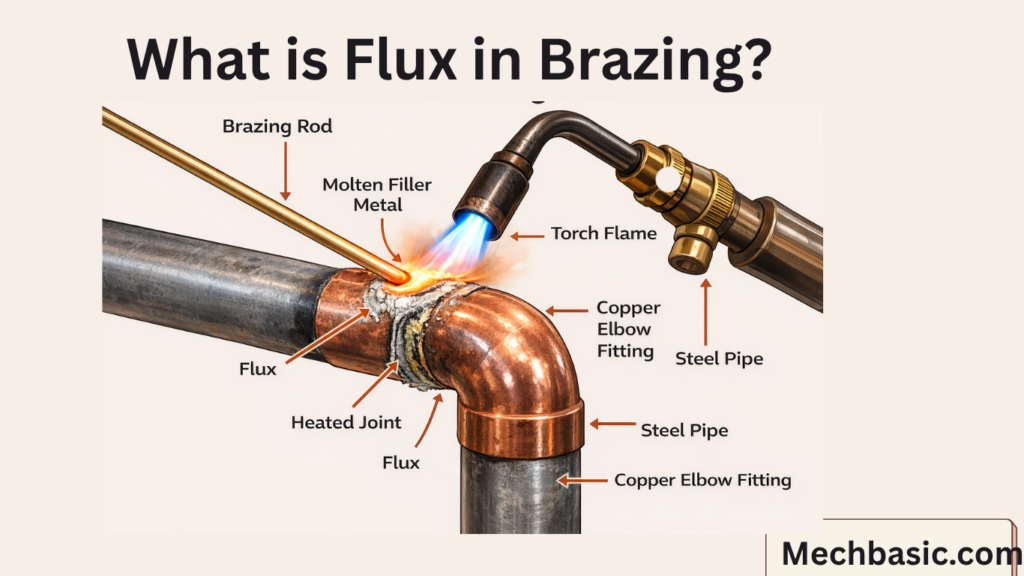
In brazing, flux is used to prevent oxidation of the base metals and filler during heating.
It helps the molten filler flow smoothly into the joint by cleaning and protecting the metal surfaces.
Flux ensures a strong, clean, and defect-free joint.
In this article:
Here’s a detailed explanation of the role of flux in brazing, why it’s essential, and how it’s used:
1. Definition of Flux in Brazing
Flux is a chemical agent applied to metal surfaces before brazing. Its main purpose is to:
- Prevent oxidation of base metals and filler metals during heating.
- Clean the metal surface by dissolving oxides and impurities.
- Promote capillary action, allowing the molten filler metal to flow smoothly into the joint.
Without flux, oxidation can prevent proper wetting, leading to weak or incomplete joints.
2. Functions of Flux
a) Prevents Oxidation
- During brazing, metals are heated to high temperatures (450–1200°C).
- Metal surfaces naturally form oxides that resist bonding.
- Flux forms a protective barrier between metal and air, preventing oxide formation.
b) Cleans the Surface
- Flux chemically reacts with existing oxides or impurities on the metal surface.
- This cleaning action ensures good wetting of the filler metal.
c) Promotes Capillary Action
- Flux helps the molten filler metal flow evenly into the joint gap.
- Improves joint uniformity and strength.
d) Reduces Surface Tension
- Flux lowers the surface tension of the molten filler metal, allowing it to spread easily and bond with the base metals.
3. Types of Flux
a) Borax-Based Flux
- Common for copper and brass brazing.
- Forms a glassy layer over the joint to prevent oxidation.
b) Fluoride-Based Flux
- Used for aluminum brazing.
- Handles highly reactive metals that oxidize quickly.
c) Phosphate-Based Flux
- Often used for steel brazing.
- Dissolves oxides and improves filler flow.
d) Flux-Free Brazing
- In some controlled-atmosphere furnace brazing, flux is unnecessary.
- Protective gases like nitrogen, hydrogen, or forming gas prevent oxidation.
4. Methods of Applying Flux
- Powder Flux – sprinkled over joint surfaces.
- Paste Flux – a viscous mixture applied with a brush.
- Liquid Flux – brushed or sprayed onto the joint.
- Flux-Coated Filler Rods – flux applied directly on the filler metal for convenience.
5. What Happens if Flux is Not Used?
- Molten filler won’t wet the base metals properly.
- Oxidation may form weak, porous, or incomplete joints.
- Surface discoloration or corrosion may occur after brazing.
- Capillary action may fail → filler metal won’t flow evenly.
6. Summary Table
| Function | Description |
|---|---|
| Prevent Oxidation | Forms protective barrier during heating |
| Clean Surface | Dissolves oxides and impurities |
| Promote Capillary Action | Helps filler metal flow into the joint gap |
| Reduce Surface Tension | Improves spreading of molten filler |
Conclusion:
- Flux is essential in brazing for clean, strong, and uniform joints.
- It prevents oxidation, cleans surfaces, and enhances filler flow.
- Some modern brazing methods (furnace or controlled atmosphere) can be flux-free if oxidation is prevented by inert or reducing gases.
- Using the correct flux type for the metal is crucial for achieving high-quality joints.
Other courses:





