
In this article:
Here’s a detailed explanation of the five primary welding joints, including their geometry, applications, advantages, and challenges:
Types of Welding Joint :
Here’s a detailed explanation of the five primary welding joints, including their geometry, applications, advantages, and challenges:
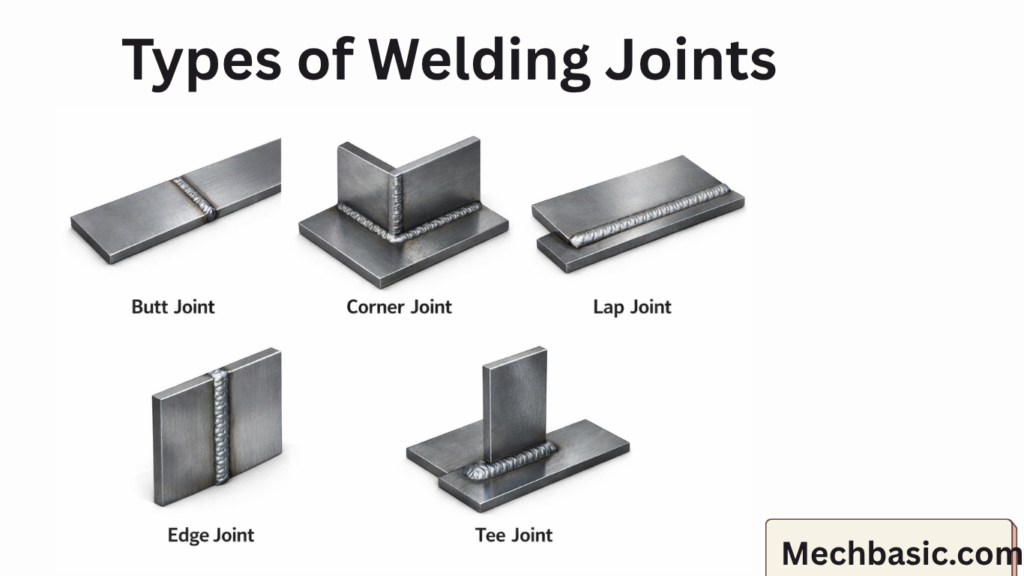
- Butt Joint – Two pieces are aligned in the same plane and welded at the edge.
- Corner Joint – Two pieces meet at a right angle, forming an “L” shape.
- Lap Joint – One piece overlaps the other and is welded at the overlap.
- Edge Joint – Edges of two or more pieces are placed side by side and welded along the edge.
- Tee Joint – One piece is perpendicular to the other, forming a “T” shape.
1. Butt Joint
Definition
A butt joint is formed when two pieces of metal are placed edge to edge in the same plane and joined along their contacting edges.
Characteristics
- Simple geometry: the two edges meet directly.
- Can be welded from one or both sides.
- Groove preparation (bevels) may be used for thicker metals to ensure full penetration.
Applications
- Pipe and tube welding
- Sheet metal fabrication
- Structural steel frames
Advantages
- Easy to prepare and align
- Strong weld if properly executed
- Suitable for thin and thick metals
Disadvantages
- For thicker metals, requires groove preparation and more filler material
- Misalignment can reduce weld strength
2. Lap Joint
Definition
A lap joint is formed when two metal pieces overlap each other and are welded at the overlapping area.
Characteristics
- Common for thin sheets or plates.
- Welds are usually placed along the edges of the overlap.
- Easy to fabricate and requires minimal edge preparation.
Applications
- Automotive panels
- Sheet metal assemblies
- Electrical enclosures
Advantages
- Simple to make
- Good for thin materials
- Provides extra joint surface area
Disadvantages
- Less suitable for thick metals
- Can trap moisture → risk of corrosion in the overlap
- Stress distribution is not uniform → potential fatigue issues
3. Corner Joint
Definition
A corner joint is formed when two metal pieces meet at a right angle, forming an L-shaped joint.
Characteristics
- One plate is usually vertical, the other horizontal (forming a corner).
- Welds are applied along the inside or outside of the corner.
- Can be single or double fillet welds depending on strength requirement.
Applications
- Box structures
- Frames and enclosures
- Sheet metal fabrication
Advantages
- Easy to align and weld
- Ideal for fabricating box-type structures
- Good for aesthetic purposes
Disadvantages
- Weld area may be smaller → lower strength than butt joint
- Corners can be stress concentrators if loaded
4. Edge Joint
Definition
An edge joint is formed when two metal pieces are placed side by side with their edges in contact and welded along the edge.
Characteristics
- Typically used for thin sheets.
- Can be single or double edge welds.
- Often requires edge preparation for thicker sheets.
Applications
- Sheet metal containers
- Boxes, tanks, and trays
- Light structural applications
Advantages
- Simple and quick to weld
- Minimal preparation needed for thin sheets
Disadvantages
- Limited strength → mostly used for light loads
- Not suitable for high-stress applications
5. Tee Joint
Definition
A tee joint is formed when one metal piece is positioned perpendicular to the middle of another, forming a T-shaped configuration.
Characteristics
- One plate is vertical, the other horizontal (like the letter T).
- Welds are applied along the intersecting edge (fillet welds).
- Can be single or double fillet depending on load requirements.
Applications
- Structural steel frameworks
- Pipe supports
- Mechanical assemblies
Advantages
- Strong for perpendicular load applications
- Easy to fabricate
- Common in structural steel construction
Disadvantages
- Stress concentration at the intersection
- Requires good weld technique for full penetration and strength
Summary Table:
| Joint Type | Description | Common Use | Advantages | Disadvantages |
|---|---|---|---|---|
| Butt Joint | Edges of two metals meet in the same plane | Pipes, frames, sheet metal | Strong, simple | Groove prep needed for thick metal |
| Lap Joint | One piece overlaps another | Thin sheets, automotive panels | Easy, good for thin metals | Traps moisture, non-uniform stress |
| Corner Joint | Two metals meet at a right angle (L-shape) | Boxes, enclosures | Easy to align, aesthetic | Lower strength than butt joint |
| Edge Joint | Edges in contact, welded along edge | Sheet metal containers | Quick, minimal prep | Weak, light-load only |
| Tee Joint | One plate perpendicular to middle of another (T-shape) | Structural steel, pipe supports | Strong for perpendicular loads | Stress concentration at intersection |
Conclusion:
- Butt joint – edge-to-edge, strong, widely used.
- Lap joint – overlapping edges, good for thin sheets, may trap moisture.
- Corner joint – L-shaped, used for frames and boxes.
- Edge joint – edges in contact, mostly for thin sheets, limited strength.
- Tee joint – perpendicular intersection, strong for structural applications.
Other courses:





