
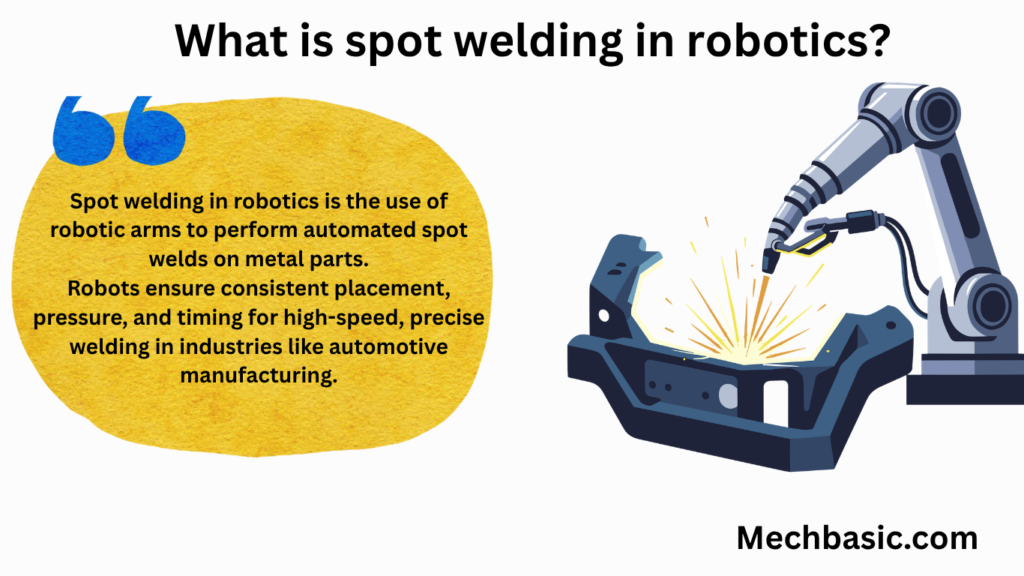
Spot welding in robotics is the use of robotic arms to perform automated spot welds on metal parts.
Robots ensure consistent placement, pressure, and timing for high-speed, precise welding in industries like automotive manufacturing.
This automation increases productivity, quality, and safety by reducing human exposure to heat and fumes.
In this article:
Here’s a detailed explanation of spot welding in robotics, including how it works, equipment, advantages, and applications:
1. Definition
Spot welding in robotics refers to the automation of resistance spot welding using industrial robots. Instead of a human operator manually positioning electrodes and controlling the weld, a robot arm performs the welding with precision, speed, and repeatability.
- The process is widely used in automobile manufacturing, appliance production, and high-volume sheet metal fabrication.
- The robot controls electrode positioning, pressure, timing, and current, ensuring consistent welds.
2. How Robotic Spot Welding Works
- Programming and Path Planning
- A robot is programmed with the exact weld locations on the workpiece.
- The path, speed, and electrode approach angle are defined.
- Material Handling
- Sheets or panels are clamped or fixtured to ensure they stay in the correct position during welding.
- Weld Execution
- The robot arm moves the spot welding torch to the designated location.
- Electrodes apply mechanical pressure to the sheets.
- A high current passes through, forming a weld nugget.
- The current is switched off, but the electrodes maintain pressure until the weld solidifies.
- Cycle Repetition
- The robot moves to the next weld point automatically.
- Can perform hundreds or thousands of welds per hour with consistent quality.
3. Equipment for Robotic Spot Welding
| Component | Function |
|---|---|
| Industrial Robot Arm | Positions the welding torch accurately and repeatedly |
| Spot Welding Gun / End Effector | Houses electrodes, applies pressure, delivers current |
| Spot Welding Power Supply | Provides low-voltage, high-current for welding |
| Fixture / Clamp System | Holds the metal sheets securely |
| Controller / Software | Programs weld sequence, timing, force, and current |
| Cooling System | Water-cooled electrodes prevent overheating |
Modern systems may also include vision sensors or laser guidance to ensure precise alignment.
4. Advantages of Robotic Spot Welding
- High Speed and Productivity
- Robots can perform hundreds of welds in minutes.
- Consistency and Quality
- Eliminates human error; weld nugget size and position are uniform.
- Safety
- Operators are removed from high-current, high-temperature welding zones.
- Reduced Labor Costs
- Fewer human welders needed for repetitive tasks.
- Precision
- Robots can weld tight tolerances and complex geometries.
- Integration with Production Lines
- Easily automated with conveyors, presses, and assembly robots.
5. Disadvantages / Challenges
- High Initial Cost – industrial robots, power supply, and fixtures are expensive.
- Programming Complexity – requires engineers to program paths, welding parameters, and safety protocols.
- Limited Flexibility for Low-Volume Jobs – better suited for mass production.
- Maintenance Requirements – robots and welding guns need regular servicing.
- Electrode Wear – copper electrodes must be replaced periodically.
6. Applications
| Industry | Use Case |
|---|---|
| Automotive | Car body panels, chassis, door frames |
| Appliance Manufacturing | Washing machine panels, refrigerator sheets |
| Electronics | Battery tab welding, metal enclosures |
| Aerospace | Thin sheet assemblies for aircraft interiors |
| Metal Furniture | Sheet metal frames and panels |
Automotive manufacturing is the largest user of robotic spot welding, often using multiple robots working simultaneously on large car bodies.
7. Comparison: Manual vs Robotic Spot Welding
| Feature | Manual Spot Welding | Robotic Spot Welding |
|---|---|---|
| Speed | Moderate | Very fast (hundreds per hour) |
| Consistency | Variable | High, reproducible welds |
| Safety | Moderate risk to operator | Higher, operator away from weld |
| Labor Requirement | Skilled welder per station | Minimal operators, mostly supervisors |
| Precision | Limited | High, precise positioning |
| Cost | Low initial cost | High initial investment, lower long-term labor cost |
Summary
- Robotic spot welding is automated resistance welding using robots to position electrodes and execute welds.
- Key benefits: speed, precision, consistency, safety, and integration with automated production lines.
- Best suited for: mass production of thin sheet metals, particularly in the automotive and appliance industries.
- Limitations: high setup cost, maintenance, and less flexibility for small-scale or custom jobs.
Other courses:





