
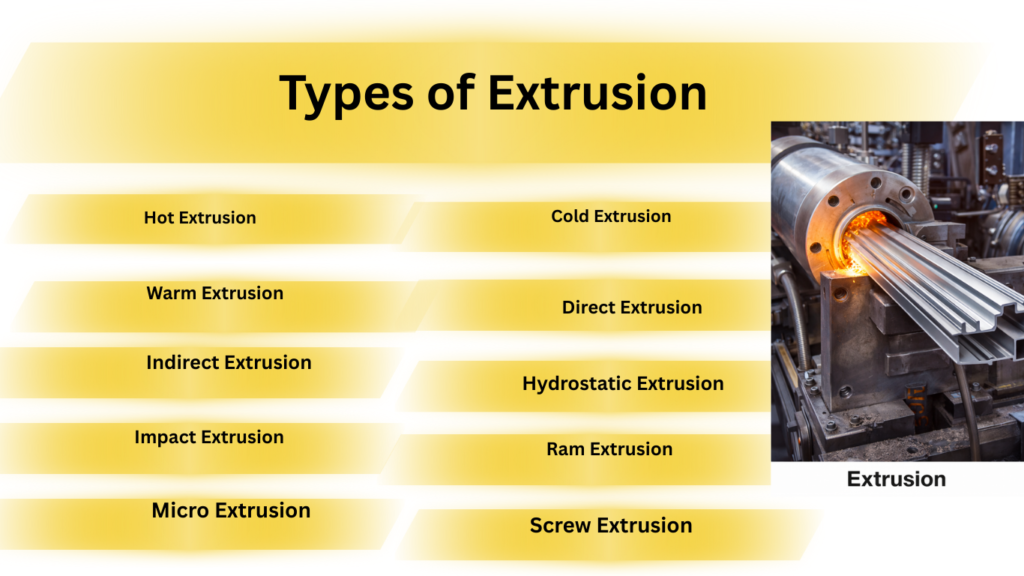
Types of Extrusion
Extrusion processes are classified based on temperature, direction of material flow, working principle, and application. Each type is chosen depending on material, shape complexity, surface finish, and production requirements.
In this article:
- Types of Extrusion
- 1. Types of Extrusion Based on Temperature
- 2. Types of Extrusion Based on Direction of Metal Flow
- 3. Types of Extrusion Based on Working Principle
- 4. Types of Extrusion Based on Product Shape
- 5. Types of Extrusion Based on Pressure Medium
- 6. Special Extrusion Processes
- 7. Summary Table
- 8. Conclusion
1. Types of Extrusion Based on Temperature
1.1 Hot Extrusion
- Performed above the recrystallization temperature of the material.
- Material flows easily due to reduced flow stress.
Characteristics
- Large deformation possible
- High extrusion speed
- Lower extrusion force
Advantages
- No strain hardening
- Suitable for brittle materials
- Complex shapes possible
Disadvantages
- Oxidation
- Poor surface finish
- Die wear
Materials
- Aluminum, copper, magnesium, steel
Applications
- Structural profiles
- Pipes
- Automotive and aerospace parts
1.2 Cold Extrusion
- Performed at room temperature or slightly above.
- Material undergoes strain hardening.
Characteristics
- High dimensional accuracy
- Excellent surface finish
Advantages
- No oxidation
- High strength products
- Less machining required
Disadvantages
- High force required
- Limited deformation
- Tool wear
Materials
- Aluminum, lead, tin, copper
Applications
- Collapsible tubes
- Fasteners
- Small precision components
1.3 Warm Extrusion
- Carried out at temperatures between hot and cold extrusion.
- Reduces force while maintaining surface finish.
Applications
- Steel components
- Automotive parts
2. Types of Extrusion Based on Direction of Metal Flow
2.1 Direct (Forward) Extrusion
- Material flows in the same direction as ram movement.
- High friction between billet and container.
Advantages
- Simple die design
- Widely used
Disadvantages
- High extrusion force
- Container wear
Applications
- Rods
- Channels
- Tubes
2.2 Indirect (Backward) Extrusion
- Die moves into stationary billet.
- Material flows opposite to ram direction.
Advantages
- Lower friction
- Lower force
Disadvantages
- Limited product length
- Complex equipment
Applications
- Hollow sections
- Precision components
2.3 Hydrostatic Extrusion
- Billet surrounded by pressurized fluid.
- No billet-container contact.
Advantages
- Very low friction
- Suitable for brittle materials
Disadvantages
- High equipment cost
- Fluid sealing problems
Applications
- Tungsten
- Titanium
- Ceramics
2.4 Impact Extrusion
- High-speed extrusion using mechanical press.
- Usually cold extrusion.
Advantages
- High production rate
- Thin-walled products
Applications
- Toothpaste tubes
- Aluminum cans
- Battery cases
3. Types of Extrusion Based on Working Principle
3.1 Conventional Extrusion
- Ram forces billet through fixed die.
- Most common type.
3.2 Continuous Extrusion
- Material is continuously fed into machine.
- Uses rotating wheel and abutment.
Example
- Conform extrusion process
Applications
- Copper wires
- Aluminum strips
3.3 Co-extrusion
- Two or more materials extruded together.
- Produces multi-layer products.
Applications
- Multi-layer pipes
- Insulated cables
- Packaging films
4. Types of Extrusion Based on Product Shape
4.1 Solid Extrusion
- Produces solid sections.
Examples
- Rods
- Bars
- Angles
4.2 Hollow Extrusion
- Produces hollow sections using mandrels.
Examples
- Pipes
- Tubes
5. Types of Extrusion Based on Pressure Medium
5.1 Ram Extrusion
- Uses a piston (ram) to apply pressure.
- Used in metal extrusion.
5.2 Screw Extrusion
- Uses a rotating screw.
- Used in polymer extrusion.
6. Special Extrusion Processes
6.1 Micro-extrusion
- Produces very small cross-section components.
- Used in medical devices.
6.2 Reactive Extrusion
- Chemical reaction occurs during extrusion.
- Used in polymer processing.
7. Summary Table
| Classification | Type |
|---|---|
| Temperature | Hot, Warm, Cold |
| Direction | Direct, Indirect, Hydrostatic, Impact |
| Principle | Conventional, Continuous, Co-extrusion |
| Shape | Solid, Hollow |
| Pressure | Ram, Screw |
8. Conclusion
Extrusion is a highly versatile manufacturing process with various types tailored to material behavior, product complexity, and production volume. Proper selection ensures high-quality products, cost efficiency, and minimum defects.
Other courses:





