
A sweep pattern is a type of pattern used in casting where a shaped board or metal plate is rotated around a fixed axis to form the mould cavity. It is commonly used to produce large, symmetrical castings such as pipes and bells.
In this article:
- Sweep Pattern in Manufacturing Process (Casting)
- 1. Definition of Sweep Pattern
- 2. Principle of Sweep Pattern
- 3. Construction of a Sweep Pattern
- 4. Procedure (Step-by-Step)
- 5. Applications of Sweep Pattern
- 6. Advantages of Sweep Pattern
- 7. Limitations of Sweep Pattern
- 8. Comparison: Sweep Pattern vs Solid Pattern
- 9. Key points to Remember
- 10. Conclusion
- 11. Summary
Sweep Pattern in Manufacturing Process (Casting)
A sweep pattern is a type of pattern used in casting to produce large, simple, and axisymmetric shapes. Instead of a complete pattern, a shaped wooden or metal sweep is rotated around a central spindle to form the mould cavity accurately and economically.
1. Definition of Sweep Pattern
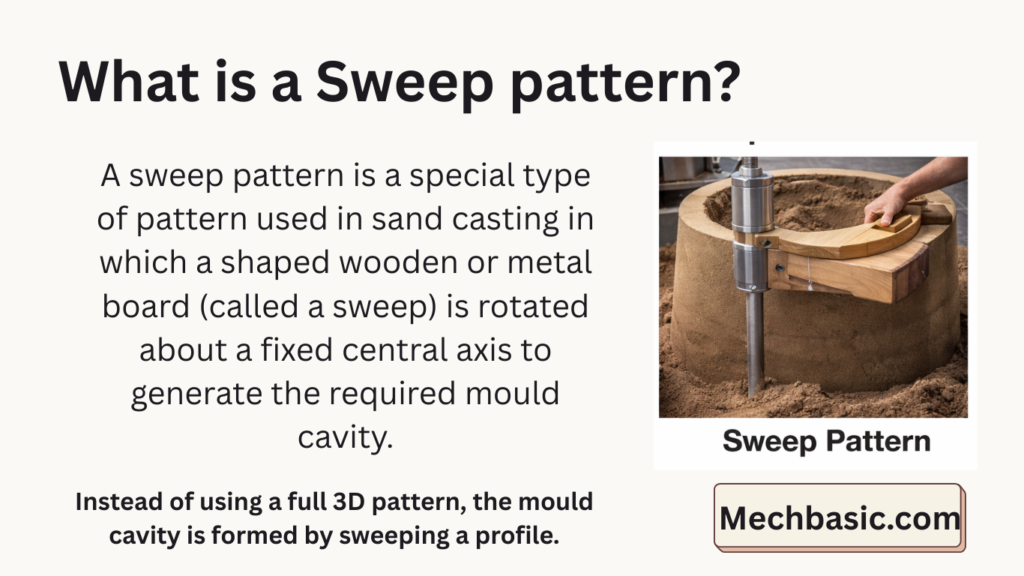
A sweep pattern is a special type of pattern used in sand casting in which a shaped wooden or metal board (called a sweep) is rotated about a fixed central axis to generate the required mould cavity.
👉 Instead of using a full 3D pattern, the mould cavity is formed by sweeping a profile.
2. Principle of Sweep Pattern
- A vertical spindle or post is fixed at the centre of the mould
- The sweep board, cut to the required cross-section of the casting, is attached to the spindle
- Sand is rammed around the spindle
- The sweep is rotated (swept) around the axis
- Excess sand is removed, leaving the desired mould cavity
This method is ideal for axisymmetric or circular shapes.
3. Construction of a Sweep Pattern
A sweep pattern consists of:
- Sweep Board
- Shaped like the cross-section of the casting
- Made of wood or metal
- Central Spindle / Pivot
- Acts as axis of rotation
- Base Plate
- Supports mould and spindle
4. Procedure (Step-by-Step)
- Fix the spindle at the centre of moulding box
- Ram moulding sand around the spindle
- Attach sweep board to spindle
- Rotate sweep through 360°
- Remove excess sand to form cavity
- Withdraw sweep and spindle carefully
- Prepare mould for pouring
5. Applications of Sweep Pattern
Used for large, symmetrical castings, such as:
- Large pipes
- Chimney bases
- Bells
- Flywheels
- Manhole covers
- Turbine casings
Especially useful when quantity is small but size is large.
6. Advantages of Sweep Pattern
- Low cost compared to full pattern
- Ideal for large-sized castings
- Simple construction
- Saves time and material
- Suitable for one-off or small-batch production
7. Limitations of Sweep Pattern
- Applicable only to circular or axisymmetric shapes
- Requires skilled labour
- Lower dimensional accuracy
- Time-consuming for complex profiles
- Not suitable for mass production
8. Comparison: Sweep Pattern vs Solid Pattern
| Aspect | Sweep Pattern | Solid Pattern |
|---|---|---|
| Shape | Circular / symmetrical | Any shape |
| Cost | Very low | High for large castings |
| Accuracy | Moderate | High |
| Production | Small quantity | Medium to large |
| Pattern type | Partial | Complete |
9. Key points to Remember
- Sweep pattern is not a full pattern
- Produces mould cavity by rotation
- Used when making a full pattern is uneconomical
- Mostly used in large cast iron castings
10. Conclusion
A sweep pattern is a pattern used in sand casting where a shaped board is rotated about a central axis to generate the mould cavity for large, symmetrical castings.
11. Summary
- Sweep pattern = rotating profile tool
- Best for large, circular castings
- Economical and simple
- Limited to symmetrical shapes
Other courses:





