
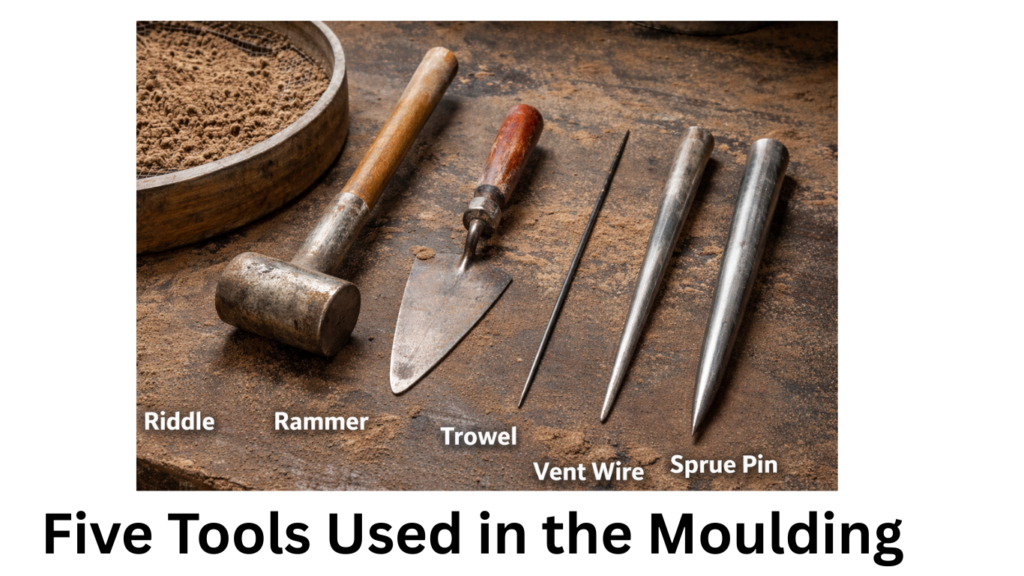
Moulding tools are hand tools used to prepare and finish mould cavities in the casting process. The five commonly used moulding tools are riddle, rammer, trowel, lifter, and vent wire.
In this article:
Five Tools Used in the Moulding Process
In foundry moulding (sand casting), moulding tools are the hand tools used to prepare, shape, and finish the sand mould around the pattern.
Most syllabi group these into five basic moulding tools and expect a clear explanation of each.
1. Riddle
Description
A riddle is a wire-mesh sieve mounted in a wooden or metal frame.
Function
- Used to separate fine sand from coarse particles
- Ensures uniform grain size near the pattern
Use in moulding
- First layer of sand is riddled over the pattern
- Improves surface finish of the mould cavity
Importance
- Prevents rough casting surface
- Avoids defects caused by oversized sand grains
2. Rammer
Description
A rammer is a hand tool with:
- Peen end (wedge-shaped)
- Butt end (flat, cylindrical)
Function
- Used to compact moulding sand
Use in moulding
- Peen end → ramming around pattern edges
- Butt end → ramming open areas
Importance
- Ensures adequate mould strength
- Prevents mould collapse during pouring
3. Trowel
Description
A flat, smooth metal tool with a handle.
Function
- Used to smooth and repair mould surfaces
- Shape corners and edges of mould cavity
Use in moulding
- Final finishing of mould
- Corrects minor surface defects
Importance
- Improves dimensional accuracy
- Enhances casting surface quality
4. Vent Wire
Description
A thin steel rod or wire with pointed end.
Function
- Used to make vent holes in moulding sand
Use in moulding
- Provides escape path for gases and air during pouring
Importance
- Prevents gas defects like blow holes and porosity
5. Sprue Pin
Description
A tapered cylindrical rod made of wood or metal.
Function
- Used to form the sprue (vertical pouring channel)
Use in moulding
- Inserted before ramming
- Removed after mould preparation
Importance
- Allows smooth entry of molten metal into the mould
- Reduces turbulence during pouring
Summary Table
| Tool | Main Function |
|---|---|
| Riddle | Sieving sand |
| Rammer | Compacting sand |
| Trowel | Finishing mould surface |
| Vent wire | Gas escape |
| Sprue pin | Forming pouring channel |
Conclusion
The five basic tools used in the moulding process are riddle, rammer, trowel, vent wire, and sprue pin, each serving a specific function in preparing a sound mould.
Other courses:





