
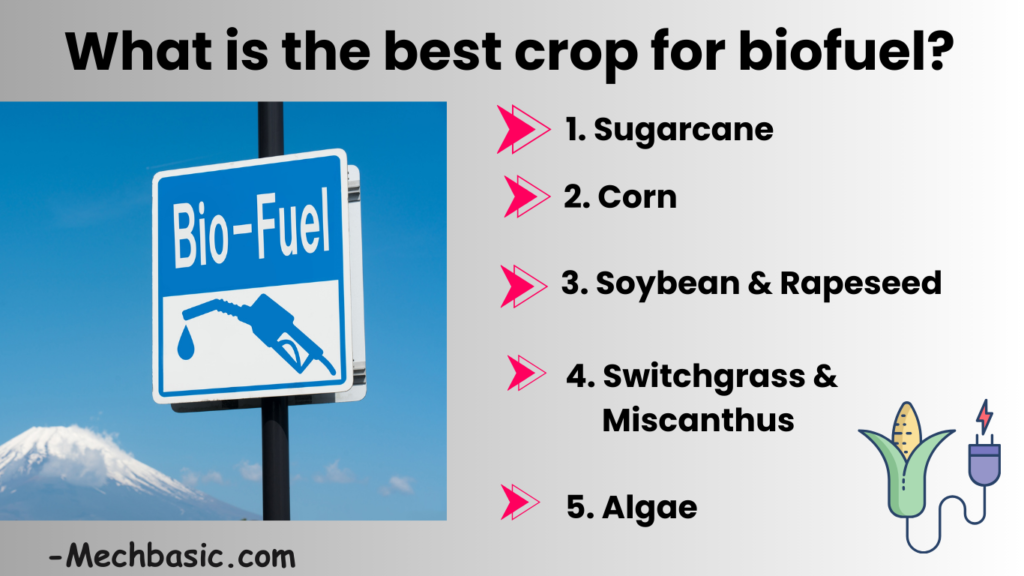
“best” biofuel crop—the ideal choice depends on climate, land availability, water use, and sustainability goals.
In general:
- Sugarcane is the most efficient biofuel crop worldwide, producing high ethanol yields with relatively low greenhouse gas emissions (especially in tropical regions).
- Corn dominates in countries like the U.S. due to existing farming infrastructure, though it has higher environmental trade-offs.
- Oil palm yields the most biodiesel per hectare but raises serious deforestation concerns.
- Switchgrass and other non-food grasses are promising next-generation options because they grow on marginal land and require fewer inputs.
Overall, locally suitable, non-food, high-yield crops are considered the most sustainable long-term solution for biofuels.
In this article:
What is the best crop for biofuel?
There isn’t a single “best” crop for biofuel in all situations. The best choice depends on climate, land quality, water availability, technology, and policy goals (energy yield vs. food security vs. emissions). Below is a detailed, evidence-based comparison of the leading biofuel crops and when each is optimal.
A biofuel crop is usually judged on five criteria:
- Energy yield per hectare
- Net greenhouse-gas reduction
- Water and fertilizer needs
- Impact on food supply
- Cost and scalability
1. Sugarcane (Overall Best for Ethanol)
Why it’s excellent
- Highest ethanol yield: ~6,000–8,000 liters/ha/year
- Very high energy return (EROI ≈ 8–10:1)
- Bagasse (residue) powers ethanol plants → low fossil input
- 70–90% lower CO₂ emissions than gasoline
Limitations
- Requires tropical climate
- High water demand
- Land-use change risks if forests are cleared
Best suited for
- Brazil, India, Southeast Asia, Africa
Verdict: Best-performing commercial biofuel crop today.
2. Corn (Most Widely Used, Not Most Efficient)
Strengths
- Existing infrastructure (especially in the U.S.)
- High starch content → easy fermentation
- Supports rural economies
Weaknesses
- Low net energy gain (EROI ≈ 1.3–1.6:1)
- Heavy fertilizer and water use
- Competes directly with food
- Only ~20–30% emissions reduction
Best suited for
- Temperate regions with large industrial farming capacity
Verdict: Politically and economically entrenched, but technically mediocre.
3. Soybean & Rapeseed (Best for Biodiesel)
Strengths
- Produces biodiesel, usable in diesel engines
- Valuable co-products (animal feed)
- Easier storage than ethanol
Weaknesses
- Low fuel yield per hectare
- Land-intensive
- Moderate emissions reduction (40–60%)
Best suited for
- Regions with existing oilseed agriculture (EU, Americas)
Verdict: Useful, but not land-efficient.
4. Switchgrass & Miscanthus (Best Second-Generation Crops)
Why they matter
- Grow on marginal land
- Minimal fertilizer
- Very high biomass yields
- Major carbon sequestration potential
Challenges
- Require cellulosic ethanol technology
- Processing costs still higher than sugar/starch crops
Best suited for
- Long-term sustainable bioenergy systems
Verdict: Best future land-based biofuel crops.
5. Algae (Highest Theoretical Potential)
Why it’s revolutionary
- Up to 10–20× more oil per hectare than crops
- Grows in saltwater or wastewater
- No competition with food
- Can absorb industrial CO₂
Why it’s not dominant (yet)
- High production costs
- Scaling challenges
- Energy-intensive harvesting
Best suited for
- Advanced, high-tech biofuel systems
Verdict: Best long-term solution, not yet economical.
Comparison Table:
| Crop | Fuel Type | Yield | Sustainability | Food Impact | Overall Rank |
|---|---|---|---|---|---|
| Sugarcane | Ethanol | ⭐⭐⭐⭐⭐ | ⭐⭐⭐⭐ | Medium | #1 Today |
| Corn | Ethanol | ⭐⭐ | ⭐⭐ | High | #4 |
| Soy/Rapeseed | Biodiesel | ⭐⭐ | ⭐⭐⭐ | High | #3 |
| Switchgrass | Cellulosic | ⭐⭐⭐⭐ | ⭐⭐⭐⭐⭐ | Low | #2 Future |
| Algae | Biodiesel | ⭐⭐⭐⭐⭐⭐ | ⭐⭐⭐⭐⭐ | None | #1 Long-Term |
Summary:
- Best overall today: Sugarcane
- Best sustainable land crop: Switchgrass / Miscanthus
- Best diesel alternative: Soybean / Rapeseed
- Best future technology: Algae
- Most overused: Corn
Other courses:





