
Drum brakes may look simple from the outside, but there are actually several types of drum brake systems, each with a slightly different mechanism for pushing the brake shoes against the drum.
Types of Drum Brake Systems
Here are the major types of drum brake system in automobile
1. Leading-Trailing Shoe (Single-Servo)
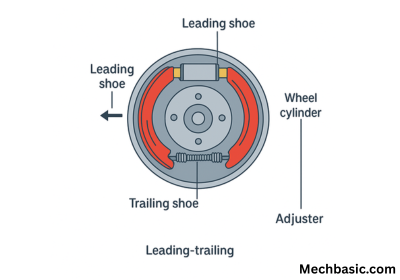
- Most common type in modern cars.
- One shoe is “leading” (moves with drum rotation), the other is “trailing” (moves against it).
- Provides consistent braking in forward and reverse.
- Simple and reliable, but less powerful than some other designs.
✅ Used in rear brakes of many passenger cars.
2. Twin Leading Shoe
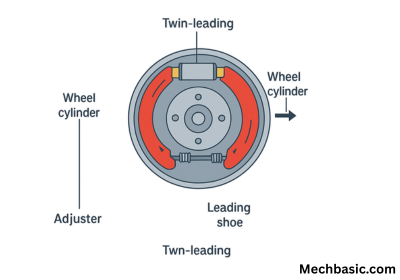
- Has two leading shoes (both move with drum rotation when braking forward).
- Provides stronger braking force than leading-trailing (good for front brakes).
- However, braking power in reverse is weaker.
✅ Used on front wheels of older cars, trucks, and some motorcycles.
3. Duo-Servo (Self-Energizing)
- Both shoes help each other apply force (linked through an adjuster at the bottom).
- Provides very strong braking force, especially forward.
- Can be prone to grabbing if not adjusted correctly.
✅ Common in older trucks and some performance applications.
4. Uni-Servo
- A simpler version of duo-servo — uses one wheel cylinder piston to push both shoes.
- Mostly found in small, lightweight vehicles.
- Lower cost but less braking power.
5. Mechanical (Parking/Handbrake Drum)
- A small drum brake often integrated into the rear disc brake rotor (called a drum-in-hat design).
- Used only for parking brake function, not regular braking.
📌 Summary Table
| Type | Key Feature | Strengths | Weaknesses |
|---|---|---|---|
| Leading-Trailing | 1 leading, 1 trailing shoe | Good forward & reverse braking | Moderate braking force |
| Twin Leading Shoe | 2 leading shoes | Strong forward braking | Weak reverse braking |
| Duo-Servo | Shoes assist each other | Very strong self-energizing | Sensitive to adjustment |
| Uni-Servo | Single piston, basic design | Cheap, simple | Weak braking power |
| Parking Brake Drum | Small drum inside rotor hat | Reliable handbrake function | Not for service braking |
FAQ Section:
1. What are the main types of drum brake systems?
The main types are:
- Leading-Trailing Shoe Brake (single leading shoe)
- Twin-Leading Shoe Brake
- Duo-Servo Brake
Each type differs in shoe arrangement, number of wheel cylinders, and braking performance.
2. What is a Leading-Trailing Shoe (Single Leading) Brake?
It has one leading shoe (self-energizing) and one trailing shoe (non-self-energizing).
- Simpler design
- Common in rear brakes of passenger cars
- Provides balanced braking in forward and reverse directions
3. What is a Twin-Leading Shoe Brake?
Both shoes act as leading shoes when braking forward, giving more braking force.
- Uses two wheel cylinders
- Commonly used in front brakes of older vehicles
- High efficiency in forward braking but less effective in reverse
4. What is a Duo-Servo Drum Brake?
A self-energizing system where both shoes assist each other during braking.
- Provides strong braking force
- Common in heavy-duty trucks, buses, trailers
- More complex, requires precise adjustment
5. Which type offers the strongest braking power?
Duo-Servo and Twin-Leading Shoe brakes offer the strongest braking force, making them suitable for high load applications or front brakes where more stopping power is needed.
6. Why is Leading-Trailing preferred for rear wheels?
Because it gives stable braking force in both directions (forward/reverse), which is important for rear wheels during parking brake applications.
7. Which type is best for frequent reverse operation (like in forklifts)?
Leading-Trailing Shoe Brake, since its performance is almost equal in both forward and reverse motion.
8. Why do Twin-Leading Shoe Brakes need two wheel cylinders?
To apply force to both shoes separately and make them act as leading shoes simultaneously — this increases forward braking efficiency.
9. Are drum brakes still used today?
Yes. Although disc brakes are common on front wheels, drum brakes are still widely used on rear wheels (especially in small cars) and heavy vehicles due to their lower cost and strong parking brake capability.
10. What are the disadvantages of drum brake systems compared to disc brakes?
- Heat dissipation is slower, leading to brake fade under heavy use
- More components (springs, adjusters) make them harder to service
- Heavier than disc brakes
- Less effective in wet conditions
Other courses:





