
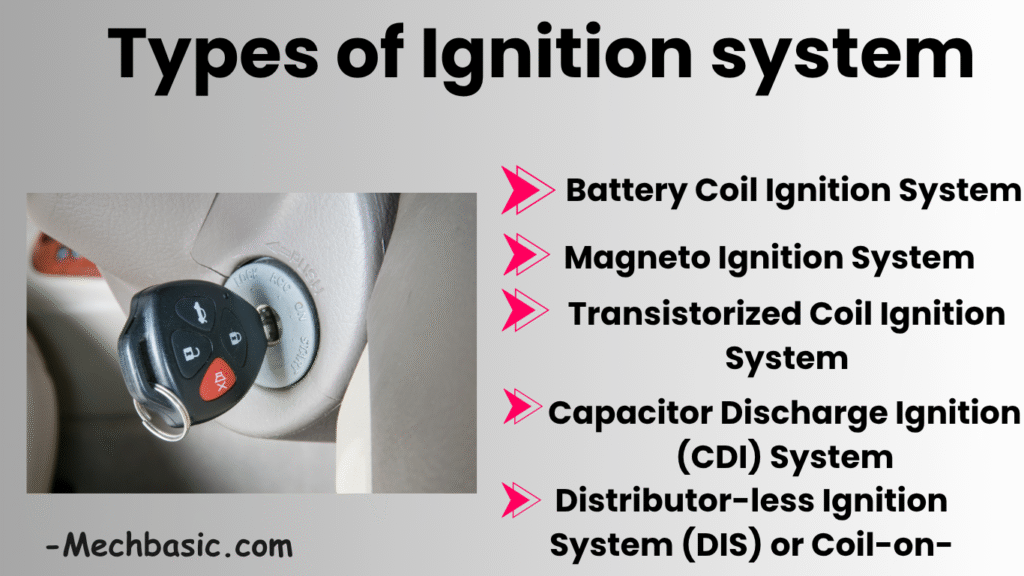
In this article, we discuss the 5 types of ignition systems used in automobiles.
In this article:
What is an ignition system in automobiles?
An ignition system in automobiles is responsible for igniting the air-fuel mixture in the engine’s combustion chamber. It generates a high-voltage spark at the right moment to start and run the engine efficiently. The system typically includes components like the ignition coil, spark plugs, and control module.
Also Read : Ignition system in automobiles.
1. Battery Coil Ignition System (Conventional)
Explanation:
This is the most traditional ignition system used in older vehicles.
It relies on a battery, a mechanical breaker (contact points), a condenser, a distributor, and a spark coil.
✅ How it works:
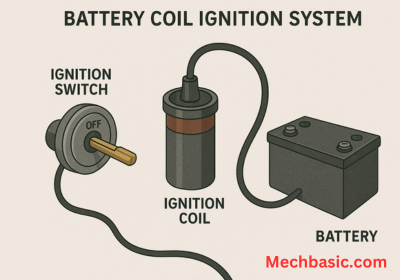
- The battery feeds low voltage current into the ignition coil’s primary side.
- When the points break, the current is interrupted.
- This generates a high voltage in the secondary side of the ignition coil.
- This high voltage is routed through the distributor to each spark plug in turn.
- The spark ignites the air-fuel mixture in the cylinder.
✅ Application:
- Older cars, trucks, and small-engine applications.
✅ Advantages:
- Reliable and simple.
- Durable with proper maintenance.
- Less expensive.
✅ Limitations:
- Requires periodic maintenance (adjust points, replace condenser).
- Less accurate at high rpm.
2. Magneto Ignition System
Explanation:
This self-contained ignition system generates its own current without needing a battery.
A rotating magnet within the magneto produces high voltage for spark.
✅ How it works:
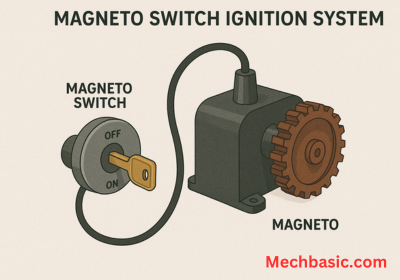
- As the flywheel with magnets rotates, a current is generated in the primary side of the ignition coil.
- This high voltage then feeds directly to the spark plug.
✅ Application:
- Small engines (lawnmowers, chainsaws, scooters), aircraft, and some agricultural machinery.
✅ Advantages:
- Reliable — operates without needing a battery.
- Durable and simple.
- Few components to service.
✅ Limitations:
- Limited output — not strong enough for larger or high-speed engines.
- Less convenient for maintenance or repairs.
3. Transistorized Coil Ignition System
Explanation:
This system replaces mechanical breaker points with a transistor.
Provides greater control and faster, more reliable spark delivery.
✅ How it works:
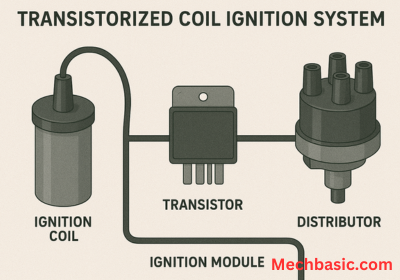
- Transistor controls when current flows through the ignition coil’s primary side instead of points.
- This results in a faster cut-off, creating a strong spark.
✅ Application:
- Later models of cars and some small engines.
✅ Advantages:
- Higher voltage output.
- Reliable and maintenance-free.
- Better spark at high rpm.
✅ Limitations:
- Requires additional electronic components (transistor, resistor).
- Higher cost than conventional points.
4. Capacitor Discharge Ignition (CDI) System
Explanation:
This high-energy ignition discharge directly from a capacitor instead of a traditional coil.
Provides faster spark delivery and greater energy under all conditions.
✅ How it works:
- The capacitor is first charged by a generator or converter.
- At the moment of ignition, it discharge its energy directly through the ignition coil.
- This results in a strong spark with very short duration — perfect for high rpm applications.
✅ Application:
- Motorcycles, scooters, high-performance and small engines, and some outboard boat engines.
✅ Advantages:
- Reliable, strong spark at high rpm.
- Better combustion under unfavorable conditions (such as high rpm or weak mixture).
- Few moving components — low maintenance.
✅ Limitations:
- Higher complexity and cost.
- Requires specialized electronic components.
5. Distributor-less Ignition System (DIS) or Coil-on-Plug
Explanation:
This modern ignition system eliminates the distributor.
Instead, each spark plug is directly fed by its own ignition coil, and an electronic control unit (ECU) controls the spark’s timing.
✅ How it works:
- An engine control unit signals each ignition coil when it’s time to fire.
- This guarantees greater spark accuracy and less energy waste.
- Often integrated with sensors (crankshaft, camshaft, airflow) for perfect spark delivery.
✅ Application:
- All modern gasoline-powered vehicles (cars, trucks, high-performance bikes).
✅ Advantages:
- Better combustion control — yielding more power, lower emissions, and greater fuel efficiency.
- Few mechanical components — less maintenance.
- Reliable under high rpm and high-load conditions.
✅ Limitations:
- Higher cost due to sophisticated electronic controls.
- Requires specialized diagnostic equipment.
Other courses:





