
Here’s a detailed explanation of the types of aerodynamic forces acting on a vehicle or any body moving through air:
In this article:
Types of Aerodynamics
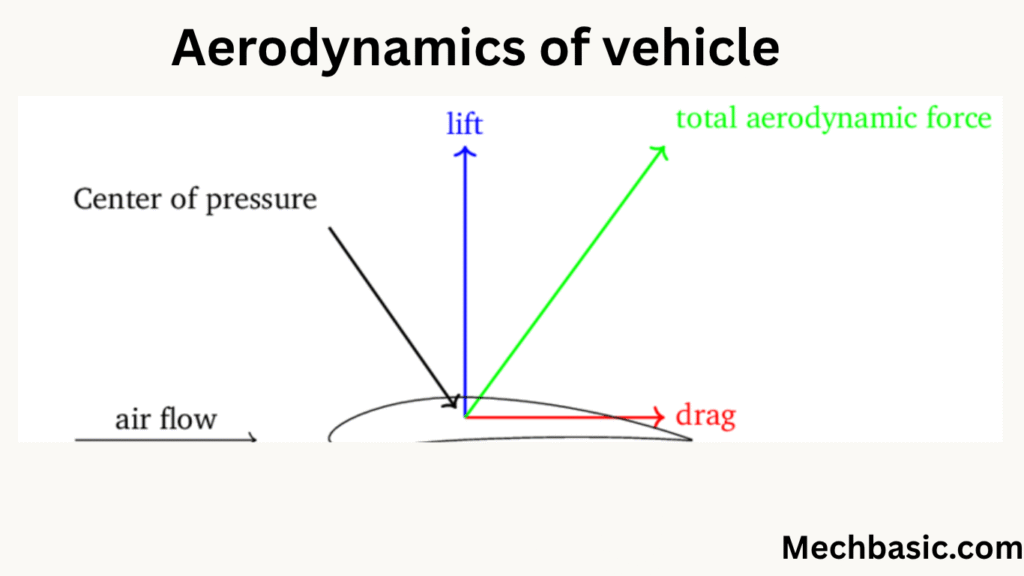
1. Drag Force
- Definition:
Drag is the resisting force that acts opposite to the direction of motion of the vehicle through air. - Cause:
It occurs due to air friction and pressure differences around the vehicle’s surface. - Types of Drag:
- Form Drag: Caused by the vehicle’s shape and frontal area; bluff shapes create more drag.
- Skin Friction Drag: Caused by air rubbing against the vehicle’s surface.
- Interference Drag: Arises when airflows from different parts of the vehicle (like the hood and windshield) meet and create turbulence.
- Induced Drag: In racing or high-performance cars, this drag is linked to the creation of downforce (similar to lift on wings).
- Effect:
Higher drag requires more engine power and fuel to maintain speed.
2. Lift Force
- Definition:
Lift is the aerodynamic force acting perpendicular to the direction of airflow. - In Vehicles:
- Lift can be positive (upward), which reduces tire traction and stability.
- Or negative (downforce), which increases tire grip and improves cornering and handling.
- Cause:
Caused by pressure differences between the upper and lower surfaces of the vehicle due to airflow speed variations. - Effect:
Too much lift at high speeds can make a car unstable or even cause loss of control.
3. Side Force (Lateral Force)
- Definition:
A force acting sideways on a vehicle, perpendicular to both the direction of motion and the ground. - Cause:
Occurs due to crosswinds or asymmetrical body design, which push the vehicle sideways. - Effect:
Can affect directional stability and control, especially at high speeds or in lightweight vehicles.
4. Downforce (Negative Lift)
- Definition:
Downforce is the aerodynamic force that pushes the vehicle downward toward the road surface. - Cause:
Created intentionally by aerodynamic components like spoilers, wings, and diffusers to counteract lift. - Effect:
Increases tire grip, improves cornering ability, and enhances stability at high speeds — essential in racing cars.
5. Pitching Moment (Aerodynamic Moment)
- Definition:
The rotational force caused by unequal aerodynamic forces acting on different parts of the vehicle, leading to pitching (tilting forward or backward). - Cause:
Arises from imbalanced pressure distribution, especially between the front and rear sections. - Effect:
Can affect steering balance and stability; engineers adjust body shapes and spoilers to minimize unwanted pitching.
✅ Summary Table
| Force Type | Direction | Cause | Main Effect |
|---|---|---|---|
| Drag | Opposite to motion | Air resistance | Reduces speed, increases fuel use |
| Lift | Perpendicular (upward) | Pressure difference | Reduces traction, stability |
| Side Force | Sideways | Crosswinds, asymmetry | Affects steering stability |
| Downforce | Perpendicular (downward) | Aero design (spoilers, wings) | Improves grip and handling |
| Pitching Moment | Rotational | Uneven airflow distribution | Affects balance and control |
Other courses:





