
When comparing Stainless Steel (SS) and Mild Steel (MS) in terms of strength, it’s important to consider different types of strength, composition, and applications. Here’s a detailed analysis:
In this article:
1. Definitions
| Material | Definition |
|---|---|
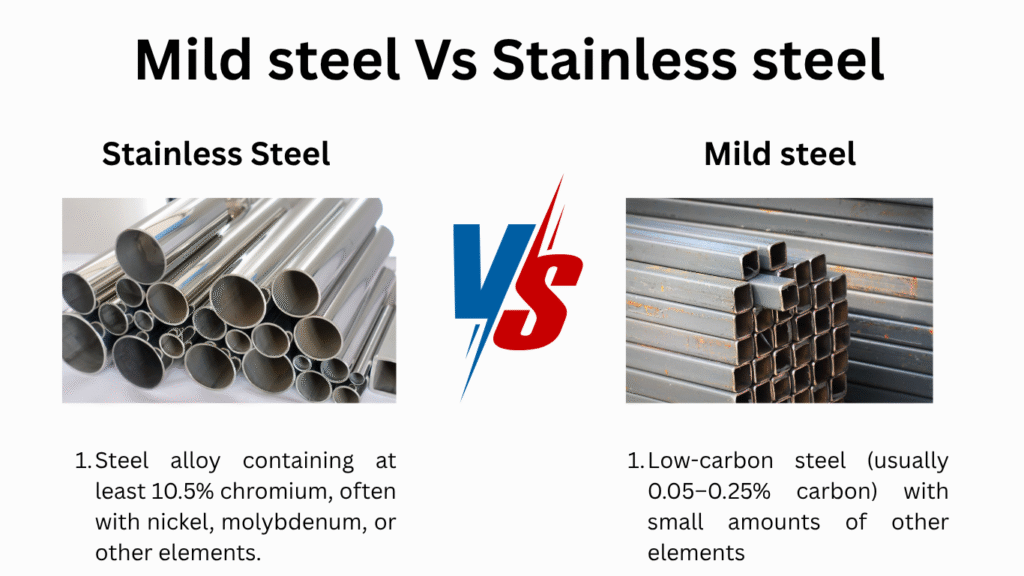
| Mild Steel (MS) | Low-carbon steel (usually 0.05–0.25% carbon) with small amounts of other elements. Soft, ductile, and easy to work with. |
| Stainless Steel (SS) | Steel alloy containing at least 10.5% chromium, often with nickel, molybdenum, or other elements. Highly corrosion-resistant. |
2. Composition Differences
| Element | MS | SS |
|---|---|---|
| Carbon | 0.05–0.25% | 0.03–1.2% (varies by grade) |
| Chromium | 0% | 10.5–30% |
| Nickel | 0% | 0–20% |
| Manganese | 0.3–0.8% | 1–2% |
| Other elements | Trace | Molybdenum, nitrogen, titanium (depending on grade) |
The chromium in SS forms a passive oxide layer, giving it corrosion resistance, which MS lacks.
3. Strength Comparison
A. Tensile Strength
- Mild Steel: ~370–500 MPa
- Stainless Steel: ~500–1,000 MPa (varies with grade)
In general, SS can be stronger in tensile strength, but some low-carbon grades of SS may be similar or slightly stronger than MS.
B. Yield Strength
- Mild Steel: ~250 MPa
- Stainless Steel: ~200–550 MPa (depending on grade, e.g., 304, 316, 410)
Certain SS grades (like martensitic SS) are much stronger than mild steel, while austenitic SS may have similar or slightly lower yield strength than hardened MS.
C. Hardness
- MS is relatively soft, easy to bend, and machinable.
- SS is harder and more wear-resistant, especially martensitic grades.
4. Corrosion Resistance
- MS: Prone to rust and oxidation unless painted or coated.
- SS: Highly corrosion-resistant due to chromium oxide layer.
- Implication: SS maintains strength even in corrosive environments, whereas MS weakens over time if exposed to moisture or chemicals.
5. Workability
| Material | Machining / Forming | Welding | Cost |
|---|---|---|---|
| MS | Easy to cut, bend, and weld | Simple | Low |
| SS | Harder to machine, can work-harden | Needs special techniques | High |
MS is easier to shape and weld; SS requires more specialized tools.
6. Practical Comparison
| Property | MS | SS |
|---|---|---|
| Tensile Strength | Moderate | High (varies with grade) |
| Hardness | Low | Medium to High |
| Ductility | High | Medium |
| Corrosion Resistance | Low | Very High |
| Cost | Low | High |
| Common Use | Car bodies, structural steel, pipelines | Kitchen equipment, chemical industry, car trim, exhaust |
Key Insight:
- Strength-wise: Certain grades of SS are stronger than MS, especially in tensile and hardness.
- Environmental strength: SS retains strength and integrity better than MS in corrosive environments.
- Cost/Workability trade-off: MS is cheaper and easier to work with, SS is stronger and corrosion-resistant but costlier.
✅ In Short
Stainless Steel (SS) is generally stronger, harder, and more corrosion-resistant than Mild Steel (MS), especially in harsh environments.
Mild Steel is cheaper, easier to work with, but is prone to rust and weaker in tensile and hardness compared to most SS grades.
Other courses:





