
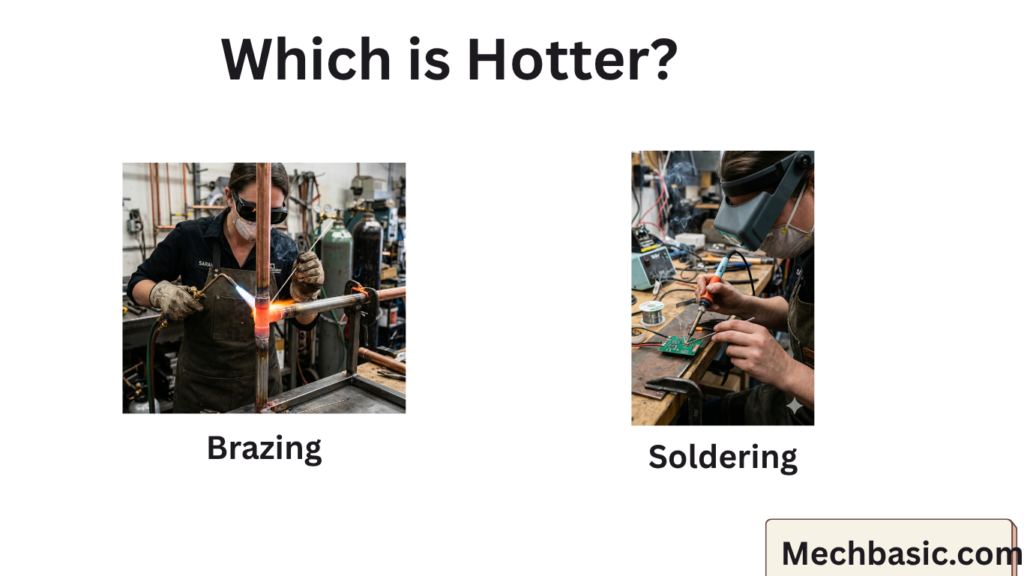
Brazing is hotter than soldering.
- Brazing uses temperatures above 450 °C, melting the filler metal but not the base metals.
- Soldering uses lower temperatures, typically below 450 °C, making it suitable for delicate or low-stress connections.
In this article:
Here’s a detailed comparison of brazing and soldering in terms of temperature, including why one is hotter than the other and the implications for metal joining:
1. Temperature Ranges
| Process | Typical Temperature Range |
|---|---|
| Brazing | 450–1200°C (840–2190°F) |
| Soldering | 180–450°C (356–840°F) |
Brazing is significantly hotter than soldering, often more than twice the temperature.
2. Why Brazing Requires Higher Temperatures
- Filler Metal Melting Point
- Brazing uses high-melting-point filler metals (copper, silver, nickel alloys).
- These metals require temperatures above 450°C to melt and flow into the joint.
- Capillary Action
- The filler metal must remain fully molten long enough to flow via capillary action between the base metals.
- Higher temperature ensures good wetting and strong metallurgical bonding.
- Base Metal Considerations
- Brazing heats the base metals enough to allow filler metal bonding, but does not melt them.
- This requires higher heat than soldering, which relies on low-melting filler metals.
3. Why Soldering is Cooler
- Low-Melting Filler Metals
- Soldering uses tin-lead, tin-silver, or other soft alloys with melting points below 450°C.
- These metals melt quickly and bond at much lower temperatures.
- No Need for Metallurgical Fusion
- Soldering relies on adhesion and wetting, not metallurgical bonding.
- This allows temperature-sensitive components (like electronics) to be joined without damage.
4. Implications of Temperature Difference
| Feature | Brazing (Hot) | Soldering (Cool) |
|---|---|---|
| Maximum Joint Strength | Higher, strong for load-bearing applications | Lower, mainly for electrical or fluid-tight connections |
| Base Metal Distortion | Possible, especially for thin metals | Minimal |
| Suitable Metals | Steel, copper, brass, aluminum, dissimilar metals | Copper, tin, electronics metals, delicate components |
| Heat-Sensitive Components | Not recommended | Safe for delicate parts (e.g., PCB soldering) |
| Flux Requirement | Usually required | Often built into solder (rosin core) |
| Equipment | Torch, furnace, induction | Soldering iron, hot plate, or torch for plumbing |
5. Summary:
- Brazing is hotter than soldering, with typical temperatures starting at 450°C and going up to 1200°C.
- Soldering is cooler, typically below 450°C, to protect delicate materials.
- The higher temperature in brazing allows for stronger joints and metallurgical bonding, while soldering is ideal for electrical and low-stress connections.
- Choosing between the two depends on strength requirements, base metal type, and heat sensitivity of the components.
Other courses:





