
CNC and PLC are both automation technologies used in manufacturing, but they serve different purposes. CNC (Computer Numerical Control) systems control machine tools to perform precise machining operations, while PLCs (Programmable Logic Controllers) manage and automate industrial processes and machine functions.
In this article:
CNC vs PLC
CNC (Computer Numerical Control) and PLC (Programmable Logic Controller) are both industrial automation systems, but they serve different purposes in manufacturing. Choosing which is “better” depends on the application, complexity, and function. Below is a detailed comparison.
1. Definitions
CNC (Computer Numerical Control)
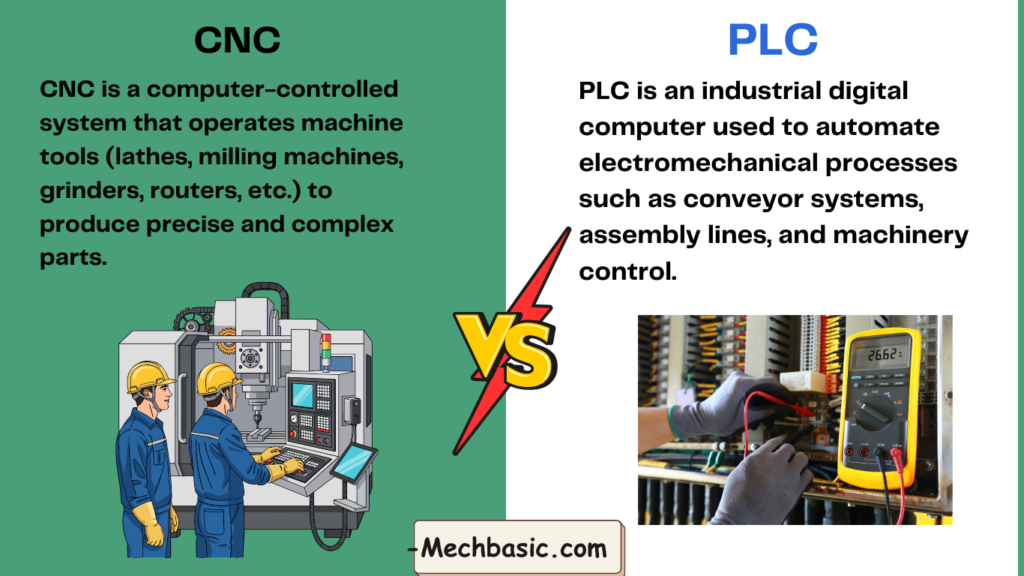
CNC is a computer-controlled system that operates machine tools (lathes, milling machines, grinders, routers, etc.) to produce precise and complex parts.
Key Features:
- Controls tool movement, speed, feed, and path.
- Works with G-code/M-code programs.
- Used in metal cutting, drilling, turning, milling.
PLC (Programmable Logic Controller)
PLC is an industrial digital computer used to automate electromechanical processes such as conveyor systems, assembly lines, and machinery control.
Key Features:
- Executes logic operations, timers, counters, and sequences.
- Works with I/O devices (sensors, actuators, motors, relays).
- Used in process control, factory automation, robotics.
2. Primary Function
| System | Primary Function |
|---|---|
| CNC | Controls machine tools to produce parts with precision. Focused on motion control and machining. |
| PLC | Controls industrial processes through logic, timing, counting, and on/off control. Focused on automation and control. |
3. Components
CNC Components
- Controller (CPU)
- Drive system for axes (X, Y, Z)
- Spindle motor
- Tool changer
- Feedback system (encoders)
- CNC software / G-code interpreter
PLC Components
- CPU (logic controller)
- Input modules (sensors, switches)
- Output modules (relays, motors, actuators)
- Programming interface (ladder logic or function block)
- Communication interface
4. Programming
| Feature | CNC | PLC |
|---|---|---|
| Language | G-code / M-code / CAM software | Ladder logic, Function Block, Structured Text |
| Purpose | Control tool path, spindle, speed, feed | Control machinery logic, on/off sequences, timing, and sensors |
| Complexity | High for precise shapes | Moderate for logic sequences |
| Modifications | Changes require new G-code or CAM programming | Ladder logic is easier to modify |
5. Applications
CNC Applications
- Turning and milling metal parts
- Drilling, threading, and grinding
- Aerospace, automotive, and precision manufacturing
- Complex shapes and contours
PLC Applications
- Conveyor belt automation
- Robotic arm sequences
- Packaging lines
- Process industries (chemical, food, water treatment)
- Industrial machinery automation
6. Advantages and Limitations
CNC Advantages
- High precision and repeatability
- Can produce complex shapes
- Reduces manual labor
- Supports multi-axis operations (3-axis, 4-axis, 5-axis)
CNC Limitations
- Expensive setup
- Requires skilled operators
- Limited to machining tasks
PLC Advantages
- Flexible for controlling many devices
- Highly reliable in harsh environments
- Easy to troubleshoot
- Can integrate multiple machines or processes
PLC Limitations
- Not designed for precision machining
- Cannot control tool paths or cutting operations
- Limited to logic and sequential control
7. CNC vs PLC – Key Differences
| Feature | CNC | PLC |
|---|---|---|
| Purpose | Machining and tool control | Process automation and logic control |
| Operation | Executes pre-programmed motion paths | Executes logic, timing, counting |
| Programming | G-code / CAM software | Ladder logic / Function blocks |
| Precision | Very high (µm-level) | Medium, depends on sensors and actuators |
| Flexibility | Limited to machine tool operation | Highly flexible, can control various devices |
| Cost | Higher initial cost | Moderate cost |
| Application | Manufacturing parts | Factory automation, industrial control |
8. Which is Better?
It depends on the application:
✅ CNC is better for:
- Producing precision parts
- Multi-axis machining
- Metal cutting and shaping
✅ PLC is better for:
- Automating industrial processes
- Controlling multiple machines or sensors
- Logic-based, repetitive operations
Note:
In modern factories, CNC machines often use PLCs internally for functions like coolant control, tool change sequencing, spindle control, and safety interlocks. So they are complementary technologies rather than competitors.
In Simple Words
CNC = brain for machines that make precise parts.
PLC = brain for machines that control processes and automation.
One is for cutting and shaping, the other is for logic and automation.
Other courses:





