
Metals (and metal-based materials) that cannot be forged or are extremely difficult to forge share certain characteristics such as brittleness, lack of plasticity, or decomposition before plastic deformation. Below is a detailed, exam- and industry-oriented explanation.
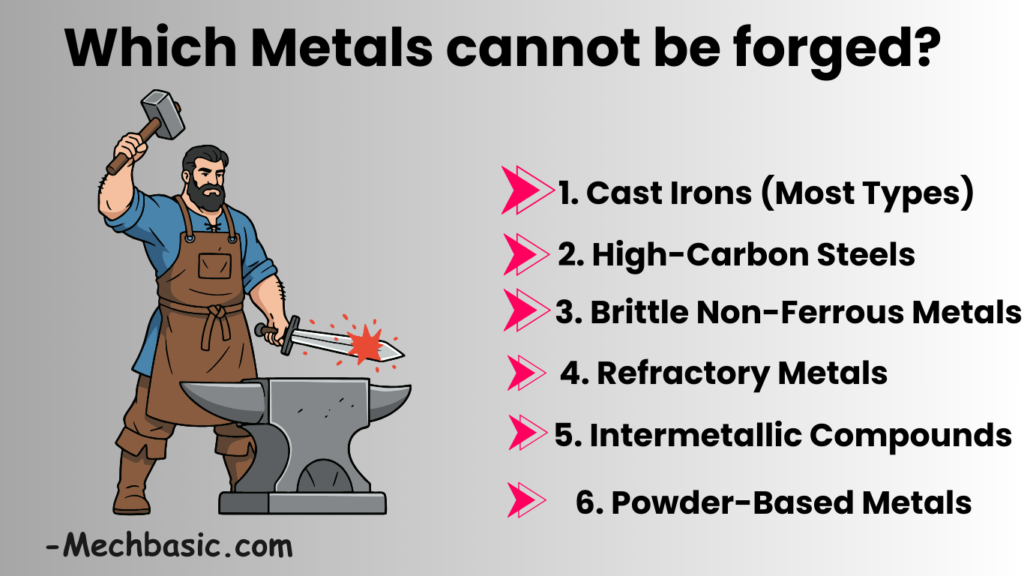
1. Cast Irons (Most Types)
Examples
- Grey cast iron
- White cast iron
- Malleable cast iron (limited forging possible only after treatment)
Why They Cannot Be Forged
- High carbon content (2–4%)
- Presence of graphite flakes or carbides
- Extremely brittle behavior
- Fracture occurs before plastic deformation
Exception
- Ductile (nodular) cast iron has limited forgeability but is still rarely forged in practice.
2. High-Carbon Steels (Very High %C)
Examples
- Tool steels (some grades)
- Steels with carbon > 1.0%
Why Forging Is Difficult
- High hardness
- Low ductility
- Cracking at forging temperatures
- Narrow safe forging temperature range
👉 These steels can sometimes be forged, but only under strict temperature control.
3. Brittle Non-Ferrous Metals
a) Zinc (Pure)
- Becomes brittle at room temperature
- Narrow plastic deformation range
b) Lead
- Extremely soft but tears instead of forging
- Deforms without gaining strength
c) Tin
- Low melting point
- Cracks instead of plastically deforming
4. Refractory Metals (Practically Non-Forgeable)
Examples
- Tungsten
- Molybdenum (limited)
- Tantalum (limited)
- Niobium (limited)
Reasons
- Extremely high melting points
- Require very high forging temperatures
- Oxidize rapidly
- Equipment limitations
👉 Tungsten is almost never forged, usually powder-processed instead.
5. Metals That Decompose or Oxidize Before Forging
Examples
- Magnesium (pure)
- Some aluminum alloys (certain cast grades)
Reasons
- Oxidation at high temperature
- Fire risk (especially magnesium)
- Limited hot-working temperature range
👉 Magnesium alloys can be forged only under controlled conditions.
6. Intermetallic Compounds (Not Forgeable)
Examples
- Nickel aluminide (NiAl)
- Titanium aluminide (TiAl)
Reasons
- Ordered crystal structures
- Very low ductility at room and elevated temperatures
- Sudden brittle fracture
7. Powder-Based Metals (Without Consolidation)
Examples
- Sintered metals
- Powder metallurgy parts
Why They Cannot Be Forged Directly
- Contain porosity
- Lack cohesion
- Crack under compressive stress
👉 They must undergo hot isostatic pressing (HIP) before any forging attempt.
8. Summary Table
| Material | Forgeability | Reason |
|---|---|---|
| Grey cast iron | ❌ Not forgeable | Brittle graphite flakes |
| White cast iron | ❌ Not forgeable | Cementite structure |
| High-carbon steel | ⚠️ Limited | Cracking risk |
| Tungsten | ❌ Not forgeable | Extremely high melting point |
| Zinc (pure) | ❌ Poor | Brittle |
| Lead | ❌ Poor | Tears easily |
| Tin | ❌ Poor | Low ductility |
| Intermetallics | ❌ Not forgeable | Brittle crystal structure |
Engineering Rule
A metal must possess sufficient ductility at forging temperature to be forgeable.
If it fractures before plastic deformation, forging is not possible.
Other courses:





