
The transmission system is one of the important system in automobile. Lets discuss transmission system of an automobile in detail.
In this article:
What is a Transmission system in automobile?
The transmission system in an automobile is the mechanism that transmits power from the engine to the wheels while controlling speed and torque according to driving conditions.
In simple terms, it ensures the engine runs efficiently while allowing the vehicle to move forward, backward, and at different speeds smoothly.
Without a transmission system, the engine’s power (which operates best in a narrow RPM range) wouldn’t be usable to drive the wheels effectively — you wouldn’t be able to start, accelerate, climb hills, or maintain speed efficiently.
Functions of the Transmission System
- Transmit power from the engine to the wheels.
- Multiply torque (increase it when starting or climbing).
- Allow speed variation (slow, fast, reverse).
- Enable smooth engagement between engine and wheels.
- Allow disconnection of engine power (for idling, gear changes).
Major Components of a Transmission System
Here’s a detailed breakdown:
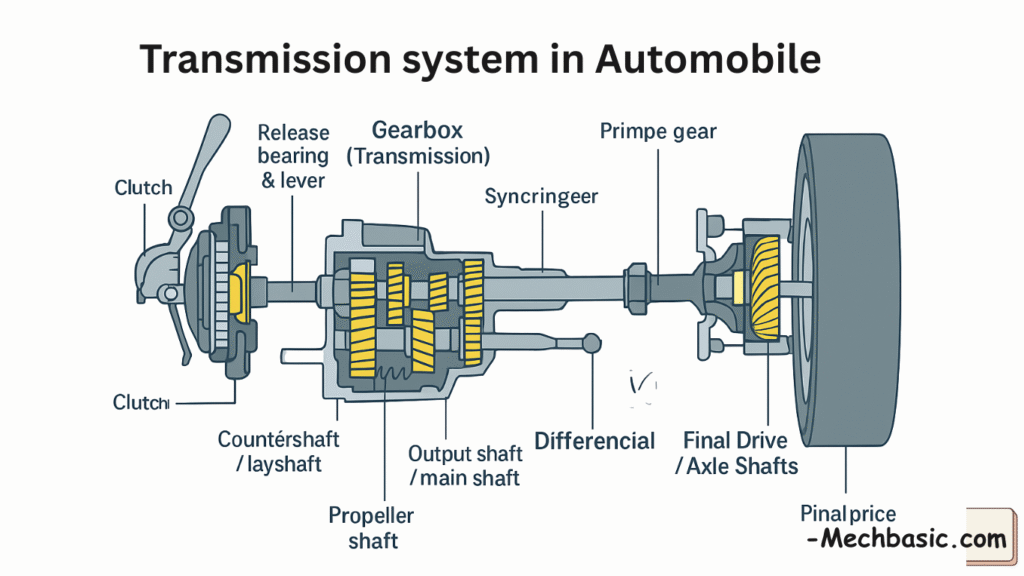
1. Clutch (or Torque Converter in Automatics)
- Function: Connects and disconnects engine power from the transmission.
- Components:
- Clutch plate – engages/disengages power.
- Pressure plate – applies pressure to keep clutch engaged.
- Release bearing & lever – operated by pedal or hydraulics to disengage clutch.
- In automatic cars, a torque converter replaces the clutch — it uses fluid coupling to transfer power smoothly.
2. Gearbox (Transmission)
- Function: Provides different gear ratios to control speed and torque.
- Types:
- Manual Gearbox – driver selects gears manually.
- Automatic Transmission – uses planetary gear sets and hydraulic control.
- CVT (Continuously Variable Transmission) – uses pulleys & belt for infinite gear ratios.
- AMT / DCT / DSG – advanced semi-automatic or dual-clutch systems.
- Components:
- Input shaft – connected to clutch.
- Countershaft / layshaft – carries gears that mesh with main shaft.
- Output shaft / main shaft – sends power to propeller shaft.
- Gear sets – for different speeds and torque multiplication.
- Synchronizers – enable smooth gear engagement in manuals.
3. Propeller Shaft (Drive Shaft)
- Function: Transmits power from gearbox to differential (in rear-wheel drive cars).
- Components:
- Universal Joints (U-joints) – allow angular movement between gearbox and differential.
- Slip Joint – allows length variation when suspension moves.
(In front-wheel-drive cars, propeller shaft is not used; power goes to differential directly.)
4. Differential
- Function: Allows wheels to rotate at different speeds when turning (outer wheel travels a longer path).
- Components:
- Ring gear – driven by propeller shaft.
- Pinion gear – transmits power to ring gear.
- Spider gears / side gears – allow difference in wheel rotation.
- Also reduces speed and increases torque before sending power to wheels.
5. Final Drive / Axle Shafts
- Function: Transfer power from differential to wheels.
- Components:
- Axle shafts (half-shafts) – connect differential to wheels.
- CV Joints (in FWD) – allow up/down movement of wheels without losing power transmission.
6. Gear Selector Mechanism
- Function: Allows driver (or ECU in automatic) to choose gear.
- Includes: Gear lever, selector forks, shift cables/rods, and sensors (in modern cars).
Supporting components:
Some of the other supporting components include:
- Transmission Mounts – absorb vibration and hold transmission in place.
- Lubrication system – keeps gears and bearings lubricated.
- Cooling system – transmission fluid cooler (in automatics) prevents overheating.
FAQ Section:
1. What is a transmission system in an automobile?
The transmission system transfers power from the engine to the wheels, adjusting torque and speed to match driving conditions.
2. What are the main types of automobile transmissions?
The primary types are:
- Manual Transmission (MT)
- Automatic Transmission (AT)
- Continuously Variable Transmission (CVT)
- Automated Manual Transmission (AMT)
- Dual-Clutch Transmission (DCT)
3. How does a manual transmission work?
It uses a clutch pedal and gear lever to manually engage and disengage gears, allowing the driver to control speed and torque output.
4. How does an automatic transmission work?
It automatically selects the appropriate gear using a torque converter (or similar device), hydraulic systems, and planetary gear sets — no clutch pedal is required.
5. What is the function of the clutch in a manual transmission?
The clutch disconnects the engine from the gearbox temporarily, allowing smooth gear shifts without damaging gears.
6. What is a CVT and how is it different?
A CVT (Continuously Variable Transmission) uses pulleys and a belt/chain to provide infinite gear ratios within a range, offering smoother acceleration and better fuel efficiency.
7. What are common problems in transmission systems?
Typical issues include:
- Slipping gears
- Delayed shifting
- Transmission fluid leaks
- Overheating
- Grinding noises
8. How do you maintain a transmission system?
Key maintenance tips:
- Regularly check and change transmission fluid
- Avoid aggressive driving and overloading
- Service as per manufacturer schedule
- Monitor for leaks or unusual noises
9. What are the signs of a failing transmission?
Warning signs include:
- Difficulty in shifting gears
- Burning smell from transmission fluid
- Unusual vibrations or noises
- Warning light on dashboard
- Loss of power or slipping
10. Which transmission is better: manual or automatic?
It depends on your needs:
- Manual: Cheaper, more control, better for enthusiasts
- Automatic: Easier to drive, smoother in traffic, often better for fuel efficiency in modern cars
Other courses:





