
In this article, we explain torque vectoring differential, its working, animation in detail.

In this article:
- What Is a Torque Vectoring Differential?
- Purpose of Torque Vectoring Differential:
- Basic Construction
- Working Principle:
- Torque Distribution Logic
- Types of Torque Vectoring Differentials
- How Torque Vectoring Enhances Cornering
- Electronic Control Strategy
- Advantages
- Disadvantages
- Applications in Modern Vehicles
- Comparison: TVD vs Other Differentials
- Other courses:
What Is a Torque Vectoring Differential?
A Torque Vectoring Differential (TVD) is an advanced, electronically controlled differential system that can actively distribute torque between the left and right wheels (and sometimes between front and rear axles) independently, based on driving conditions.
In simple terms:
While an LSD limits slip and a locker forces equal torque,
a torque vectoring differential intelligently decides how much torque to send to each wheel for optimal grip and cornering.
Purpose of Torque Vectoring Differential:
The main goal of a torque vectoring differential is to:
- Improve traction
- Enhance cornering performance
- Increase vehicle stability
- Reduce understeer or oversteer
- Maximize acceleration through turns
In other words, it doesn’t just react to wheel slip — it predicts and controls torque distribution to improve handling dynamics.
Basic Construction
A torque vectoring differential builds upon a limited-slip differential (LSD) design but adds electronic sensors, clutches, and actuators to actively control torque split.
🔩 Main Components
- Differential Case – Houses the differential gears.
- Side Gears and Spider Gears – Perform basic differential action.
- Multi-Plate Clutch Packs – One for each axle shaft (left and right wheel).
- Actuators (Hydraulic or Electric) – Control the engagement of each clutch.
- Electronic Control Unit (ECU) – Brain of the system; processes sensor inputs and controls actuators.
- Sensors – Measure parameters like:
- Wheel speeds (from ABS sensors)
- Steering angle
- Throttle position
- Yaw rate
- Lateral and longitudinal acceleration
Working Principle:
Let’s understand how a Torque Vectoring Differential operates under various conditions:
1. Straight-Line Driving
- Both wheels rotate at the same speed.
- ECU detects minimal steering input and yaw rate.
- Clutches are partially disengaged — torque is split evenly.
➡️ Acts like a normal differential.
2. Cornering (Turning)
When a car turns, the outer wheel travels a longer distance than the inner wheel — it must rotate faster.
In traditional systems:
- Open diff: equal torque → less traction.
- LSD: limits slip but not fully optimized.
But in TVD:
- ECU predicts the turn (using steering angle + yaw sensors).
- It preemptively sends more torque to the outer wheel, which:
- Helps “push” the car around the corner.
- Increases yaw rate.
- Reduces understeer.
This effect is similar to rear-wheel steering, but achieved through torque control rather than steering geometry.
3. Slippery or Uneven Surfaces
- If one wheel loses traction, ECU applies more clutch pressure on the wheel with better grip.
- Torque is redistributed instantly.
➡️ Maintains traction and vehicle stability even on low-friction roads.
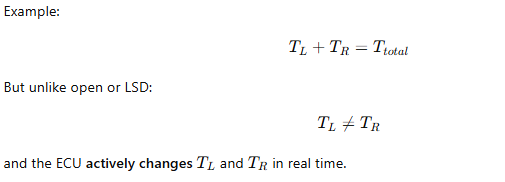
Torque Distribution Logic
Depending on design and manufacturer:
- Torque bias ratio can be as high as 80:20 or 100:0 between left and right wheels.
- Some systems even send all torque to a single wheel temporarily to improve cornering or recovery.
Types of Torque Vectoring Differentials
There are two main categories based on drivetrain layout:
1. Axle-Based Torque Vectoring (Left–Right)
- Installed on the rear or front axle.
- Controls torque distribution between left and right wheels on the same axle.
Example:
- Audi Sport Differential (Quattro system)
- BMW M Active Differential
- Lexus RC F and LC 500 TVD
2. Powertrain-Based Torque Vectoring (Front–Rear + Side–Side)
- Used in AWD systems.
- Distributes torque between axles (front vs rear) and between wheels on each axle.
Example:
- Acura SH-AWD (Super Handling AWD)
- Nissan GT-R ATTESA E-TS system
- Ford Focus RS AWD TVD
How Torque Vectoring Enhances Cornering
Let’s visualize cornering on a right-hand turn:
- The outer left wheel travels farther and needs more torque.
- The inner right wheel travels less and needs less torque.
TVD sends more torque to the outer wheel, generating a yaw moment that helps rotate the vehicle into the turn.
This is often described as “torque-induced yaw control.”
➡️ Result:
- Sharper turn-in
- Less understeer
- Improved stability and agility
Electronic Control Strategy
The ECU continuously monitors:
- Steering angle
- Vehicle speed
- Yaw rate
- Throttle/brake position
- Wheel speeds
Then it calculates desired torque vectoring and commands the actuators accordingly — up to hundreds of times per second.
This integration with the ESC (Electronic Stability Control) and ABS systems ensures that torque vectoring complements braking and traction control seamlessly.
Advantages
✅ Superior traction under all conditions
✅ Enhanced cornering performance (reduces understeer)
✅ Improved stability during acceleration and braking
✅ Active yaw control — car feels more agile and balanced
✅ Adaptive behavior — responds to driver style and road surface
Disadvantages
❌ Complex and expensive (requires sensors, actuators, ECU)
❌ Heavier than traditional diffs (adds weight)
❌ Higher maintenance and repair costs
❌ Software-dependent — can fail if electronics malfunction
Applications in Modern Vehicles
| Vehicle | System Name | Description |
|---|---|---|
| Audi S/RS models | Audi Sport Differential | Actively distributes torque across rear axle |
| BMW M series | Active M Differential | Electronically controlled clutch packs |
| Acura NSX / SH-AWD | Torque Vectoring AWD | Varies torque front/rear and side/side |
| Nissan GT-R | ATTESA E-TS | Dynamic AWD torque vectoring |
| Ford Focus RS | Dynamic AWD TVD | Uses twin clutch packs for rear torque control |
| Lexus RC F / LC 500 | TVD | Driver-selectable torque vectoring modes |
Comparison: TVD vs Other Differentials
| Feature | Open Diff | LSD | Locking Diff | Torque Vectoring Diff |
|---|---|---|---|---|
| Torque Distribution | Equal | Variable (limited) | Equal (locked) | Actively variable (controlled) |
| Speed Difference | Free | Limited | None when locked | Controlled electronically |
| Traction | Poor | Good | Excellent (off-road) | Excellent (on-road performance) |
| Handling | Smooth | Stable | Hard to steer | Agile and responsive |
| Control | Passive | Semi-active | Manual/auto | Fully active (ECU controlled) |
| Cost | Low | Medium | High | Very high |
Summary
| Aspect | Description |
|---|---|
| Definition | Electronically controlled differential that distributes torque between wheels actively |
| Purpose | Improve traction, cornering, and stability |
| Mechanism | Uses clutch packs, actuators, and sensors controlled by ECU |
| Operation | Sends more torque to the outer wheel during cornering |
| Applications | High-performance and AWD vehicles |
| Advantages | Maximum grip, agility, and stability |
| Disadvantages | Complex, costly, heavier |
FAQ Section:
What is a Torque Vectoring Differential?
It’s an advanced differential that actively distributes torque between wheels to improve traction, stability, and handling.
How does a Torque Vectoring Differential work?
It uses electronic sensors and actuators to control torque flow, sending more power to the wheel that can best use it.
What’s the difference between Torque Vectoring and LSD?
Unlike an LSD, which passively limits slip, torque vectoring actively manages torque using electronic controls for faster response and precision.
What are the benefits of Torque Vectoring?
It enhances cornering performance, improves grip, reduces understeer or oversteer, and increases driving stability.
Is Torque Vectoring only for sports cars?
No, it’s also used in SUVs and performance sedans to improve handling and safety in various driving conditions.
Does Torque Vectoring improve acceleration?
Yes, by directing torque to the wheels with the most grip, it helps maintain traction and faster corner exits.
How is Torque Vectoring controlled?
It’s typically managed by the vehicle’s ECU, using data from sensors like steering angle, yaw rate, and wheel speed.
Is Torque Vectoring available in both AWD and FWD cars?
Yes, it’s used in both systems, though it’s more common in AWD vehicles for optimal power distribution.
Does Torque Vectoring require maintenance?
It generally requires minimal maintenance, but periodic fluid checks and software updates may be needed.
Can Torque Vectoring be retrofitted to older vehicles?
Not easily — it’s an integrated system requiring advanced electronics and drivetrain components designed into the vehicle.
Other courses:





