
Casting is a manufacturing process in which molten metal is poured into a mould cavity, allowed to solidify, and then removed to produce a shaped metal component.
In this article:
Casting Process in Manufacturing
Here’s a complete, detailed explanation of the casting process in manufacturing, definition, types, steps, materials, advantages, disadvantages, and applications.
1. Definition of Casting
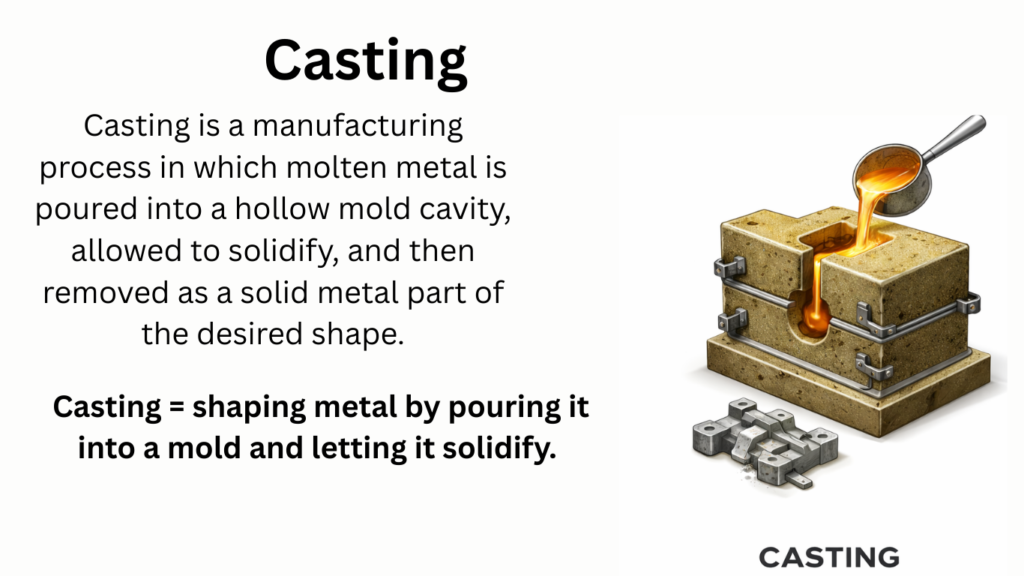
Casting is a manufacturing process in which molten metal is poured into a hollow mold cavity, allowed to solidify, and then removed as a solid metal part of the desired shape.
Casting = shaping metal by pouring it into a mold and letting it solidify.
2. Principle of Casting
- Molten metal flows into the mold cavity by gravity, pressure, or vacuum
- Metal cools and solidifies, taking the shape of the mold
- Mold is removed (broken or opened), leaving the casting
Key Concept: Molten metal → Mold → Solidified part
3. Types of Casting
A. Based on Mold Material
| Type | Description | Examples |
|---|---|---|
| Sand Casting | Mold made of sand (green sand or chemically bonded) | Engine blocks, pump housings |
| Die Casting | Permanent metal die; molten metal injected under pressure | Gear housings, electrical components |
| Investment Casting | Wax pattern coated with ceramic shell | Turbine blades, aerospace parts |
| Centrifugal Casting | Mold rotated to force metal outward | Pipes, rings, cylinder liners |
| Shell Molding | Thin shell of sand + resin | Small precision parts |
B. Based on Metal Flow
- Gravity Casting: Molten metal flows under gravity
- Pressure Casting: High-pressure injection into mold (die casting)
- Vacuum Casting: Vacuum assists filling, reduces porosity
4. Process Steps of Casting
The casting process generally includes the following steps:
Step 1: Pattern Making
- Create a replica of the part (slightly oversized to allow for shrinkage)
- Materials: Wood, metal, plastic, wax
Step 2: Core Making (if required)
- Used to form internal cavities in the casting
- Materials: Sand, salt, ceramic
Step 3: Mold Making
- Sand Casting: Pack sand around pattern
- Die Casting: Steel die is machined
- Investment Casting: Coat wax pattern with ceramic
Step 4: Melting the Metal
- Heat metal above its melting point in a furnace
- Maintain proper alloy composition
Step 5: Pouring / Injection
- Molten metal poured into mold or injected under pressure
- Ensure smooth flow to avoid turbulence
Step 6: Cooling / Solidification
- Metal cools in mold
- Cooling rate affects microstructure, strength, and shrinkage
Step 7: Mold Removal
- Sand Casting: Break the sand mold
- Die Casting: Open the die
- Investment Casting: Remove ceramic shell
Step 8: Fettling and Cleaning
- Remove gates, risers, flash, and excess metal
- Grinding, sanding, or shot blasting
Step 9: Heat Treatment (Optional)
- Improve strength, hardness, or ductility
Step 10: Inspection and Testing
- Dimensional checks, visual inspection, X-ray, dye penetrant
- Detect defects like porosity, cracks, cold shut
5. Materials Used in Casting
- Ferrous metals: Iron, steel, stainless steel, alloy steel
- Non-ferrous metals: Aluminium, copper alloys, zinc, magnesium
- Special alloys: Titanium, nickel superalloys (for aerospace)
6. Advantages of Casting
- Can produce complex shapes
- Can cast large and heavy components
- Versatile: Any metal or alloy
- Minimal machining required for near-net shapes
- Cost-effective for medium to large production
7. Disadvantages of Casting
- Lower dimensional accuracy (except die and investment casting)
- Poor surface finish (sand casting)
- Defects like porosity, shrinkage, and misruns
- Slow production cycle for some casting types
- Not suitable for very thin walls (<2 mm in sand casting)
8. Common Defects in Casting
- Porosity / Blow holes: Gas trapped in metal
- Shrinkage cavities: Metal contracts during cooling
- Misruns: Metal does not fill the mold
- Cold shuts: Metal solidifies before merging
- Sand inclusions: Particles trapped in metal
9. Applications of Casting
- Engine blocks, cylinder heads, pump housings
- Gearboxes, valve bodies
- Aerospace turbine blades
- Electrical housings
- Industrial machinery parts
- Jewelry and decorative items
10. Summary
Casting is a metal shaping process where molten metal is poured into a mold, solidified, and removed to produce components of desired shape. It is versatile, suitable for complex and large parts, but may have defects and lower accuracy.
Conclusion
Casting is the process of producing metal parts by pouring molten metal into a mold, allowing it to solidify, and removing the mold to obtain the desired shape.
Other courses:





