
Investment casting is a manufacturing process in which a wax pattern is coated with a ceramic shell to form a mould, then molten metal is poured into the mould to produce precise and complex metal components.
In this article:
Investment Casting
1. Definition
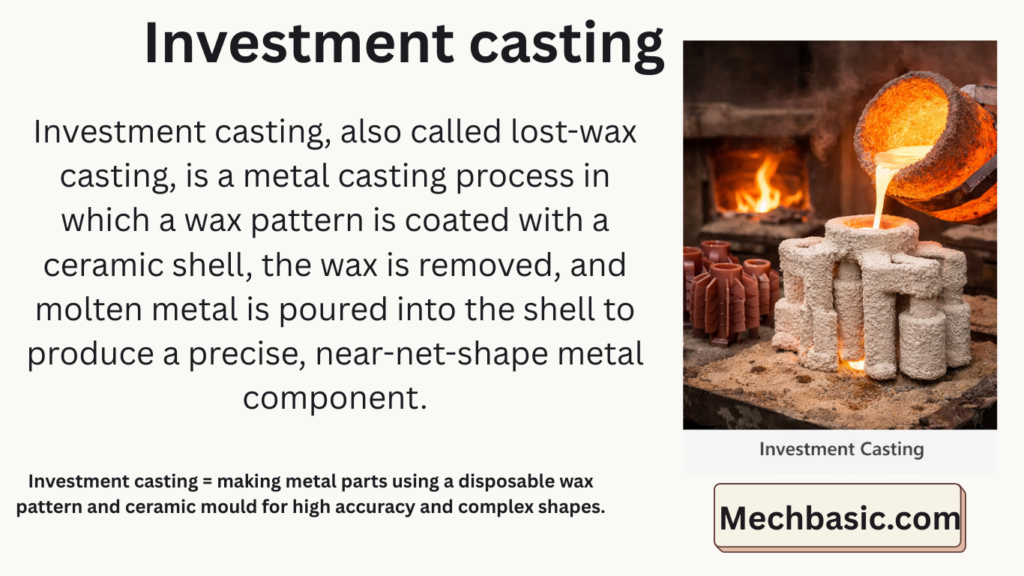
Investment casting, also called lost-wax casting, is a metal casting process in which a wax pattern is coated with a ceramic shell, the wax is removed, and molten metal is poured into the shell to produce a precise, near-net-shape metal component.
Investment casting = making metal parts using a disposable wax pattern and ceramic mould for high accuracy and complex shapes.
2. History
- One of the oldest casting methods (originated ~5000 years ago)
- Initially used for jewelry, coins, and statues
- Modern investment casting is used for aerospace, automotive, and medical components
3. Principle of Investment Casting
- Pattern Creation
- Wax patterns are made, either individually or in a tree assembly
- Shell Building
- Wax pattern is repeatedly dipped in ceramic slurry and coated with stucco to form a hard shell
- Dewaxing
- Wax is melted or burned out, leaving a hollow ceramic mould
- Firing the Shell
- Shell is heated to remove moisture and strengthen it
- Metal Pouring
- Molten metal is poured into the ceramic shell
- Cooling & Solidification
- Metal solidifies and takes the shape of the original wax pattern
- Shell Removal
- Ceramic shell is broken to retrieve the casting
- Finishing
- Gates, runners, and flash are removed, and surface finishing is applied
The key idea: wax pattern is “invested” in ceramic → hence the name investment casting.
4. Materials Used
(a) Pattern Material
- Wax (paraffin, microcrystalline)
- Plastic (sometimes)
(b) Shell Material
- Silica, zircon, alumina, and mullite
(c) Binder
- Colloidal silica, ethyl silicate
(d) Casting Metals
- Ferrous: carbon steel, stainless steel, alloy steel
- Non-ferrous: aluminium, copper, nickel superalloys, titanium
5. Advantages
- Excellent dimensional accuracy (±0.05–0.1 mm)
- Superior surface finish (Ra 1.6–3.2 µm)
- Can produce complex and intricate shapes
- Wide range of materials, including superalloys and titanium
- Near-net shape → reduces machining
- Thin sections and internal cavities possible
6. Disadvantages
- High initial cost (wax dies, ceramic materials)
- Slow process (multiple steps)
- Limited to medium-sized components
- Fragile ceramic shells
- Not ideal for very large production runs
7. Applications
- Aerospace components (turbine blades)
- Automotive precision parts (engine components, valve bodies)
- Medical implants
- Jewelry and decorative items
- Industrial machinery
8. Comparison With Other Casting Processes
| Feature | Investment Casting | Sand Casting | Die Casting |
|---|---|---|---|
| Accuracy | Very high | Low | High |
| Surface finish | Excellent | Moderate | Very good |
| Complexity | Very high | Moderate | High |
| Material | Almost any | Ferrous/non-ferrous | Mostly non-ferrous |
| Production rate | Slow | Medium | Very high |
| Cost | High | Low | Medium |
9. Summary
Investment casting is a precise metal casting process in which a wax pattern is coated with a ceramic shell, the wax is removed, and molten metal is poured into the shell to produce complex, high-accuracy components.
Conclusion:
Investment casting is a lost-wax casting process used to make high-precision, complex metal parts by pouring molten metal into a ceramic shell formed around a wax pattern.
Other courses:





